Last week’s post laid out the argument that the only true solution for tanking in the NBA is a system of promotion and relegation, but also acknowledged that the NBA owners would never adopt such a system on their own. But I also got a bit carried away listing some of the solutions that others had proposed, some of which weren’t intended to be that serious to begin with, and some of which I got intrigued by as I looked into them. So if promotion and relegation isn’t on the table, how should the NBA address tanking?
In trying to deal with tanking, the NBA is trying to juggle three goals that all conflict with one another:
- Teams should never be incentivized to try to lose.
- The genuinely-worst teams should have the best chance to obtain the best players so they can escape the basement and become good.
- The teams in the middle should have the chance to obtain players good enough to allow them to become good, so that the middle of the league doesn’t become a purgatory that teams can only escape by tanking.
The problem is, the impact the best players have on the game is such that a) as my previous post argued, completely meeting the first goal might not be possible, and b) the third goal (arguably following from the first) is as much a function of the size of the league as anything else. If there are only so many great players to go around, that implies that there can only be so many good teams, and as talent attempts to cluster enough to become viable threats to win championships, the number of good teams goes down further. Picking in the middle of the first round isn’t a viable path to actually improving; if mid-tier teams keep collecting mid-tier talent, they never escape being mid-tier. (That said, as has been pointed out, any spot in the draft can produce potential undervalued gems.)
I don’t think the first goal is completely achievable, but the NBA is certainly trying its best. Two days after I made my post, Shams Charania reported that the first of three concepts that had previously been reported to the owners had the most momentum. This concept would put the bottom 18 teams in the lottery, including all the play-in participants. The bottom 10 teams, missing both the playoffs and the play-in, would have flat 8% odds at the top pick, with the play-in teams having diminishing shares of the remaining 20% – and as I proposed in my previous post, all the spots within the lottery would be drawn at the lottery, meaning teams would have no floor and there is truly no difference between having the worst record and the tenth-worst. But while the league might have eliminated the incentive to tank among the worst teams, they might have created an incentive for teams to try to avoid the play-in and get one of the ten worst records, or even for teams in the fifth or sixth seeds to tank their way into the play-in and retain a shot at making the playoffs while also getting a chance to get a marquee talent.
Those concerns were raised at the NBA’s general managers meeting, which also saw one GM propose prohibiting the bottom three teams from getting the first pick entirely, which another GM softened to simply giving the bottom teams slightly worse odds for the top pick, which Commissioner Adam Silver reportedly responded enthusiastically to. To me, this illustrates a more general problem with the NBA’s anti-tanking quest: that in their quest to pursue the first goal I listed, and to some extent the third, the NBA has lost sight of the second. If you must have tanking, it’s much better to have it among the bottom few teams than among teams in or competing for the play-in. Even among the worst teams, tanking has knock-on effects that make it understandable that the league is trying to eliminate it entirely. But if the NBA’s proposal is successful at eliminating tanking, it will do so by effectively punishing the teams that most need help for failing to get out of the bottom three spots.
Ideally, whatever system the NBA comes up with shouldn’t go so far as to actively punish the worst teams, but should still incentivize them to at least try to win. There should come a point where losing doesn’t help you and may even hurt you, but it doesn’t hurt you so much as to trap the worst teams in a downward spiral. It should be a system that works even once tanking has been completely eliminated, by limiting the range where losing becomes a penalty to one that should only be reached through intent or staggering incompetence.
I have an idea for this, but first I want to briefly cover some of the other ideas that have been floated and what their prospects are, going into more detail than on my original post. Some such ideas were shot down in this article, but I think ideas such as “use records over multiple years” and “limit pick protections” are in the category of “won’t be silver bullets but can’t hurt”. In fact, I would say that limiting protections and using the lottery to determine every pick should be considered table stakes in this conversation, to be assumed to be in place for every proposal I discuss that keeps some form of the lottery.
- In my previous post I mentioned that Charles Barkley and Bill Simmons had floated ideas that would hit owners in the pocketbook directly by preventing them from raising ticket prices, refunding season-ticket holders, or otherwise depriving them of revenue. The degree to which this would motivate owners probably depends on how important the team is to them and their wealth. In sports with salary caps, team revenue doesn’t have much to do with competitiveness, and mucking with teams’ cap space threatens to undermine the point of the draft to begin with, so depriving teams of revenue mostly becomes a matter of pride, at least for owners for whom the team isn’t that important to their wealth. If the prize for tanking is a generational talent that can help you win championships down the line, for many owners, that’s worth a hit to their pride. And for fans, owners who try to avoid penalties to their revenue could be seen as cheapskates.
- Having committees determine the draft order, or move draft odds around, is an intriguing idea, especially given the NBA has long been accused of rigging the lottery so that certain teams win, ever since Patrick Ewing wound up on the New York Knicks as a result of the very first lottery. The problem is that the motives of owners and the league aren’t the same as what fans may think the motives should be. Dallas winning the Cooper Flagg lottery months after enraging their fanbase by trading Luka Doncic exasperated fans, and yet, part of the frustration was knowing that it was exactly what the league would do if it was rigging the lottery. The idea behind the committee idea is supposed to be to reward teams for conducting themselves with integrity, but the owners’ idea of what integrity looks like might not be what it is to fans.
- Stan Van Gundy’s idea for how to preserve small markets’ access to talent without the draft is to eliminate individual salary maximums so that teams can spend as much money as the market can bear on talent, potentially pushing rookies to smaller-market teams. In my previous post I said that this assumes that big-market teams would be dumber than they’re likely to actually be. Billy Beane and Moneyball was an inspiration for how small-market teams could field competitive teams despite how much of an advantage big-market teams have in baseball, by identifying and signing undervalued talent. Then the Boston Red Sox hired Theo Epstein and used Moneyball tactics to put together a team that won multiple World Series, and now Beane’s practices have become the norm and aren’t an advantage for anyone anymore.
If there’s still an overall salary cap, richer owners and bigger-market teams don’t have an inherent advantage in acquiring talent as any team can offer as much as any other team. Team-building should then become an exercise in how smart teams are in putting together a winning team, avoiding committing so much to a superstar that he has to carry the team by himself because the team can only afford scrubs with the rest of their cap space. “Will a guy sacrifice a million or two a year to play on a better team? Yeah. Will he sacrifice $20 million a year? No, he won’t,” Van Gundy recently told Zach Lowe. But going to a better team, or one with a smarter front office, isn’t the only thing players could take less money for. Simmons’ rebuttal to Malcolm Gladwell when he made a similar proposal in 2009, that every player wants to play in one of a handful of markets, is one that should be considered before assuming that removing salary minimums but retaining the cap would allow small-market franchises to field competitive teams without the draft. - I was intrigued by Nate Silver’s auction idea even though I’m not sure how effective it would be at curbing tanking or how good an idea it is, and I’m absolutely sensitive about the optics of having a bunch of rich white people bidding on the services of a bunch of fit, mostly black people. Athletes do of course get paid in the NBA, so it’s not quite a “slave auction”, but it does underscore that they don’t actually get to choose where they play to start their careers, which is one of the stronger arguments against the existence of the draft. As such, I think you’d have to marry it to Simmons’ player-empowerment idea and have draftees choose their destination if multiple teams bid the same amount for them. I saw one response to that that argued that small markets would never have a chance at a star player again, but since the pay would be the same, I don’t think that’s necessarily the case. Simmons’ destination markets would have the edge in any comparison, but is there really that much difference between, say, Dallas and Houston on the one hand and San Antonio or Oklahoma City on the other if they’re all paying you the same? Couldn’t you argue that New Orleans might have an advantage over larger-market teams for the same reason it hosts so many Super Bowls? (Nate would rather break ties with a lottery system so that a team “can’t just stockpile [draft capital] and guarantee yourself a Wemby or a Cooper Flagg”, but that strategy would be risky if your team is still good enough to make the playoffs. The other point Nate makes – that the more teams bid the max on a player, the less of a chance each individual team has to win him – is noteworthy, however, and suggests that letting players pick teams could actually affect teams’ approach to stockpiling and using draft capital.)
The main reason Nate’s idea intrigued me is just how fun it would be on draft/auction night. Similar to a fantasy auction, teams nominate players in reverse order of finish, and then everyone has seven minutes to submit bids. Imagine it: Adam Silver opening the draft, the Wizards announcing the first player nominated, the player coming on stage as bids are submitted and the TV analysts discuss the value the player would bring to the team. Consider all the opportunities for intrigue and storylines: who is this team going to nominate and why? Why did this team not bid the maximum on this player? Which team is that player going to choose and why? Why did that team spend so much on that player? Simmons’ mind would be blown at every turn. That’s not even getting into the speculation leading up to the draft looking at the teams with the most draft capital and what they could do with it.
As a mechanism to curb tanking, though, it’s a bit questionable. Draft points (Nate calls them “acquisition rights capital” or ARC, but I think “draft points” splits the difference between pithiness, understandability, and formality) are allocated with 100 points going to the teams with the three worst records down to 25 for the winner of the NBA Finals. With 100 being the most that can be bid on any player, even the step down to 98 for the fourth-worst record could be significant. Teams can carry over draft points from previous seasons (while paying a tax) and trade for more draft points, but the prospect of a guaranteed shot at top talent is huge. But the tradeoff, as brought down Van Gundy’s proposal, is that a 100-point bid deprives you of the ability to bid on other talent, so while the worst teams get another bite at the apple in the second round on top of getting potential superstars in the first now, that wouldn’t be the case without retaining more points from other sources. And for the worst teams to win the best talent, they’d need to have something to offer to the best players, whether that’s being in a destination market, plausibly putting a good team around them, or just being the player’s home market. And having more players playing close to where they grew up or went to college has to be appealing to fans and owners.
Further down the curve, though, I wonder if Nate’s proposal went through rounds of editing that created uncaught contradictions. Nate claims that the steepest part of the curve in his proposal, where there’s the biggest trade-offs in terms of how many draft points you might earn by dropping down a spot in the standings, is for teams that make the playoffs – but looking at his chart, the range where the gap in draft points between consecutive spots in the standings is largest at four points is from 16th to 21st, spanning the bottom half of the play-in and one spot on either side. Nate might be referring to the value teams can get for their draft points – teams outside the top three in his proposal receive significantly more points than the value of the player at the equivalent spot, with that value growing as you approach the middle and shrinking as you approach either end, so the drop-off in earned draft points for play-in teams is offset by the ability to acquire multiple players for those points.
Nate’s system also includes two rules filed under the explicit heading of “anti-tanking measures”, but one of them is that the league can take away draft points for tanking or “failing to uphold the competitive integrity of the league”, when Nate acknowledges in a footnote that the league can already take away lottery combinations for tanking and doesn’t do so, so what makes him think that the league would be any more aggressive with a draft point system? That leaves a 20% tax on the draft point allocation for teams that fail to make the playoffs or even the play-in for more than three consecutive years, but that still allows a decently long rebuilding period. It’s certainly possible that Nate’s idea would sufficiently reduce the incentive to tank, but it might be too hard to figure out if it definitely will. If we were to adopt it, I’d adopt the following changes to Nate’s rules:- Replace rule 6 by giving the player a certain amount of time to choose between the tied teams – a 30 second baseline plus 15 seconds per tied team. If the player is present on auction night, they may bring two or three people on stage with them to discuss who to choose. If the player is not present, there is a buffer time while the league attempts to contact them; if the league cannot contact the player within a reasonable time, or the player doesn’t decide on a team in the time allotted, they are assigned to a team by lottery. In case the player wishes to go incommunicado on draft night, they may submit to the league a list of their order of preferred teams.
- Under rule 14, if the amount of draft points collected in penalties is not evenly divisible by the number of teams, the remaining points are allocated in this order: lowest contribution to the penalty pool to begin with; most redistributed penalty points lost in previous seasons (in other words, if you got the short end of the redistributed points stick before, we’ll make up for it now); least distance advanced in the playoffs; fewest games won in the last playoff series, if breaking a tie between teams that lost in the same round; furthest distance advanced in the NBA Cup; teams not falling under rule 15 (the tax on teams missing the playoffs and play-in in three consecutive seasons) win at this point over teams that do; worse team record; worse team record over two seasons; worse team record over three seasons; larger proportion of penalties coming from carrying over points from last season under rule 13; most points spent in the most recent draft; and if the above is insufficient, assign points at random.
- Because I saw a concern that teams would hoard points like crazy and only spend the bare minimum, add a rule that a team’s outstanding draft point balance counts towards their salary cap and luxury tax threshold according to the equivalent rookie salary scale value of those points under rule 17. In addition, they also face whatever consequences will result from adding their current draft point balance plus 25 to their current commitment in salaries next year, this year. (Basically, their salary cap hit is the higher of (current-year salaries+draft points) and (next-year salaries+(draft points+25)).) And in the event the players’ union files a successful collusion grievance based on teams’ stinginess with draft points, teams must contribute to any settlement in proportion to their outstanding draft point balance at the time the grievance was filed.
- The balance of salaries in trades includes the equivalent rookie salary scale value, under rule 17, of any draft points traded. (This is separate from the above rule because it might be a good idea regardless.)
- I’m keeping the 100-point allocation to expansion teams from Nate’s rule 20; however, expansion teams cannot submit 100-point bids the first year, and their turn to nominate players is smack-dab in the middle of the order. This is roughly equivalent to how expansion teams have been treated in the NHL and WNBA in recent years. (On the other hand, the Seattle Kraken actually ended up with the second pick in their first-ever draft and managed to land a player widely believed to be the best in his draft class, so maybe this rule isn’t strictly necessary if the expansion team doesn’t have a way to obtain more draft points until the expansion draft.)
- Under the assumption that an auction can’t happen until a new CBA is negotiated in 2030, factoring in the possibility that the players’ union kills the idea or changes the point scale or distribution, and addressing concerns that figuring out how to convert traded draft picks into draft points in a manner agreeable to all parties could be a nightmare: cut down future draft pick trades to five years in advance. Any future trades involving draft picks from the 2031 draft or later must include a mutually-agreed upon mechanism to convert the picks to draft points; any such trades made this past season must reach a similar agreement before the end of this upcoming season. Older trades of 2031 draft picks may reach a similar mutual agreement, or may have the NBA decide how to convert the picks once the system is enacted.
The last point suggests that the proposal I’m most interested in might be too much of a radical change to be a short-term solution, so we should look for something that works with the current draft system. On that note, I saw a few different versions of this sentiment:
I, personally, think if you win fewer than 23-25 games (somewhere in there), you're tanking. It's just almost impossible to be that bad. https://t.co/t087iZnk9N
— Hardwood Paroxysm (@HPbasketball) April 10, 2026
Is it possible to specify that falling below a specific win percentage marks you as tanking? Could you define a specific win level for teams to target, below which they start getting penalized? Could the worst, truly bad teams be set up to obtain the best talent, while still identifying and punishing teams that are trying to lose? I decided to see what would happen if the league required teams to win at least a third of their games – 27 or 28, so a bit higher than in the above tweet – to get the full draft odds due to their position in the standings, chosen to remain consistent regardless of future changes in season lengths while also being a nice, simple fraction. Here’s what I had in mind:
| TmRk | %Odds |
|---|---|
| 1 | 24.5 |
| 2 | 19.5 |
| 3 | 15.3 |
| 4 | 11.6 |
| 5 | 8.6 |
| 6 | 6.2 |
| 7 | 4.2 |
| 8 | 2.7 |
| 9 | 1.7 |
| 10 | 1.1 |
| 11 | 0.8 |
| 12 | 0.7 |
| 13 | 0.6 |
| 14 | 0.5 |
| 15 | 0.4 |
| 16 | 0.4 |
| 17 | 0.3 |
| 18 | 0.3 |
| 19 | 0.2 |
| 20 | 0.2 |
| 21 | 0.1 |
| 22 | 0.1 |
-
- Go back to a modified version of the pre-2019 draft odds, but expanded to 22 teams, but with most of the first-round losers receiving infinitesimal odds. The pre-2019 odds seemed to be polynomially distributed, but using a formula that bottomed out right near the end of the lottery, so extending it to bottom out after 30 or 32 teams wasn’t trivial and I might not have got it right. We’ll see why that was necessary later.
- All teams with fewer than 28 wins have their lottery odds capped at the highest rank among them. So this season, eight teams had fewer than 28 wins, so they all share the odds due to the eighth-worst record of 2.7 percent. This applies to any ties in the system in general: capped at the lowest odds rather than combining and averaging the odds for all positions. However, the playoff-advancement, playoff-games-won, and NBA-Cup-advancement tiebreakers from the auction system above still apply. Teams that traded their pick without any protections may keep their full lottery odds based on their finish order, but a) not if they traded their pick more than two years in advance and b) if they traded their pick during the season, they are considered to have the higher of their full-season win percentage and their win percentage in games following the trade.
- In addition, each team has one lottery combination taken away for each loss they take over 55, or if you prefer, each win they fall short of 27. The way the lottery works is that the NBA draws four of fourteen balls and the combination of balls drawn is associated with a team, with order not mattering, for a total of 1,001 combinations, one of which is thrown out. Thus, each combination is equivalent to one-tenth of one percent of lottery odds. The Washington Wizards went 17-65, so they lose ten combinations and drop to a 1.7% chance, roughly equivalent to dropping another spot in the lottery to the ninth-worst record.
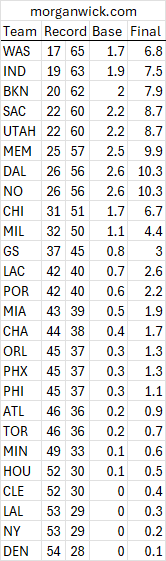
- The surrendered combinations from each of the previous two steps are redistributed to all 30 teams in proportion to their existing lottery odds. This is why I wanted to extend the distribution of lottery odds to encompass every team: because I’m assigning every team a set of theoretical lottery odds that only get converted into actual combinations if the redistributed odds due to them get high enough to warrant some, with the goal of keeping the odds from getting too flat if too many teams fall below the .333 target win percentage. (If I only took the 14 non-playoff teams, the teams with the highest odds this season would have barely five times the odds of the team with the lowest odds; under the current distribution, after the 2019 flattening of lottery odds, the worst teams have 28 times the odds of the 14th worst.) In this example we bring in the theoretical conference semifinal losers; the table at left breaks ties based on how teams did in the play-in, and doesn’t factor in any pick trades. (Technically Toronto should have gotten an extra combination before the Wizards but I didn’t want a higher position to see a larger drop-off than a lower one until consecutive positions start getting the same odds.)
- Lottery odds are not re-redistributed after each pick; every team keeps the combinations assigned to them after the previous step. However, as an optional rule, teams below .333 get the equivalent of one of their pre-redistribution lottery combinations back after each pick they don’t win (about 3-4 post-redistribution combinations in this example), until they win a pick or get back to the level they were originally capped at. If the team that won the last pick does not represent enough pre-redistribution combinations to distribute to every sub-.333 team with outstanding lost combinations, teams with worse records get their combinations back first. Teams cannot jump ahead of a sub-.333 team with a better record this way, but otherwise there’s nothing stopping the Wizards from getting combinations back after every pick. I consider this an optional rule because you could argue that teams should continue being penalized for every pick, considering how much of tanking is about maximizing your slot in the draft order wherever it falls.
- At any point, if the sum of outstanding lottery combinations for the remaining teams are less than 200 (so less than a 20% cumulative chance) and all sub-.333 teams have been allocated a draft pick, the lottery ends and the remaining teams are simply slotted in reverse order of record. This prevents constant re-draws as the lottery goes along and minimizes the chaos in the draft order for play-in teams or better, while maintaining the idea that there is no floor for how low tanking teams can go other than the bounds of the lottery itself.
Under this system, the way to maximize your lottery odds is to get as close as possible to 27 wins, with it being better to miss low than high. But it’s hard to precisely target how many games you win or when, considering the impact of injuries and hot streaks, so teams could just decide to play the season straight until they get to somewhere around 20-25 wins. Then if a team is genuinely bad enough to fall short of 27 wins, they should still have strong lottery odds unless several other teams tank. If two teams play each other that could fall on either side of the cut line, they may be incentivized to lose both to boost their own lottery odds and to try and keep another team from hitting the cut line and reducing how high their own lottery odds can go, but if they also have a shot at the play-in that could alienate fans. Conversely, if both teams are already over 55 losses, they want to win as many games as possible to keep their odds as high as possible, while also potentially getting some extra combinations from their opponent losing.
All told, this idea might not be a silver bullet to completely eliminate tanking, but it should disincentivize it for the worst teams without punishing them too hard for being so bad, and push the teams that aren’t quite that bad to wait longer before completely giving up on the season. (Would the Pacers, who didn’t even hit 20 wins, have sat players in the middle of a game in February if the way to maximize their lottery odds was to win more games?) Meanwhile, de-flattening lottery odds should reduce the reward for tanking for teams with any shot at the play-in by, ironically enough, flattening odds in the back end of the current lottery. (Currently teams 11-14 lose half a percent in lottery odds for each position they gain, compared to .1 percent in the pre-2019 system.) And teams in the play-in, representing the middle tier of the league, should have a decent chance of moving up at least a few spots, especially if there’s still a decent amount of tanking. You could quibble with the details, but I’m not sure there’s a proposal that better balances all three of the goals I argue the league should have.