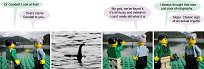
Is it sad that I actually waited until 3 in the morning so I could include today’s strip in the write-up?

(From Irregular Webcomic! Click for full-sized cryptids! Man, I really am taking after Websnark, aren’t I?)

I’d like to expand on the points made in today’s strip on Irregular Webcomic!, but before I do, I want to talk about someone else.

Scott McCloud.

McCloud was a creator of comic books, mostly deconstructionist superhero stuff, but he was mostly concerned about the legitimization of comics as an art form. So in 1993, he wrote a book called Understanding Comics, in which he talked about the medium seriously, deconstructing its methods, exploring what is and isn’t comics, and the like. And because he wanted to practice what he preached, he published it as a comic book.

In 2000, he wrote a follow-up, Reinventing Comics. Whereas before he was talking to people outside the comics industry, this time he talked to people inside it, outlining twelve “revolutions” that could help comics survive and thrive as an art form. He especially talked about the then-nascent medium of webcomics and how the Web had a number of advantages that allowed it to thrive as an art form on its own. The most famous of these is probably the idea of the “infinite canvas” – that, similar to the idea that, since Wikipedia is not a paper encyclopedia, it can talk about a lot more topics than Brittanica (and for the love of God please do not make this a battleground regarding whether it really takes full advantage of this), so too can webcomics extend over a much larger space than would ever be practical on a sheet of paper.

In practice, though, creating larger, more expansive comics taking up lengthy stretches of the page is rather impractical. It takes a lot of work to create a big comic, and as a result the infinite canvas is really only utilized as occasional novelty acts in more standard webcomics, or as one shots. It doesn’t help that there really is a sort of limit on the amount of space you can devote to a comic, the size of the screen (people don’t like scrolling, and they REALLY don’t like LOTS of scrolling, especially horizontal scrolling which is harder to do with a mouse wheel), or that a lot of webcomic artists would rather prefer to be able to publish print publications of their work. After all, for most people, webcomicking is really more of a hobby.

The same goes for the other much-ballyhooed benefits of the Web for the comics medium, such as interactive or multimedia webcomics. (Especially when you consider that “multimedia webcomics” in particular can blur the lines in regards to exactly what is and isn’t a webcomic. For example, is Homestar Runner a webcomic? If not, on what grounds?) There have been occasional experiments in all of them, but generally there haven’t really been many, if any, ongoing webcomics that actually take full advantage of their medium in ways they can’t do in print.

Which brings us to Irregular Webcomic!

IWC, despite the name, is anything but irregular. David Morgan-Mar has faithfully produced a strip a day for virtually the whole history of the strip. He likes to joke about how his strip has been “more regular than many webcomics that actually claim to be updated regularly”.

The “irregular” part comes in the specifics. You see, Irregular Webcomic! is actually seventeen different webcomics, known as “themes”, and those are updated semi-irregularly with each nightly update of IWC itself. There isn’t always one a night, as the themes cross over rather often, often in combinations you would never think possible. Some (Fantasy, Cliffhangers, Steve and Terry) are updated more often than others (Supers, Imperial Rome), and a few (Martians, Nigerian Finance Minister) seem to be abandoned entirely. Some are also more like unifying elements than full-on webcomics, despite occasionally having non-crossovers (Me [yes, Morgan-Mar himself appears as a character], Death, Miscellaneous).

The original conceit was that all these different “themes” reflected different role-playing games (pseudo-board-game kind, not video game kind) Morgan-Mar (as “Me”) was playing (if there’s a third tradition in most webcomics, RPGs are it), although that seems to have fallen mostly by the wayside, especially in the newer themes. (Only Fantasy and Space really show any signs of being role-playing games anymore.) The older themes (Fantasy and Space again) were and continue to be played out by semi-realistic looking figures (well, as realistic-looking as figures of hobbits and aliens can be) but by and large, the vast majority of themes, which is to say the vast majority of strips, have been played out by LEGOs, which have become the strip’s trademark. (Exceptions are Martians, although even that has key LEGO figures; Supers, which is hand-drawn by another artist; and Miscellaneous.)

It’s important to note that, hand-in-hand with this structure, Morgan-Mar has a rather robust navigational engine that facilitates all of this. You could, conceivably, just read IWC right straight through, like a conventional webcomic, although, especially at this point, IWC shuttles between themes every day. (For example, yesterday’s comic was in the Espionage theme. The day before that was Mythbusters (yes, based on the Discovery Channel show, and done with LEGOs too – and they’re not alone; Jane Goodall, appearing above, is a character in Steve and Terry, which is itself a not-really-them-honest version of the late “Crocodile Hunter” Steve Irwin from Morgan-Mar’s native Australia; Shakespeare has a theme where he’s transplanted in the modern day; Espionage is a takeoff on James Bond; Cliffhangers is a takeoff on Indiana Jones; there are actual themes named Harry Potter and Star Wars…), and the one before that was Space, and the one before that was Cliffhangers…) But you can also read each theme as an individual webcomic, following the strip as it follows one plot and completely ignoring any others. IWC has gone on for almost 2000 strips, but you don’t need to read all of them to understand just one or two themes. And the ability to read it five days at a time is just gravy.

You can’t do that in print. Well, at the least, you can’t do that in print and expect much of a following. I’ve actually conceived of a similar structure for Da Blog, where each tag could conceivably be read as its own individual blog, so that, for example, you could decide to read just my “nba” or “my comments on the news” posts, and ignore my “webcomic” or “about me” posts, except where I tag an “about me” post as “my comments on the news”. In webcomics, it actually opens up brave new worlds of storytelling possibilities. I envision a large, expansive world with several different webcomics weaving in and out of one another, perhaps even with different writers, which could be read individually but which forms a complete picture when read in total. Wait, that sounds like modern comic books. But one important difference would be the ability for strips to exist in multiple comics at once. There are other possibilities for the format as well that I probably have never even heard of. Scott McCloud, I would hope, would be proud.

The really funny part is, Irregular Webcomic! is one of those things that’s a pioneer but doesn’t really define its field; it sort of falls by the wayside, but what it pioneers is ripe to be overtaken by other, sharper minds. For example, IBM pioneered the germ of what became personal computing, including operating system writing, before Apple and Microsoft came along; now they barely even exist in the computer industry, now serving as mostly a consulting firm, near as I can tell. There are some themes I’m interested in – Mythbusters, Death and Shakespeare come to mind – but after certain current plot lines wrap up, or at least come to a stopping point, I’m probably going to stop following IWC every single day. (Of course, given the irregularity of the strip, I’ve been waiting six months for them to wrap up…) I would continue to follow just the ones I’m interested in, but Morgan-Mar doesn’t offer individual RSS feeds for each theme; instead, his one RSS theme lists the strip number and any themes it’s in. That makes it harder to follow individual themes instead of the whole comic. I kind of have to agree with Eric Burns that I actually find Morgan-Mar’s side project, the group-produced Darths and Droids, a re-enactment of Star Wars as played by RPG players (thus taking off on ground previously trod, for Lord of the Rings, by the now-ended DM of the Rings), more consistently entertaining, even if it’s hit a slow spell for the moment. In fact, D&D is one of only two webcomics that holds a place in Internet Explorer 7’s built-in RSS reader.

Which is odd, because the other one of those two is also set in that role-playing game milieu, and it wasn’t that long ago that I was barely even aware of RPGs’ existence, certainly beyond the venerable Dungeons and Dragons.

But we’ll talk more about Order of the Stick later in the week.
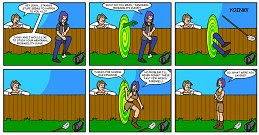
Should I hold a cigarette, snicker, and say “You fools! NO ONE can stop me now! MWA-HA-HA-HA-HAAAA!!!”

Okay. Yesterday’s debacle is behind us.

But I’ve entered a new stage of my Evil Plan, and there are some people here who might not know of which I speak. And I should probably link to the strips in question to maximize the chances of my Evil Plan working.

So. Here’s Penny Arcade, and here’s Sluggy Freelance. I linked to Sluggy yesterday, but I’m mentioning it today, so I might as well link to it again.

One interesting aside? Remember yesterday when I talked about the two types of most webcomics? Well, Penny Arcade is probably the ur-nerdy, video game strip, while Sluggy is, as I mentioned then, an example of an unlimited wackiness strip.

This post rambles on for ages and ends up going nowhere. I think I need a biscuit.

Prelude: At one point, when I was very young, before I had an e-mail address, I would occasionally use my mom’s e-mail account to give certain people a piece of my mind. Hey, I didn’t have anything else to work with. I would end up lectured as much for their content as for the act of using her e-mail address to do it, and sometimes Mom would discover the message before I even sent it and dissuaded me from it, like the time, shortly after the TV rating system was introduced, when I started writing an e-mail to some random web site as a starting point for starting to assign a Web site rating system, but Mom found it and dissuaded me from it. Keep in mind, I WAS, LIKE, TEN YEARS OLD! And I’m acting like huge committees all by my lonesome.
Anyway, as this behavior progressed I started including entreaties not to reply to my e-mails, lest my mom found out about them. And lo and behold, they DID reply, and my mom DID find out about them, and I DID get lectured. Such as the time (bringing this to the topic for the rest of this post, which has nothing to do with the “about me” tag) when I made some comments about how some guy could improve his web site, complete with entreaty not to reply, and I got a Notepad file on the desktop saying, among other things, something like “PLEASE don’t make comments on other people’s sites, or you will have to be chaperoned while using the Internet!!!”

(Since 2000, I haven’t had to share a computer with Mom while using the Internet, and I got my own e-mail address in 2002, minimizing the problem. And I finally started getting the hint as well.)

Anyway, the point of all this rambling is, I don’t like making critical comments on another web site.

But this is a blog, not an e-mail. And a blog is different from a web site as well. And I do feel I should probably explain this strip, because to this point I haven’t really done much to connect to the broader “webcomic community”, and I may as well make some comment on the site of which I speak.

And it helps that I’ve met several blogs that precisely do make critical comments on other websites, including, especially, the one of which we speak today. (Nonetheless, I still feel somewhat queasy about the enterprise…)

Websnark was originally the final evolution of a series of blogs by Eric Burns (as I’ll explain later, that’s not quite accurate); in fact, before the blog’s “official” birth date of August 20, 2004, one will find a number of posts dating back to January of that year, only much further spaced apart, longer form, and about more random topics – the remnants of Burns’ attempt to revive his “online journal”, ported to Websnark.

Specifically, Websnark was Burns’ plan to clear the junk out of his still-running Livejournal and allow it to be refocused. I’m going to make a metaphor using the structures in place at this site: Burns wanted his Livejournal account to be composed mostly of the sort of posts I would tag “about me”, but instead it was mostly the sorts of things I would tag “internet adventures”. In his case, “internet adventures” usually meant whatever random memes were criscrossing the Internet and “pictures of dogs”, which basically meant whatever webcomics struck his fancy, but in theory, Websnark was going to be specifically devoted to neither, just shuttling between the two. In practice, after the first post it would be another 11 posts until the next non-webcomic post. Websnark has had its fair share of non-webcomic posts – in fact, I would estimate that as it became more popular as many posts were not about webcomics as were (especially, circa early 2005, posts about itself) – but webcomics would be its bread and butter, the ticket that took it to the dance.

And as it turned out, it would deliver Eric Burns fame, fortune, and even, as made official just this past weekend, a wife.

The Internet has redefined the phrase “overnight sensation” but even by its standards Burns’ ascent seems amazingly literal, both for the speed from which he went from being maybe as famous as me to one of the biggest names in webcomics, and how quickly that ascent came after his blog’s foundation. No less than four days after starting Websnark, Burns wrote an unusually sarcastic and, well, snarky post (despite the name, Websnark does not particularly make fun of its subjects as it does neutrally, or even positively, comment on them with a funny tone) that started a chain of events that netted his little corner of the ‘net thousands of readers. He ragged on popular webcomic PVP for how unpredictably it might update each day, his ragging was brought to the attention of PVP’s creator, Burns was rapped by the PVP forum regulars, and went on his merry way.

Just two days after that, Burns returned to the topic of PVP, for substantive reasons this time, PVP’s creator liked it enough to link to it on his front page, and the floodgates were opened.

There are a few more stops along the way, and Burns himself goes into plenty more detail on the rapid rise of Websnark here. Long story short, Websnark became as much of a go-to place as some of the webcomics it remarked upon, including with webcartoonists themselves. This despite the fact that Burns engaged in a form of advertising known as “none whatsoever”.

Maybe it was the smartness of the criticism. Maybe it was the respect Burns paid to the medium. Maybe it was how constructive and neutral he could be with the criticism, coming from the perspective of a reader without a horse in the race. Or maybe it was that he was doing it at all.

…But a surprisingly large number of webcartoonists started regularly reading.
This surprised me. This surprised me a lot. And it made me realize that there
weren’t that many people out there doing what I was doing — offering up
critiques of the medium and discussions of the individual executions. […]

The dialogue is all important in art. It’s criticism — in the truest sense of the word. The understanding and analysis of what is there. The placing of art within the cosm of its fellows. The distillation and discovery of new truths from interpretation. I’m not going to claim to be the first webcomics critic, nor anywhere near the best, but through luck and timing I managed to become one of the better known. It got me two gigs that mean the world to me — writing for Comixpedia, and contributing to the Webcomics Examiner — and it’s spawned others trying to do the same thing. Tangents, by Robert Howard. I’m Just Saying, by Phil Khan. Journey Into History (and the HB Comic Blog) by Bob Stevenson. Webcomic Finds by Ping Teo. The Digital Strips Blog and Podcast, by Zampson and Daku. And many, many others.

I’m not saying I’m the reason those guys are doing what they’re doing. I’m not saying Websnark by Burns and White was necessary for all those other voices. But we clearly had an impact. We clearly caused some folks to read what we wrote and say “wait a second — I can do that!” And that’s monumental. That’s massive. That is good for comics in general. That is good for webcomics in particular. The dialogue improves everything. And if my making this blog a year ago helped that… well, that’s about as fine a thing as I could hope for.

I advise you to read that whole post, if only to marvel at how prominent Burns became after only a year of posts. There are blogs that become insanely popular for a time, there are blogs that develop devoted followings for a time, but in all likelihood Burns and Websnark takes the cake.

And there are good reasons for that. By no means was Websnark the first place that commented on webcomics, nor am I in any place to say whether it’s the best. But I can say with some degree of confidence that Websnark was probably the first place to treat webcomics like War and Peace, and certainly the first to do it in a humorous tone. And Websnark – this is important – could take webcomics seriously when webcomics didn’t take themselves seriously.

At right is a 2005 strip from semi-popular webcomic Casey and Andy. Click on the thumbnail to see it in all its glory.

Probably the majority of webcomics fall into two categories: the video game comic, in which a cast of nerds sit around all day being nerds, including playing video games and making commentary about the world of video games. Sandsday falls into this category.

The comics that aren’t video game comics tend to be strips where wacky adventures happen to ordinary people. Alien abduction? Getting turned into Bigfoot? Being made the bride of Satan? All par for the course, and in fact, child’s play for some strips. Casey and Andy falls into this category, and this strip captures the mood perfectly. (And it’s arguably tame compared to, say, Sluggy Freelance.) If a webcomic doesn’t fall into one of those two categories it’s probably some combination of the two, at times simultaneously. There are exceptions, but even the exceptions tend to be nerdy in some way.

That, by the way, is the sort of analysis Websnark foisted upon the world, and which is now far from unique to Websnark. And I haven’t even gotten into the effect created by the way Andy Weir draws eyes. But I digress.

This strip was unleashed to the world during the closing stages of Websnark’s golden age. You probably see a funny strip where wacky hijinks happen. I mean, she gets yoinked away, then returns after a few weeks of adventure and picks up the conversation as if nothing happened! And she’s wearing a bikini warrior outfit! It’s madness! MADNESS I TELL YOU!

Well, Eric Burns sees this:

Some time ago, in the course of snarking Casey and Andy, I mentioned that Jenn Brozek had become the strip’s protagonist. My thesis was simple enough: Casey, Andy, Mary, Satan, Quantum Cop and all the rest were funny characters that funny things happened to, but Jenn was the strip’s Mary Richards — she was the (relatively) normal character who had insanity surround her. As a result, her reactions echoed the reactions of the reader. She might be Queen of the Hunkinites, but her reactions are those of a normal person. More or less.

And, as a result, the major plot arcs seem to center on her. Jenn gets kidnapped transdimensionally or temporally. Things happen. Other things result. Her air of normalcy lends itself to weird situations.

However, part of character development is growth. If Jenn remained aggressively normal, she’d become a one-note joke character, existing only to not be quite as weird as everyone else. Sooner or later, she has to take weirdness in stride.

Today’s strip makes it official. Jenn getting kidnapped and going off on a several week jaunt which leads to her coming back in significantly different clothing doesn’t make her bat an eye. She’s ready to pick up her conversation.

Not to mention that even before she was kidnapped, she was casually burying a satchel in the yard.

Jenn may still be the protagonist of the strip, but she’s not Mary Richards any more. She’s gone full on Phyllis on us.

(Does anyone even remember Phyllis? I always liked her character.)

It’s a psychoanalysis of Jenn’s whole character spun out of a single strip! I haven’t even chose a particularly representative example of the sort of madness Burns brought to his craft at his height. This is a fairly good example. I think.

But I have a few more thoughts on this. (Pardon me if this post sounds really random right now. I’m really tired and I spent way too long reading Websnark posts instead of writing about it. And now I’m aping parts of its style. I really need sleep.)

I’ve talked about the rise of Websnark. Now I want to talk about its fall. Which Burns totally saw coming. “I’ve maintained for a while that we’ve found the audience we’re going to find, and readership is only going to decline from here,” he writes in that first anniversary post. By 2007, he was barely posting at all, as he recognized in one of the rare actual posts:

[I]n 2006, Websnark was running somewhere close to the height of its popularity. I think the “glory year” was probably 2005, but 2006 was still doing darn nicely. At the same time, I was at that point a creature of habit. There are things that I did, and things I didn’t do, and very little breaking up of them.

Which is the nature of a thing like Websnark. When you begin, you’re throwing everything against the wall and seeing what sticks. Sooner or later, you get a sense of what sticks and then… well, you stick with it. You become formalized. You become ritualized. You become expected and perhaps complacent. And for a while, you run high on that formula, because it really is what people want to see, and you really are pretty good at it, and it’s all pretty fun.

Eventually, of course, things run their course. There is shift, and breakdown. You lose your enthusiasm. Daily posting becomes weekly posting, and then monthly posting. People might still read, but things shift from water cooler talk to “oh yeah, he’s on X again,” to nodding and moving on. You become part of the landscape, and eventually you become yesterday.

That is not a complaint, mind. It’s what we predicted from day one — there is a life cycle to these kinds of things. And no, Websnark isn’t going away. Er, more than it already has, what since it’s at best getting handfuls of posts. Regardless, I’m always happy when people come back to see what’s going on.

I honestly don’t know what to make of this. Burns portrayed his decline as inevitable, as some sort of natural law of the Internet. Until I re-read this, I was going to talk about how Websnark is not a good test case. For one thing, it dropped down to posting on certain rare occasions; for upwards of a year, Burns posted every single day. I wrote before that when you update your site every day, people forgive missed updates easier than when you update less often but still consistently. Miss a heck of a lot of updates, however, and you can see the holy fury coming down on your ass. Actually, check that. You can see people acting as if you never even existed.

Had Websnark kept updating every single day, or even a few times a week, perhaps it could have stayed popular indefinitely. Certainly there are plenty of sites on the Internet that have maintained the same level of popularity for ages. But perhaps that’s Eric’s point: he didn’t maintain the same level of enthusiasm for Websnark. Things change. Tastes change. What may seem like the thing you’re intensely, obsessively proud of today may be something you go “meh” at tomorrow. Why, just earlier this year, I fancied myself a philosopher, making pithy, insightful comments on human nature. Now? Political activist. But more on that later in the summer and into the fall. And back in high school I fancied myself a novelist, and before that a famous musician, the MTV kind (you know, if MTV still did music videos and all)…

But there are other reasons for Websnark’s decline. Nearly a full year ago, Burns explained how he was burning out on webcomics. But even at the height of Websnark’s popularity, in 2005, Websnark was starting to drift away from webcomics and into other topics. A signifcant number of posts were about Websnark itself and its growing popularity.

Anyway, the point is: Did the people burn out on Websnark, or did Eric? And if it was Eric that burned out on Websnark, does that really give us any real insight into the working of the Internet, or just into the mind of one Eric Burns?

Well, Websnark may be on the rise again. Back in February it got back into hardcore webcomic commentary with “State of the Web(cartoonist)“. Or maybe “State of the (Web)cartoonist” depending on the week. Anyway, each day Burns would take a look at one person with a webcomic and take a look at that webcartoonist’s strengths and weaknesses and what Burns thought of that cartoonist’s strip. And he posted every single day! For two weeks. Then his schedule started slipping and eventually posts became just as nonexistent as before. Recently it returned for a spell, remarked on three comics, and disappeared again.

He was going to do sixty-five webcomics. By my count, he’s done fifteen cartoonists. And I was counting on getting this strip up the instant he was done with those sixty-five comics, dammit!

Well, it’s not like he’s going to notice it in time anyway.

Right?

Dear God I need to get to bed. It’s one in the freaking morning as I finish this. It’s taken me several days to write it.

And I’m probably going to regret every word of it.

Truth! What a concept!

I’m not doing any more editions of the News You Can Use feature, unless of course someone paid me for it. It’s another great idea that I think someone should take up as long as it’s not me (like the NFL SuperPower Rankings). The next evolution of it might be something akin to a webcast where someone could recite the really important stories of the day.

(Where’s the best news source(s), between TV, print, and the Internet, for finding news the American people really need to hear, while still having a good balance of US news and not sounding like a liberal screed?)

Anyway, as you may have noticed, I tend to link to the AP’s web site (which I’m not sure they intend for real public consumption) whenever there’s a news story I want to comment on, and now the AP wants to talk with the Media Bloggers Association for standards for quoting from AP stories. (I’m not sure I ever quote per se, but it might apply anyway.)

The article talks about things like making sure the AP’s guidelines closely follow fair use provisions, but I want to talk about more basic things, like a backlash by bloggers wondering where these people in the MBA came from, and some nasty accusations I’ve learned of that the MBA is a scam, or even a front for “traditional” journalists who have as much incentive to squelch blogging as the AP.

So, in a Da Blog Investigative Report, let’s try and separate fact from fiction.

First, the backlash from bloggers has been wondering who the hell are these people and why they should have any claim to represent bloggerdom. From Gawker:

And who are they? It’s hard to say, even after reading the group’s site and searching for more information elsewhere on the Web.

The association obtained credentials for some bloggers to attend the Scooter Libby trial. Founder Robert Cox claims the group “makes available” pro-bono legal services. There is some sort of partnership with Newsweek. Rabble-rousing blogger Jeff Jarvis is a member. But the association is a self-appointed representative of a hugely diverse group, and its legitimacy appears entirely self-assigned. Gawker Media, for one, is not aligned with the association, I am reliably informed.

The AP’s decision to emphasize its meetings with this lone, opaque organization only makes its copyright crusade seem all the more surreal.

Also arousing suspicion: A claim that the closest thing it has to a blog of its own is hosted by Newsweek… a representative of “old media.” Well, that’s not completely fair; the MBA does host president Robert Cox’s personal blog, but seems to want to hide it, only showing a list of posts on the sidebar of some pages. Gawker commenter Triborough raised more red flags on the same post:

The group claims to be in New Rochelle, but a search of the NYS Department of
State Corporation and Business Entity Database doesn’t have them listed. The whois info for the domain lists a P.0. Box in Philadelphia (looks like a possibly privately registered domain with things like olbermannwatch.com being registered to the same address) with the Pennsylvania Department of State’s business entity database revealing zip. The phone number listed on the website’s contact us page is in Arizona with the Arizona Corporation Commission database revealing no listing.

And this raises a red flag for us: The Media Bloggers Association will be opening up registration for membership starting in Summer 2008. Just send them your name and e-mail. Seems like a bit of a scam.

Then again it is about 1AM and are tired and feel like not doing any more research
into possibly dubious groups that I don’t think anyone has ever heard of.

Cox didn’t do his organization any favors in their response to the Gawker post:

Some kid named Ryan Tate has a snarky little post about our efforts to help a
blogger facing a legal threat over at Gawker. He claims to have tried to find out about the MBA by reading our site and searching the web. Here’s a thought, kid. Pick up the phone and call us – our phone number and email is on the same site you claimed to have read.

Yeah. Here’s a thought: Instead of attacking him (which makes you look like even more of a shill to old media), why don’t you answer why very popular blogs like Gawker don’t appear to be represented in your organization, and why people have to call and e-mail you to find out information that virtually every other similar organization in the world puts on their Web site? You claim to represent bloggers, why don’t you have some sort of membership roll on your Web site? Even listing some of the “very popular” blogs you claim to represent?

The rest of the article completely ignores Tate’s concerns in order to establish that the operator of the blog that started this mess did indeed contact the MBA for legal protection. I find it odd that the MBA would accuse Tate of “sneering” and “snarking” about them when Tate’s post is not all that sneery and snarky, but the MBA sure loves to snark about what a punk kid Tate is! Gawker summarily counter-mocked them.

Meanwhile, Gawker commenters continued the march of evidence that something was wrong with the MBA, suspecting it of being a possible scam and being friendly with the AP. The evidence is collected here, and here are some excerpts:

This is the group that the blogger behind Drudge Retort turned to when faced with legal threats from the Associated Press. AP backed down, but who knows what Cox and his MBA got from the blogger. And now this group is supposedly in negotiations with the AP to issue blogging guidelines that most likely will be stricter than copyright law even calls for.

Cox has now written a post claiming that there are several “misconceptions” about the case, and regarding the topic that now has people’s panties in a bunch, claims:

A final note, there has been a lot said about the absurd notion that the MBA thinks it is representing “all bloggers” or that the AP is “negotiating” with the MBA. Ridiculous. We were approached for help by Rogers Cadenhead and, as we have done hundreds of times over the past four years, responded by offering him pro bono legal counsel and to set up a direct dialog with the plaintiff to see if the dialog could resolve the problem. We represent A BLOGGER and achieving an outcome acceptable to that blogger is our goal. Any discussion about how AP could better communicate its view of what is and is not acceptable is important and useful but secondary to the primary issue of getting to resolution for the blogger we agreed to help.

In looking back as to how that notion got out there, I see The New York Times article which ran over the weekend. While the article was factually correct it mischaracterized what was going on in a way that caused a great deal of misunderstanding.

So, let me try to address that too. In wrapping up my call with Jim Kennedy I expressed my view that it seemed incumbent on the AP to offer bloggers a better understanding of what the AP did find acceptable, to offer some sort of guidance which might help bloggers operate in a way less likely to draw the attention of the legal department and thereby reduce the number of legal threats made against bloggers. Such a discussion is entirely in keeping with our mission as an organization. Looking back on it now it may seem incredible but I told him that if he was willing to come up with some sort of guidelines, the MBA would help promulgate them as much as possible. The concern being that no one would know the outcome of such discussions and so any guidelines they came up with would be a tree falling in the forest. Jim knew the MBA could help with such things because our members include quite a few widely read bloggers who would most likely have been willing to consider putting up a post about it if they were asked. Apparently Jim told The New York Times the he was going to meet with me per our conversation but the way that came out was that the sole purpose of the meeting was to negotiate guidelines for bloggers. That take on the conversation was then twisted into the absurd notion that that MBA was going to meet with the AP for some sort of binding arbitration to negotiate terms on behalf of all bloggers. Even after I picked up the phone and explained the actual purpose of the meeting – to sort out what to do about the outstanding DMCA Take Down Notices – some bloggers just continued to run with this absurd story in order to advance an agenda that I can assure you has nothing to do with resolving the case at hand.

Um, here’s AP’s own story on the issue, which I linked to at the top of this post:

NEW YORK (AP) — The Associated Press, following criticism from bloggers over an AP assertion of copyright, plans to meet this week with a bloggers’ group to help form guidelines under which AP news stories could be quoted online.

Jim Kennedy, the AP’s director of strategic planning, said Monday that he planned to meet Thursday with Robert Cox, president of the Media Bloggers Association, as part of an effort to create standards for online use of AP stories by bloggers that would protect AP content without discouraging bloggers from legitimately quoting from it.

Here’s some advice for Cox: The best way to avoid the appearance of a “negotiation” would be to not “meet” with them at all. Having any say in what the guidelines are makes it look like a “negotiation”. The New York Times has nothing to do with it. In certain circles at least, that WILL get equated with “negotiation” even if whoever is making the judgment makes it based on this fairly neutral AP story. Considering most bloggers hadn’t heard of your organization before now, it’s not likely you would have had much effect “promulgating them as much as possible”. There is no such thing as a centrally controlled blog that every other blogger reads; blogs are the most decentralized concept on the Internet. The best way for the AP to distribute its guidelines would have been to post them on its web site and include them on its articles wherever they are legally distributed.

Another reason why “bloggers continue to run with this absurd story”? They would actually prefer a “negotiation” to the AP unilaterally determining its guidelines! It seems obvious that Cox is out of touch with a blogging community that, by and large, sits far to the left of his own positions. (Cox also runs Olbermann Watch, a site criticizing MSNBC host Keith Olbermann.) Here’s Gawker on the MBA working with the AP in 2007 on coverage of the Scooter Libby trial:

In return, Cox promised to keep bloggers in line! “This is not the time to write a post titled ‘Dick Cheney is a [expletive deleted].’ We sought to address [the AP’s concerns] by saying we have a vetted membership of bloggers who’ve agreed to ascribe to certain ideals of what they’re trying to do. [The AP] has the kind of accountability that they want. I’m not going to control what the blogger writes, but if they get way out of line and embarrass the AP, they can be pulled from the feed.”

Goddammit Cox this is the time to write a post titled “Dick Cheney is a [expletive deleted].” If we can’t do that, then what is the point of blogging?

The blog community is far more anarchic and opinionated than Cox gives it (or himself – another Gawker commenter writes, “Cox is the guy who a few years ago tried to make his point about the New York Times “correction” policy by creating parody websites of their correction page and then was threatened with a lawsuit by the Times and then I forget what happened”) credit for, and like capitalism, blogging works best when it’s given free rein. It’s a free market of opinions out there, and Cox and the AP shouldn’t be trying to censor people who don’t agree with his own right-wing views.

Now on the other hand, if swearing is Cox’s only concern, I have little problem with that and wouldn’t help but wonder if Gawker is overreacting. Similarly, I’m not sure what the big deal is here either, unless the AP ends up restricting quoting so much it’s ridiculous, which some bloggers fear. The AP should be able to present common sense guidelines most people will follow anyway. Cox claims this started because Cadenhead posted several entries that quoted AP stories in full, which seems ridiculous; you may as well just post a link in that case.

But the posts in dispute now, if they violated any rules, could breach the spirit of fair use and limit bloggers’ ability to take certain parts of a story and perform analysis on them. And what the AP seemed to want in its first communique with Cadenhead is REALLY disturbing:

… you purport that the Drudge Retort’s users reproduce and display AP headlines and leads under a fair use defense. Please note that contrary to your assertion, AP considers that the Drudge Retort users’ use of AP content does not fall within the parameters of fair use. The use is not fair use simply because the work copied happened to be a news article and that the use is of the headline and the first few sentences only. This is a misunderstanding of the doctrine of “fair use.” AP considers taking the headline and lede of a story without a proper license to be an infringement of its copyrights, and additionally constitutes “hot news” misappropriation.

WTF? I don’t even understand what this is supposed to mean, and the consequences for any interpretation are disturbing. And I don’t understand why AP would even have a problem. Is not quoting the headline and lede of a story common practice even outside the world of blogs? Would not the AP want traffic to its member sites? Is the problem that the AP thinks that taking the headline and lede takes it out of context? Does the AP want MORE than this, or LESS than this? Or is the AP’s problem with the comments associated with each item? I can’t assess that since Cadenhead was required to take down the offending posts immediately, but he explains the issue better than I could:

I have no desire to be the third member of that club, but sharing links to news stories of interest has become an essential component of how millions of people read and evaluate the news today. When linking to articles, bloggers commonly include excerpts of the article for the purposes of criticism or discussion. Some AP member sites encourage this kind of reuse. Yahoo News, the source for two disputed stories, invites bloggers to use items from its RSS feeds. USA Today, the source for two others, includes a browser widget alongside articles that facilitates their submission to Digg, Mixx and other sites. Wade Duchene, the attorney who helped me win the domain name arbitration for Wargames.Com, says that what we’re doing on the Retort is the “absolute definition of fair use.”

Cadenhead, obviously, is on the MBA’s side, calling them a “blogger’s ACLU” in a later post, which is to be expected since he is taking legal counsel from them. Commenters for Gawker disagree, seeing it as a “just an excuse to sell scared bloggers useless liability insurance.” Your mileage may vary, but the ACLU doesn’t unilaterally negotiate with some group on what guidelines they will set on searches and seizures that may or may not be broader or narrower than what the Fourth Amendment allows.

There’s some hysteria going around the Internet that the MBA is a scammy, right-wing organization that is claiming to represent all bloggers so that the AP can institute overly restrictive regulations. It’s probably unfair to the MBA, but I’m not sure what to believe here. Is the AP going to lay the smack down by itself and let the MBA just be the messenger, as Cox claims, or are they actively negotiating even though most bloggers had never heard of MBA before now? If they are actively negotiating on rules the AP will expect to apply to all bloggers, sorry, but no matter what else you may claim, the MBA IS claiming to represent all bloggers if only de facto. And if the AP is going to impose its rules unilaterally on all bloggers, and most bloggers find them unacceptable (and if the MBA so much as says “we find this unacceptable” then it IS representing all bloggers in a negotiation, like it or not, and it probably SHOULD be claiming to), they’ll wish someone had claimed to represent them and post their objections.

If the AP IS “negotiating” with the MBA, they made a bad choice because it’s apparent that the MBA needs to do some “negotiating” itself with the group it claims to represent. Certainly the MBA has made some bad PR moves rooted in not understanding most of the blogosphere or even the Web itself, such as making little about their organization available online, or being anywhere near as high-profile as the ACLU, or not taking any new members at such a high-profile time. People naturally fear what they don’t know, and after reading about an organization they’d never heard of being treated as some sort of advocacy organization for all bloggers that was going to be the closest thing to an advocate the blogging community had for the adoption of the AP’s guidelines, maybe they couldn’t be blamed for lashing out. And given what little information is available, they also couldn’t be blamed for coming to the conclusion that the MBA is a scam or an old media front group out to suppress those uppity bloggers. I would come to the same conclusion myself if it weren’t for one thing: Cadenhead still trusts that the MBA is on his side, and he cites a liberal blogger as having referred him to the organization.

I’ll wait and see what the AP’s ultimate guidelines are, but I hope the blogosphere isn’t just trying to protect a mythical right to quote entire articles with maybe one word omitted. Instead of attacking the MBA, perhaps blogs across the Web should post what rights they refuse to have taken away from them, and what rights they think are just reasonable, and bring those posts to the attention of the AP and MBA. In addition to the right to post the headline and lede, I’d also like the right to selectively copy relevant passages from an article and comment on them as I see fit, without obviating any need on the part of a reader to read the article in full.

Verdict: Let’s wait for the AP’s guidelines, the blogging community’s reaction to them, and the first legal test of the guidelines. But while I’m certainly not ruling out that the MBA is part of an AP Master Plan, I’m willing to give the MBA greater benefit of the doubt than most bloggers, depending in part on the specifics of Cadenhead’s involvement with them. It’s very possible that the MBA has laudable intentions but not enough credibility to be an effective negotiating force. As strange as it might sound now, the MBA could come out of this episode with a greater understanding of the blogosphere and an actual legitimate role to play where bloggers see them as an organization they can trust as an ally against the distrustful, litigous forces of old media, not distrust as an ally of old media. Or the MBA could come out of it as Public Enemy for bloggers everywhere.

P.S. Why “Verdict”? What’s with the “truth court” tag? Ah, that would be telling…

Well, certainly one involving Bill Simmons, at least.

Hold on, I’m about to go into super-nerdy mode for a moment here.

Popular ESPN.com columnist Bill Simmons has had a total of one column since May 1st, and the reason why is not a secret within the sports blogosphere, as much as ESPN may not want it to come out. When popular sports blog Deadspin inquired about his lack of columnage May 14, Simmons cited “behind the scenes bullshit” and claimed “certain promises were not kept” “within a few months” of signing a recent extension. Shortly thereafter, Simmons started up an off-site blog, albeit only posting old columns for the time being, and introduced one such column as having been “written right as I was starting to find a groove and my column was starting to resemble what it’s like now, only if nobody was killing five of the best jokes or making me re-write them so they weren’t as funny.

So it’s interesting to note that the Sports Guy’s latest ESPN column is basically a roundup of very short, quick takes on various sports (and non-sports) stories from the past month-plus. What may be a lot more interesting is this:

…[a]nd can ESPN organize a Josh Howard roast so I can stand on a dais and make
these jokes as someone like Jerry Stackhouse keels over in hysterics and does
the slumped-over-and-pounding-the-table routine? (Whoops, I forgot — you’ll see
Danny Moder leave Julia Roberts alone for the night with George Clooney before
you see ESPN get involved with another roast. Scratch that thought.)

Of course, Simmons is referring to an infamous incident during ESPN’s roast of their “Mike and Mike” personalities earlier this year, when Dana Jacobsen made some rather offensive comments while drunk. Okay, it’s not taking a shot because of Simmons’ own battles with ESPN, and that incident wasn’t even really ESPN’s fault, but am I the only one surprised, given what we’ve learned so far, that ESPN didn’t censor what could be considered taking a shot at the Worldwide Leader in Sports?

Anyone? Anyone? Bueller?

This post has something to do with the Derby, but it isn’t about it. Well, maybe a little.

Recently read:

NBC analyst Bob Neumeier correctly predicted favorite Big Brown would win. That
prompted NBC handicapper Mike Battaglia, citing confident Big Brown trainer
Richard Dutrow Jr., to say Neumeier “drank the Rick Dutrow Kool-Aid” — with
Neumeier adding “on the rocks.” Has everybody forgotten the origin of that
relatively young cliché?

Wait, I’m hardly an alcohol drinker (wouldn’t do it even if I was old enough), but aren’t “the rocks” just ice? It may be a bit of an off-color, mixed metaphor, and this probably wasn’t his intention, but it does seem to work

(All I have to say about the death of Eight Belles is that, regardless of whether or not horse racing objectively needs to change anything, they need to do something or they could risk becoming absolutely dead, as people will see it as an insensitive sport where deaths of competitors are simply brushed off, even induced in some circumstances. At this point, Big Brown winning the Triple Crown, far from revitalizing horse racing’s popularity, could actually crush it, because a big reason for watching the Triple Crown – seeing a horse win it for the first time in 30 years – will be gone.)

Okay, I’m pissed now.

Can I rant for a bit on Microsoft? (Which will probably cause a flock of nerds to come here and follow suit on the basis of that phrase alone, but whatever.)

Occasionally Windows will download updates, and some of these will require a reboot. Most of the time, I’m told that I have updates, I can start the process of installing them, and when they’re installed I’m told I have to reboot to complete the process. Often I’m nagged on this point every five to ten minutes or so. However, when the updates are more critical than critical, Windows downloads and installs it itself, then just up and spontaneously reboots at 3 AM with no warning. (No word if the phone rings at Hillary Clinton’s house when that happens.)

Now, I routinely leave my computer running for days, weeks, even months on end, often with several files open. It’s not a big deal that my computer will spontaneously reboot with Office programs, since they have AutoRecover (although Publisher 2003’s is iffy at best), but Notepad files are not so lucky. And while many of you might say that it’s unwise to leave my computer running for so long with files open and unsaved for so long, that doesn’t justify Microsoft discriminating against people like me in such a… pissing-off manner. Especially when laptops encourage the practice by allowing you to simply close them instead of actually shutting down. I don’t like finding myself comparing Microsoft to someone hacking into my system and controlling it from afar, and I doubt Microsoft does either.

Windows’ “I’m sorry” message after rebooting reads as follows: “Windows recently downloaded and installed an automatic security update to help protect your computer. This update required an automatic restart of your computer.” If this update is so important, shouldn’t I get some sort of warning that my computer is going to reboot itself without an opportunity to save my files? I don’t even have a clue about it unless I happen to catch the little “downloading updates” indicator appear in the systray, and then don’t dismiss it since nothing else comes of it. Shouldn’t I at least get a notification when the installation is complete telling me my computer is going to reboot at 3 AM? One that isn’t tucked underneath the arrow to open the whole systray, but that actually pops up while I’m working? I understand that some people like me might decide to try to push back the reboot, but can’t you just tell them that the computer is going to reboot and to start saving files? Better yet, be as obnoxious about it as for your less critical updates?

(I’m actually okay with Windows and Office otherwise. I’m morally opposed to monopolies on principle, but I’ve used Windows for years and I’m not likely to gleefully switch to Mac anytime soon, and I doubt many Office imitators have as many features as Office.)