NFL Schedule: Week 1

This is a new feature I’m trying out that will undoubtedly suck up all of my time: the NFL schedule for each week, with all the information you could possibly want, including DirecTV Sunday Ticket channel numbers, announcers from Awful Announcing, and coverage maps from the506.com. (Click the network logo for the coverage map.) Teams with a golden outline hold a lineal title.

The numbers between the team logos cram a lot of gambling-related information into a small space. That is the MXS, or Median Expected Score, an amalgamation of the point spread and over/under number. The formula is: 2U+S=N, where N is the over/under number, S is the point spread, and U is the underdog’s MXS. The favorite’s MXS is simply U+S, so when you add the two together you get 2L+S.

Away MXS Home Time (ET) TV DTV Announcers WW1? SIRIUS Notes
Away Home
21½-26½ Thu 8:30 PM Al Michaels, Cris Collinsworth, Michele Tafoya Yes 92 93 Let’s get back to football! Last two Super Bowl champions.
21½-19 Sun 1:00 PM 709 Kenny Albert, Daryl Johnston, Tony Siragusa 134 92 Defensive showdown between the NFC’s two best teams of the last regular season.
17¼-25¾ Sun 1:00 PM 706 Greg Gumbel, Dan Dierdorf 136 137 No Manning, big problems: could this be the Texans’ year?
17-23 Sun 1:00 PM 708 Marv Albert, Rich Gannon 117 91 Chiefs fans start getting the answer to the question: Was last year for real?
17½-19½ Sun 1:00 PM 707 Ian Eagle, Dan Fouts 149 135 Manning’s injury gives these teams hope, if they can get off on the right foot.
14½-21 Sun 1:00 PM 705 Kevin Harlan, Solomon Wilcots 106 113 Will this intrastate rivalry kick off the Andrew Luck Sweepstakes?
24¼-19¾ Sun 1:00 PM 710 Thom Brennaman, Brian Billick, Laura Okmin 93 138 The Dream Team kicks off against the NFC West favorites.
17-19 Sun 1:00 PM 704 Jim Nantz, Phil Simms Yes 112 86 What better way to honor the 10th anniversary of 9/11 than one of the NFL’s hottest rivalries?
19½-21½ Sun 1:00 PM 711 Chris Myers, Tim Ryan 128 94 People are feeling optimistic about the Lions. Will it prove well-founded?
16½-25 Sun 4:15 PM 713 Ron Pitts, Jim Mora Yes 139 93 The McNabb era starts in Minnesota, while the Chargers seek redemption.
20¼-17¼ Sun 4:15 PM 715 Joe Buck, Troy Aikman, Pam Oliver 92 86 More than an NFC East rivalry, it’s honoring the day that changed both cities forever.
15-22 Sun 4:15 PM 712 Sam Rosen, Chad Pennington 136 94 Fans hope new quarterbacks for both teams change their fortunes.
16-21½ Sun 4:15 PM 714 Dick Stockton, John Lynch 91 85 Harbaugh starts his coaching career against old college rival Carroll.
17¾-22¾ Sun 8:20 PM Al Michaels, Cris Collinsworth, Michele Tafoya Yes 92 93 It’s Ryan vs. Ryan as two highly-scrutinized teams square off.
26¼-19¼ Mon 7:00 PM Mike Tirico, Jon Gruden, Ron Jaworski, Suzy Kolber Yes 92 93 Patriots begin their latest Super Bowl quest with a divisional showdown.
18¾-21¾ Mon 10:15 PM Brad Nessler, Trent Dilfer Yes 113 94 Close out the first week of the NFL season with an AFC West clash.

The Simulated Experts’ Fantasy League

Way back in 2007, during the very first year of Da Blog, I flirted with holding a simulated fantasy league to find out which site had the best experts, even going so far as holding a draft before the combined stress of that and counting up points by hand in Excel (good luck finding a site that will let you run every team in a league – even the one I chose I have to trick) forced me to abandon it right away. However, last year my thoughts turned towards trying again, so that’s what I’m going to do, even though other sites have sprung up to compare fantasy experts, and have gone as far as actually holding a league of the top experts.

Rosters are 16 players, with starters 1 QB, 2 RB, 2 WR, 1 TE, 1 RB/WR, 1 DST, 1 K. (Maximums: 4 QB, 7 RB or WR, 3 TE, DST, or K.) Scoring is as follows, based on the general consensus of the rules of most leagues. I wound up designing the scoring rules for defensive yardage myself, because very few leagues have them by default and those that do have wildly differing philosophies. It would have been most fair to omit them entirely, but I went with realism over standards.

  • 4 points per passing TD
  • 6 points per TD (except QB passing)
  • 2 points per 2-point conversion
  • 1 point per 25 passing yards
  • 1 point per 10 running or receiving yards
  • -2 points per turnover (interceptions or lost fumbles)
  • 1 point per PAT
  • 3 points per field goal
  • 4 points per FG of 40-50 yards
  • 5 points per FG of >50 yards
  • 2 points per defensive turnover
  • 2 points per safety
  • 1 point per sack
  • 10 points for 0 points allowed
  • 7 points for <7 points allowed
  • 4 points for <14 points allowed
  • 1 point for <21 points allowed
  • 0 points for <28 points allowed
  • -1 point for <35 points allowed
  • -4 points for >35 points allowed
  • 10 points for <100 yards allowed
  • 7 points for <200 yards allowed
  • 4 points for <250 yards allowed
  • 1 point for <300 yards allowed
  • 0 points for <400 yards allowed
  • -1 point for <500 yards allowed
  • -4 points for >500 yards allowed

The way the schedule works, each team plays each other once and plays three other teams an additional time, for a total of 14 games. The team with the most overall points through 14 weeks is guaranteed a spot in the playoffs regardless of record. To ensure a balanced schedule, the schedule for weeks 12, 13, and 14 – the three additional games – will not be finalized until after Week 11. The entire schedule isn’t finalized yet. Roster moves are handled largely the same way they were going to be in 2007. The draft is being held Wednesday (I was going to do it sooner but I was waiting to see if Yahoo would have rankings that at least took into account the Chris Johnson signing), with the following first-round order; I restricted myself to sites that posted overall rankings instead of just positional rankings. Keep checking this page and my tweeter as the draft progresses.

  1. Commissioner’s Favorite (NFL.com): Adrian Peterson, RB, Vikings
  2. Worldwide Leaders (ESPN): Chris Johnson, RB, Titans
  3. The SportsLine (CBS): Arian Foster, RB, Texans
  4. Takedown Glaze (Fox): Jamaal Charles, RB, Chiefs (Note: I’m also using these very outdated rankings as the above-linked ones look too weird to be draft rankings as opposed to Week 1 rankings.)
  5. College Busters (Yahoo): Ray Rice, RB, Ravens
  6. Swimsuit Issues (SI): LeSean McCoy, RB, Eagles
  7. Team Infograph (USA Today): Maurice Jones-Drew, RB, Jaguars
  8. Indy Tea Party (FFToolbox.com): Darren McFadden, RB, Raiders
  9. Ron Burgundy All-Stars (KFFL): Andre Johnson, WR, Texans
  10. Politically Incorrect (RealTime Fantasy Sports): Aaron Rodgers, QB, Packers
  11. Wisdom of Crowds (FantasyPros): Rashard Mendenhall, RB, Steelers
  12. Inside Information (Fleaflicker): Calvin Johnson, WR, Lions (more after the jump)

    Read more

Handicapping the Thursday Night Football race

Good news: We’re not getting an 18-game schedule!

If that’s the bad news for the NFL, here’s the good news: They’re going to take Thursday Night Football full-season!

Back in 2006, the NFL surprised many observers by putting a slate of late-season Thursday night games on its own NFL Network, rebuffing offers from other cable networks. Now reports are that the NFL will soon be awarding an early-season slate of Thursday-night games, giving those networks a second chance. And with the sports television wars heating up, the timing couldn’t be better, as the NFL – somewhat unexpectedly – plays host to the second major battle of the Wars with the Olympics in the rear view, one with no true incumbent.

Naturally, all the major cable players are involved, as well as one surprising dark horse; according to reports, Turner and Comcast are the front-runners. The NFL could even hand over control of the NFL Network to the winner. Before we continue, I should mention that I doubt the NFL will sign with any network for more than two years, when their other contracts expire. That means this contract will ultimately be a “trial balloon” of sorts. That said, here are the major players, what they have to gain, what they have going against them, and what their ultimate chances are:

Turner Sports

What they’re fighting for: Turner has the major advantage of not only having cable sports experience, but even being a pre-existing NFL rightsholder, holding half the then-Sunday night package until ESPN decided they wanted the whole thing. They’ve wanted to get back into the game ever since; apparently during the 2005 negotiations, Turner had actually hired some analysts for games before striking out on all the packages. Putting NFL games on TNT would not only give them a shot at redemption, it also would be the best fit from the perspective of the uninformed casual fan wondering why the Thursday night games move to the NFL Network midseason – the NFL would shuffle off TNT just in time for the NBA season to start. Turner also has experience running a league-owned network in NBA TV. Then there’s the prestige factor; Turner would join ESPN as the only entities to have all four of the modern major sports at the same time.

What they have going against them: Turner is already established in the game, which means they don’t have as much to gain as the next contenders…

NBC/Comcast

What they’re fighting for: Simply put, nothing less than firmly establishing their position as the competitor to ESPN they so dearly want to be. You know Comcast is looking longingly at the blueprint ESPN established for their success using NFL games. They’d love to relish the sweet irony of turning that blueprint against them, especially with the ability to tie it in to the NBC Sunday Night package (and make the season-opening game on NBC a natural extention of the Thursday package). In fact, in 2005 Comcast and Versus came closest of any other entity to getting the Thursday night package before the NFL took it to the NFL Network, setting up a lengthy carriage dispute between NFLN and the nation’s largest cable operator.

There’s a meme going around that Comcast tapped themselves out of cash on their Olympic bid, but that doesn’t make much sense to me. As I’ve said before, I don’t buy that two weeks every two years will grow the soon-to-be-NBC-Sports-Network, especially since audiences, even if they hate tape delays, have grown used to watching NBC’s primetime Olympic highlights packages. For Comcast to spend so much money on the Olympics that they’d doom any effort to get another high-profile package seems like a risky all-in bet to me for their ESPN-killer hopes. And they, too, have experience running a league-owned network, even if it’s just the mtn.; NFLN could also look to the Golf Channel to see what Comcast running the show might look like.

What they have going against them: I don’t think Comcast is hurting too much for money in the short term, the NFL’s relationship with Comcast has improved since the NFLN carriage dispute, and NBC Sports Network could probably handle showing games just fine, even if it shows UFL games right now. So what would a problem be? Well, Comcast may ultimately decide that, while the NFL would be nice, it has other options to grow the NBC Sports Network… like Major League Baseball in a year or two. For reasons I’ll get to when we get closer to those negotiations, if Comcast doesn’t win this fight I would consider them the favorites to snag some MLB games, and if Comcast decides they have a better chance of beating Turner or ESPN for MLB rights than beating a crowded field for eight NFL games, they might decide to underbid now.

Fox

What they’re fighting for: Fox has made no secret of their ambitions to return big-time sports to FX. The NFL would not only fit the bill nicely, but would also tie in nicely to Fox’s existing NFL package, and NFLN would be just one more sport-specific network to join the likes of Speed, Fox Soccer Channel, BTN, and Fuel TV.

What they have going against them: Fox’s existing NFL package is all the NFC games the primetime packages don’t snag, while FX would show games from both CBS and Fox, which would be awkward. But a far bigger issue is that, according to reports, cable operators have a clause that protects them from any rate hikes for FX. That means nothing Fox adds to FX’s lineup can increase their revenue from subscriber fees, effectively reducing FX to the level of a broadcast network and preventing them from effectively competing with networks that can hike their fees to cable operators. I would expect Fox to try to change this at the soonest opportunity – whether or not they can is another matter – but until they do any serious effort to turn FX into a sports power is likely to be a nonstarter, including netting them a slate of NFL games. FX will likely have to settle for its new UFC programming to grow their sports brand, along with select college football games.

ESPN

What they’re fighting for: An existing slate of NFL games that would tie in neatly, as well as the most powerful brand in sports. Also, ESPN once floated the idea of increasing NFLN’s distribution by merging it with ESPN Classic, so they’ve flirted with taking over the network before. For the most part, though, ESPN is mostly fighting to keep this slate away from (or make it cost-prohibitive for) their competitors, especially Comcast.

What they have going against them: Besides their utter lack of motivation, ESPN has already committed to college football on Thursdays; their fall slate is already pretty crowded, though ESPN could bump college football to the Deuce. Also, while ESPN may have flirted with NFL Network before, they have never run a network owned by another entity – Longhorn Network, which is less than a week old, is wholly owned by ESPN – and neither ESPNU nor LHN quite prepares them for the challenges they’d face running the NFL Network, owned by them or not.

Spike TV

What they’re fighting for: The big five contenders in the sports TV wars represent only five of the top six biggest media conglomerates in the country. You have to imagine that Viacom – the other half of the split that produced the CBS Corporation – wants to take their own place in the wars. Since the then-National Network picked up WWE programming in 2000, the network now known as Spike TV has used first WWE and later UFC programming to goose its fortunes. Now the UFC has bailed for Fox, and Spike may feel it needs another draw. The NFL would seem to fit the bill nicely.

What they have going against them: I’ll believe that Viacom is serious about competing in the war when I see it. For now, I’ll simply point out that like Turner, Viacom doesn’t have a broadcast TV outlet (not even a potential one like the CW). Like Turner, Viacom could shack up with its former corporate sibling CBS for anything that would seem to need a broadcast outlet. Unlike Turner, Viacom has zero experience broadcasting sports – even their WWE and UFC programming has been produced by those entities themselves – other than TNN’s time showcasing the short-lived XFL, and even less experience running a league-owned network. It’s going to take a lot of doing to convince any league to shack up with someone as unproven as Spike. Comcast managed to convince the NHL to shack up with a little outfit called the Outdoor Life Network; can Spike convince a prominent league to do the same? In any case, Spike isn’t mentioned in the SportsBusiness Daily’s latest reporting on the subject, so they’re probably out of the running by now, if they ever were.

Who will ultimately come out on top? Past history backs up the notion that Comcast and Turner are the favorites, as does motivation. Both factors also suggest Comcast will come out ahead. By all accounts, Versus would have nabbed the Thursday Night Football rights in 2006 if the NFL hadn’t given them to the NFL Network, and Comcast has far more motivation as well, with nothing less than the cornerstone of a new sports empire at stake. If the soon-to-be NBC Sports Network wins this package, it will go down as a turning point in the history of sports television in America, the point that gave birth to an entity with enough firepower to challenge ESPN’s stranglehold over the sports landscape.

Back in July, Ken Fang of the Fang’s Bites blog tabbed Fox as the third favorite over ESPN, citing Fox’s motivation and ESPN’s crowded schedule. I think he underestimates the impact of FX’s inability to raise subscriber rates, as well as ESPN’s desperate desire for Comcast not to get the rights. The last thing ESPN wants is for Comcast to gain a foothold that would allow them to become a true competitor to ESPN. Unless Turner proves virtually untouchable, I would expect ESPN to stay in the race right to the end, at least trying to influence the outcome.

Comcast is the most likely to pick up eight Thursday night NFL games unless Turner and ESPN can hold them off. I don’t know if ESPN can tip the scales from Comcast to Turner, but they can certainly bite the bullet and crowd their Thursday night schedule in the early season if they value not having a lot more to worry about from Comcast for many, many years to come. Many sports fans have been hoping for some sort of real competition to ESPN. Within a month, they may have their answer.

Predictions for the Pro Football Hall of Fame Class of 2011

The Pro Football Hall of Fame’s selections are performed by a panel of 44 leading NFL media members including representatives of all 32 NFL teams, a representative of the Pro Football Writers of America, and 11 at-large writers.

The panel has selected a list of 15 finalists from the modern era, defined as playing all or part of their careers within the last 25 years. A player must have spent 5 years out of the league before they can be considered for induction into the Hall of Fame. Players that last played in the 2005 season will be eligible for induction in 2011.

During Super Bowl Weekend, the panel will meet and narrow down the list of modern-era finalists down to five. Those five will be considered alongside two senior candidates, selected by a nine-member subpanel of the larger panel last August, for a total of seven. From this list, at least four and no more than seven people will be selected for induction into the Pro Football Hall of Fame.

My prediction for the Pro Football Hall of Fame Class of 2010 is:

Deion Sanders
Marshall Faulk
Andre Reed
Dermontti Dawson
Ed Sabol
Les Richter

Hall of Fame Game: Falcons v. Rams

Rating the Super Bowl Logos: Part IX

Previously in this series: Part I | II | III | IV | V | VI | VII | VIII

Super Bowl XLI: Tried to repeat the simplicity of the Super Bowl XL logo, but didn’t work out as well. Can’t say I particularly like the pylon taking the place of the “I” in the Roman numeral; if there’s one place I expect the serifs it’s there. That singlehandedly brings this logo down several notches. And what’s up with that weird twinkle up there? Grade: C.

Super Bowl XLII: Oh. Oh, dear God. How could one of the best Super Bowls ever, the answer to life, the universe, and everything, have one of the worst logos? It’s trying to look like the state of Arizona, but the stripes ruin the effect and it just looks like a bunch of random, disjointed bands. And why is it curving like that? The red and blue streaks with the stars feel shoehorned in, the Roman numeral itself is utterly dull especially with the ugly coloring and stops in the middle of one of the bands for some reason, and having the “Super Bowl” wrap above and below has never looked worse than here. And there’s one band above and two below! Oh god, the more I look at this the worse it becomes! What convinced them this was a good logo? I wouldn’t be surprised if it was their experience with this logo that convinced them to go with a single generic logo instead of unique logos going forward. (Here’s a hint: avoid crappy logos like this one.) And yet, even with all of that, when all is said and done, it still isn’t as bad as Scrappy-Doo. Probably. Grade: D-.

Super Bowl XLIII: Well, after the unmitigated disaster that was the last logo, you probably can’t blame the NFL for going incredibly generic for this one. I’ll be honest, when I first saw this logo, it was so generic I thought it was a fake, or Photoshopped, or a placeholder until they could get a real logo. It’s certainly inoffensive, I’ll say that much, but apparently it’s supposed to look like the specific stadium or something… I don’t know, all I know is that if they wanted a logo to serve as the generic logo of the Super Bowl going forward, you could do worse as a starting point. Besides, anything would be better than the abomination of a Super Bowl XLII logo. Grade: C+.

Super Bowl XLIV: The XLI logo, only without the pylon taking the place of the I, and bulky. Seriously, it looks like a battering ram. The bulkiness is especially apparent when you consider how the L wraps around the goal post. Oh, and the Roman numeral looks like it belongs on an 80s video game for some reason. It’s certainly inoffensive, but it’s sad that this is going to be the last game-specific logo. Grade: C+.

Super Bowl XLV: Get a good look at your new Super Bowl logo going forward. As a game-specific logo, it would actually be quite good, especially if they got rid of the Lombardi trophy and put the emphasis on Cowboys Stadium as the site of the game. As is, the Lombardi trophy kind of dominates the composition, and makes it look overly tall (and a bit suggestive). I wouldn’t have said no to the Lombardi trophy being used in past Super Bowl logos, maybe even as the “I” in a Roman numeral even though I criticized a similar practice in Super Bowl XLI, but apparently the NFL wanted to avoid tainting its trophy by associating it with a single Super Bowl. Personally, I don’t see how that would have happened, and it didn’t stop the NFL from using the logo for the entire league in XXXIV.

Which brings me to this logo as a generic logo going forward, where it falls short in key areas. The Roman numeral, once the key element of any logo, is still more prominent than “Super Bowl”, but it’s now very modular and lazy, and it still doesn’t stand out as much as it used to. The Lombardi trophy dominating the composition and making it too tall becomes even more of a sin, making you barely notice the other elements, especially at a distance. The grey color is just dull and boring – acceptable one year, but not year after year. And what’s the point of even including the stadium when virtually nothing around it will change? (I’ve actually seen quite a few Super Bowl logos recently that exclude the stadium).

But the worst part is that not only will each individual game no longer feel special in relation to the Super Bowl in general, the Super Bowl itself won’t feel special in relation to the rest of the playoffs! In addition to the general logo, the NFL is introducing new logos for the rest of the playoffs to match it, which means the Super Bowl logo will only differ from the logos leading up to it in which trophy it has to represent it and the vestigial inclusion of a Roman numeral. Admittedly the Playoff and Championship Game logos are much more subdued, but they also suck. But how much difference is there, really, between the Super Bowl logo and the Pro Bowl logo? Grade: C-.

Rating the Super Bowl Logos: Part VIII

Previously in this series: Part I | II | III | IV | V | VI | VII

Super Bowl XXXVI: A good enough logo for the first Super Bowl after 9/11. The United States and flag motif is used very well, the fonts are agreeable, it looks dynamic, and the whole thing really makes it feel like America’s game. Primo! (Sadly, it doesn’t look so good in 2-D.) This is going to sound insensitive, but 9/11 certainly saved the NFL from the awful logo they previously had in mind for this game. Yes, apparently that thing is not a fake and really would have represented a sizeable step backwards from the recent trend. Grade: A+.

Super Bowl XXXVII: Well, the lighthouse motif works a bit better than the Semaphore flags, and this time they managed to make the width of the Roman numeral not quite so distracting as in XXVII. (Now if there were more lighthouses over to the sides it would be a different story.) It’s a perfectly serviceable logo where the elements all make sense for what they’re trying to accomplish. I even like the big “V” in the Roman numeral. Grade: B.

Super Bowl XXXVIII: Simple, yet effective. Nice and symmetrical, with the orbit motif being easily recognizible and associated with Houston. The one thing that bumps it down is that it’s arguably too simple, and doesn’t feel special enough for a Super Bowl. And what’s for the vaguely electronic font for “Super Bowl”? Grade: B+.

Super Bowl XXXIX: Remember when I said that the XXXVII logo managed to avoid the Roman numeral looking too awkward? Yeah, you can’t say that for this logo. Whatever that thing at the top is, it’s barely recognizable (is it a bridge, or the stadium itself?), which makes it a perfect symbol for Jacksonville, and both it and the “Super Bowl” are dwarfed by that huge Roman numeral just sticking out there, with legs holding it up and the pointless little wave at the bottom. They actually made it worse that the “I” is stranded among the Xs. All in all, not the best effort. Grade: D+.

Super Bowl XL: A very different, simple approach. They deliberately went for the “car” look, with the “Super Bowl” looking vaguely like hub caps. You just have the huge Roman numerals and the red and blue stars that would be repeated for the next four Super Bowls. It’s the simplest logo in years, yet it still manages to look modern. Overall, a quite appealing logo. Grade: A.

Next time, we wrap up with Super Bowl XL’s cousins and the worst Super Bowl logo ever!

Rating the Super Bowl Logos: Part VII

Previously in this series: Part I | II | III | IV | V | VI

Super Bowl XXXI: Now this logo says “New Orleans” to me. Although it’s also a chaotic logo: the colors are too similar and weird in their own right (seriously, teal and purple?), the ribbons are hard to make out in close-up and impossible, and the Roman numeral just looks weird and hard to read. The crown would work better and maybe even save this logo if it were easier to make out. All told, there were probably better ways to say “Mardi Gras” than this logo. Grade: C+.

Super Bowl XXXII: Now they decided to get cute and have the Roman numeral represented by Semaphore flags, because… um… San Diego isn’t known for much. But I guess a sea mammal would be mistaken for Miami, and they couldn’t figure out how to represent comic book nerds in a Super Bowl logo. It actually works pretty well and is surprisingly readable (and it’s really surprising no one would mistake the II for a III), but it’s still kinda distracting. The compass rose points are almost pointless, and the “Super Bowl” itself, viewed in close-up, almost makes this look like a place where you can get fish and chips for $9.95. Which would be weird if they combined that with a comic book store. Grade: C+.

Super Bowl XXXIII: This logo almost looks like it belongs in Las Vegas. I knew Miami was weird, but not that weird (though admittedly this is probably the most Miami-like of any of their Super Bowl logos). While previous logos looked triumphant, almost trophy-like, this logo subtly goes in a different direction – literally. What is it even supposed to be? A casino sign? Yeah, because that’s what you want to associate with the Super Bowl. What’s with the little dots over to the side? What’s going on? At least it’s readable, and works for whatever it’s trying to accomplish, and is actually vaguely iconic as Super Bowl logos go, once again making it feel like a party, because when you really analyze it it looks like D material. Grade: C.

Super Bowl XXXIV: For the new millenium, the NFL basically just reappropriated its own logo for a Super Bowl logo. I’ll get into the stupidity of that later. It’s generic and works for what it does, though the tilt makes it look like it’s about to take off, but the real star of this logo is the awkward Roman numeral, now fat in a different way from some of the 80s logos. And the NFL logo has always looked like a highway logo and especially so here. I almost don’t get the point of appropriating it, because it’s clearly the NFL logo, but it looks different enough that a lot of its impact is dulled. Grade: C.

Super Bowl XXXV: I don’t get this. On the one hand, it’s trying for a pirate motif in Tampa, which is good because it’s appropriate and pirates are cool. On the other hand, the Roman numeral is really fat and colored similarly to the background, like it’s trying to hide. That’s something the tiny “Super Bowl” banner can’t really save. And what is it supposed to look like, anyway? Grade: D+.

Rating the Super Bowl Logos: Part VI

Previously in this series: Part I | II | III | IV | V

Super Bowl XXVI: A return to the XIX and XX era. This logo looks really retro; it almost looks like a jukebox. The Roman numeral isn’t grotesquely fat and in fact reminds me of the good Super Bowl XXII logo, but it’s not as readable for some reason on long shot, and I can’t get past the old-fashioned “Super Bowl” wording, and what’s with the weird motif of a football shooting up? Well, on the plus side, that’s the most football-related element we’ve yet had. Grade: C-.

Super Bowl XXVII: This is another milestone in the march to modern logos. This logo and the next one will slowly transition the Super Bowl logo away from using blue all the time. The rose motif is better integrated with the rest of the logo this time, and the effect would look really nice…except the Roman numeral is so wide and dominates the logo. It’s still a good effort, it just makes an odd mixing with the roses when the Roman numeral is like that. Or maybe my problem is that the roses are so far apart, I don’t know. Grade: B-.

Super Bowl XXVIII: Now we’re getting really modern. We’ve finally escaped the fonts of the 80s and early 90s, and now we have a serviceable circular logo of a peach (no butt jokes, please, although can you find the moon?) surrounded by a banner (which doesn’t really help the butt metaphor) with the Roman numeral. The circle would look generic if it weren’t for the peach that helps represent the host city, and the Roman numeral, despite the colors and blending together, is actually quite readable. Grade: B+.

Super Bowl XXIX: I’d expect this for a Super Bowl in Arizona, but more on that in a minute. This motif really doesn’t say “sun” to me. And what’s up with the way the Roman numeral bulges out like that? And what’s up with the font for “Super Bowl”? This logo actually looks pretty good from afar, but it is a bit generic and confusing, and doesn’t say anything in particular. Grade: B-.

Super Bowl XXX: This isn’t the best logo for getting away from the pornographic implications of the Roman numeral, but it certainly could have been worse. It actually reminds me of those Vin Diesel/Ice Cube movies from the early part of this millenium. The overall motif actually works pretty well if you know what it’s going for, although you could argue that it looks like a bunch of random shapes, the Roman numeral itself is kind of hard to read, and the “Super Bowl” is tiny. Grade: B-.

Rating the Super Bowl Logos: Part V

Previously in this series: Part I | II | III | IV

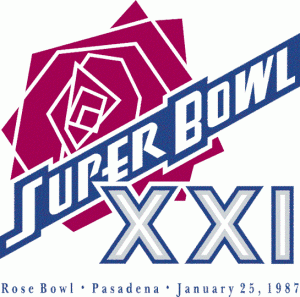
Super Bowl XXI: A very different approach from the last few, this goes for an even more retro look, while still achieving a new milestone for the future. This is the first Super Bowl logo that actively tries to represent its home stadium with the rose motif, which is very abstract and avant-garde. It’s also very asymmetrical, and I could do without the “Super Bowl” font. It barely even looks like a logo; it’s like they tried desperately to get all the elements they wanted to fit. There is a time and place for the diagonal phrase, but this wasn’t it. Grade: C-.

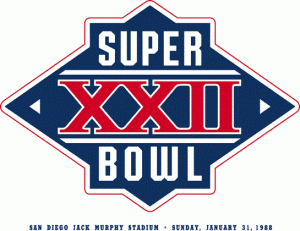
Super Bowl XXII: This one goes back to the same approach used for recent Super Bowls, to very good effect. It’s nice and simple, the “Super Bowl” font is retro but in a way that befits the toughness of the game, and unlike those earlier games, the Roman numeral isn’t fat and distracting. This is one logo that really makes the game look important, and I wouldn’t be surprised if this was the model for many of the 90s logos. Grade: A-.

Super Bowl XXIII: Is this a real game, or a video game? With the generic triangles, generic and blocky Roman numerals, and blocky, vaguely pixelated, asymetric “Super Bowl” (most apparent close up), I wouldn’t be surprised if this was made for the Atari 2600 (or at least the original NES). What’s up with the white poofy collar? Why are the triangles placed where they are relative to the Roman numeral? Why is “Super Bowl” so small, are they trying to hide that this is a recycled video game logo? Can I use Bo Jackson to pwn people’s asses in this game? Grade: C.

Super Bowl XXIV: Now they decided to really get modern, and instead of focusing on strict geometrical shapes, have an impossible banner wrapping around the Roman numeral at an angle. The banner kind of makes it seem like a party, but I can’t keep my eyes off the Roman numeral. It’s so blocky (especially viewed close up where you can see the interior gray lines), and vaguely reminicent of the horrible Super Bowl V logo, that it seems an odd fit with the informal “Super Bowl”. Points for effort, but it’s still an awkward logo. Grade: C+.

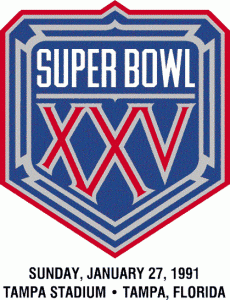
Super Bowl XXV: A return to the geometrical shapes. This logo re-uses many of the best elements of the Super Bowl XXII logo, and puts it in a vaguely pentagonal shape. The “Super Bowl” doesn’t wrap around the Roman numeral, which helps with readability, and the motif all around it helps it look like a real logo. It almost looks like a police badge or a shield. Once again, a simple logo that gets the job done. Grade: A.

Next time: Logos that looks like the recent logos!

Rating the Super Bowl Logos: Part IV

Previously in this series: Part I | II | III

Super Bowl XVI: Similar logo to the last one, but now it’s gold-embossed and in a fat font with sharp edges. They really tried to make this one look special. And yet… something seems off. Maybe it’s how 80s it all is. Maybe it’s the trapezoidal serifs on the Roman numerals. Maybe it’s something off-putting about the embossed look, like it kind of looks like it’s a logo for Publisher’s Clearing House giveaways. Maybe it’s how it manages to be complex and simple at the same time. But somehow, this seems like a step down. Grade: C+.

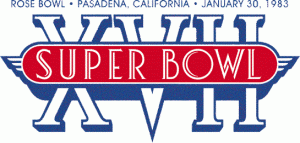
Super Bowl XVII: I guess if Pasadena isn’t known for making cars, it’s known for driving them, because this is the second straight logo for a Super Bowl at the Rose Bowl that looks like the front grille of a car, and the comparisons are even more obvious. “Haven’t you heard? The Super Bowl XVII is so much better than the Super Bowl XIV!” This is another candidate for “first modern Super Bowl logo” with the long rounded rectangle containing the words “Super Bowl”. I’m not necessarily feeling this one either; it hasn’t aged well. The long bottom of the “V” is the main thing putting me off, but there’s also how fancy they tried to make the words “Super Bowl”, which can make it hard to read, and the general perplexity of making the Super Bowl look like a car brand. I’m actually vacillating between whether this is a good logo or a bad one, but I’m kind of leaning bad. Grade: C.

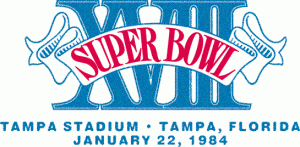
Super Bowl XVIII: Simple yet effective, with the “Super Bowl” banner curving impossibly against perfectly serviceable Roman numerals… and yet the font of the words “Super Bowl” kills it instantly. Just look at how wild those letters are and how they manage to make the whole logo cheezy. Although looking at it in long shot, the way the letters of the Roman numeral are crammed together doesn’t help. Grade: C+.

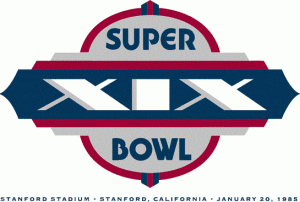
Super Bowl XIX: This is the opposite of the Super Bowl XVIII logo: the “Super Bowl” that flanks the Roman numeral is perfectly servicable, if in a funky 80s font, and the whole pseudo-circle motif really makes this feel like a big football game, but my god, that fat Roman numeral! It’s not as hard to read as you might think, but it’s still an ugly 80s number. Grade: C.

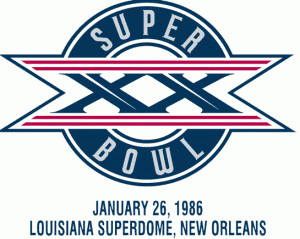
Super Bowl XX: Well, points for looking like the Broadway Video logo. And the Roman numeral, while still fat, isn’t quite as distracting as on the last logo and tries to fit in better. It’s still very 80s, but its simplicity manages to save it from being completely irredeemably cheezy, and instead gives it a certain retro charm. It actually looks like a logo from the 60s or 70s if it weren’t for the fact the Super Bowl didn’t have that kind of logo in that era. Grade: B.