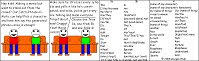
For some of the more overzealous forum members, re: 614: Celia may be ridiculously, stupidly naive, but that doesn’t translate into being dead meat. Just ask Elan.

(From The Order of the Stick. Click for full-sized minty-fresh breath.)

So my time this week has been monopolized by various other things, such as the whole college-football-tournament thing, and the webcomic post has been pushed to Thursday as a result, and this is what happens when I don’t have much time to write it: I fall back on OOTS and produce something fairly hastily thrown together. And still take much longer to write it than my schedule should by all rights allow.

So what the hell is going on with Belkar? I touched on this once before, but as just about every single thing Belkar does is being viewed in light of Shojo’s challenge to him, I think it’s important to establish a baseline for what that actually means.

So far, though more so in his first couple of strips back in action, not much seems to have actually changed in Belkar’s behavior, which has only stoked the speculation on what he will do differently, and how that’ll affect his much-prophesied death, and what it means for when that’ll happen. The general consensus, so far as I have observed on the forums (and as over-interpreted by me), seems to be that Belkar is going to toe the line and, outwardly, do everything Haley and later Roy asks of him, effectively turning into the ultimate team player, more committed to the main quest than anyone, appearing to have seen the light and turned good, trying to play the Great Hero, while only occasionally “cheating” somehow, out of sight of anyone else. And in an addendum that’s growing in popularity, actually becoming good in the process.

The most succinct interpretation of the matter I could find on short notice probably came from Robert A. Howard of Tangents:

One of the greatest flaws of Belkar’s character was that he has been a two-trick pony for the longest time. He was a violent comedic foil who had no social graces, no interest in blending in, and whose solution for everything was “stick a knife in it until it’s dead.” And it was getting old and boring. What’s worse, it was hurting the rest of the comic as well. The rest of the cast have undergone character growth and have had some truly intriguing stories behind them. Belkar? Outside of killing things, he was useless. The visitation of Lord Shojo (whether it was Shojo’s spirit, a manifestation of the curse Belkar was under, or even just a hallucination) ended up providing Belkar with a chance (and a reason) to grow, while staying fundamentally who and what he is.
Thus Belkar is going to pretend to have character growth. Yet I must wonder… in pretending, and while playing the same game everyone else is, some of that faked character growth may actually rub off. In the meanwhile, watching Belkar slaughter his way through a horde of low-level thieves, leaving the one girl alive after kissing her breathless, has actually become amusing again. What’s more, he may actually get to play the part of hero once again, and enjoy himself immensely while doing so. And while he is fated to die (according to the Oracle, whose death activated Belkar’s Mark of Justice to begin with), I can’t help but wonder if maybe he’ll gain a measure of redemption in the process… or at the very least enter into the Abyss ready to kick butt and chew bubblegum.
There is a bit of a problem with this interpretation, at least judging what it is by the first paragraph: it’s not necessarily new to Belkar. But in large measure it’s pretty much what I’ve seen presented elsewhere: Belkar making a show of being the hero, while still being his old self if he can get away with it, whatever that means.

Okay. What was Shojo actually saying when he made his challenge to Belkar?

For starters, he invites Belkar to play

The Game, the big one. The one that each of us plays every day when we get out of bed, put on our face, and go out into the world. Some of us play to get ahead, some of us just want to get through the day without breaking character. It’s called “Civilization”. No, wait, there’s already a game called that… OK, it’s called “Society”. Your problem is that you don’t want to play the game at all, you want to sit on the couch and eat Cheetos while everyone else is playing.
Belkar snaps back, “Well, why shouldn’t I? What’s the point of their Society, anyway? It never did anything for me.” Shojo’s response is that if he keeps mocking them and ignoring them, they’ll kill him.

To this point, it seems that Shojo’s point might be bigger than whether or not Belkar should be a “hero”, but whether he should simply live a life bigger than just stabbing everyone at every opportunity. Consider Belkar’s life immediately preceding being struck by the Mark of Justice: skipping out on the entire explanation of the Gates because he’d killed a guard and fled, leading Miko on a wild goose chase and slowly driving her more and more insane with fury, pretty much trying to get her to kill him out of blind fury for kicks. Belkar doesn’t even care about staying alive as long as he believes he can be quickly resurrected. The only reason he doesn’t simply kill the rest of the group is so he has people to back him up if he ever gets in deep, to be led to people to kill, because if he kills one the rest will turn on him, and as an audience to his deeds. (As I’ve said many times in the past, I have neither prequel book, but according to Wikipedia, the main reason he joined the Order in the first place is a variant of the first reason.) The purpose behind the quest doesn’t matter so much as “Those people? Bad. Take care of them.”

For further insight, look no further than strip #58, when Vaarsuvius gives Belkar Owl’s Wisdom so he can give Elan a couple last-minute healing spells. Before V dismisses the Owl’s Wisdom, Belkar briefly seems to undergo some actual character growth: “I’ve wasted my life on anger and needless rage, when I could have been healing. My eyes are finally open. From this day forward, I’m never hurting a living creature ever again.” (That last sentence would prove oddly prophetic…) With this piece of evidence, we can place a name to Belkar’s life through the Mark of Justice experience: “anger and needless rage”. He’s spent too much time consumed with both to realize his true potential, whether that involves “hurting…living creature[s]” or not.

Interestingly, that Miko chase I mentioned? Might be a perfect metaphor for what Shojo was talking about. Belkar cared only about his own fun, and missed something far more interesting and important in the process. As many people have suggested, this whole episode may cast into a new light why Shojo afflicted Belkar with the Mark of Justice in the first place.

Belkar interprets “playing the game” as “show[ing] up and play[ing] by everyone else’s stupid rules”, and Shojo replies, “Of course not, my wooly friend [Belkar at this point has metaphorically turned into a sheep]. You can cheat.”

Nudge die rolls, palm cards, “forget” penalties… but you have to sit down to play first. As long as the people at the table see a fellow player across from them, they’ll tolerate you. A crooked player is a pain in the ass, but someone who refuses to play at all makes them start questioning their own lives – and people HATE to think. They’d rather lose to a cheater than dwell too long on why they’re playing in the first place.
The apparent implication of this speech is that it doesn’t even matter if the other players know Belkar is cheating, so long as he plays at all. It’s entirely possible that Belkar could continue to be the same stabby, backstabbing jerk he’s always been, so long as he gives a rat’s ass about what everyone else is doing, and doesn’t display a willful ignorance of the rules. But Belkar doesn’t seem to interpret it this way: “So, you’re saying that if I can trick all the other mindless drones into believing that I subscribe to their arbitrary moral framework, they’ll just leave me alone?” Shojo doesn’t correct him: “They all assumed I followed the Paladin’s Code, didn’t they?” That calls back to Shojo’s addendum to the “you can cheat” comment: “Twelve Gods know that I always did.”

Now, let’s refresh your memory as to the nature of Shojo’s deception. We first encountered him as a senile old fool who took advice from his cat. There was some evidence he wasn’t what he appeared, but only a speechless Haley seemed to catch on. As Shojo explains to Roy, he puts on an act of senility in order to shirk any public responsibility for his edicts, which might result in certain upset parties putting an end to his life. Shojo also explains that he is “the commander of the paladins of the Sapphire Guard by virtue of my inheritance, not merit. In other words, I command the paladins. I have never claimed to be one. … Technically, I’m a 14th level aristocrat. Heck, I’m not even Lawful!”

Shojo explains that he hides his true nature from the paladins to get away with acts he feels might be the right course of action but which technically violate the code the actual paladins swear to uphold – taking the Gates as an example. Shojo felt that with two gates down, there was a clear and present danger to the others, but none of the paladins would be willing or able to investigate or reinforce them without violating an oath of non-interference in the other gates, so he created a complex scheme to bring in the OOTS and have them do his dirty work instead, including misleading Miko as to the true purpose of the arrest and putting on a show trial with a largely predetermined outcome issued by Roy’s own disguised father’s ghost.

(Incidentially, this is why Roy is pretty much blameless for not leaving open the possibility that Xykon might strike against Azure City when consulting with the Oracle: that’s not why he was hired. Re-read #290: Shojo did not even technically hire the Order to reinforce either of the other two gates, only to report on their status so Shojo would have an excuse to, presumably, send the Sapphire Guard to do the reinforcing.)

For two or three reasons, this isn’t completely applicable to Belkar’s situation. Belkar’s evil, his only “responsibility” is to the OOTS, and he’s far from in a position to make any decisions, or manipulate anyone. He barely even has any “true” motivations to work towards while technically still following the Order’s “arbitrary moral framework”. Even if viewed from the lens of his desire to kill as many bodies as possible, it’s not necessarily in line with the Order’s goals. The point is that Shojo wasn’t pretending to have the good of Azure City, or even the universe, at heart. If anything, Shojo had the exact same goal as the paladins – but he still felt the need to be deceptive in the way he achieved that goal.
The Order of the Stick has a place for non-Good members. Haley has described herself as “Chaotic Good-ish“, and even before going insane Vaarsuvius had a decidedly Neutral streak. For that matter, there’s nothing preventing Belkar from achieving anything just from being Chaotic Evil at all – Xykon is Chaotic Evil, and he has his sights set on nothing less than world domination, yet oddly, the old Belkar probably would not get along well with him, as he wouldn’t care so much about the mission as about the next target to kill.

Shojo’s not saying Belkar needs to stop being evil, even outwardly. Really, nothing about the conversation says Belkar needs to stop acting outwardly evil; only the circumstances would determine that at any time. I think there are two more appropriate interpretations, and both feed into each other, and which is more correct depends more on where Belkar is than on what Shojo says.

The first of which is that Shojo wants Belkar to act more Lawful. Shojo was a Chaotic passing off as at least a reluctant Lawful, and it’s a Chaotic alignment that Shojo and Belkar have in common – rather important when Shojo starts the conversation by saying “We’re rather alike, you know.”

The second interpretation is that Belkar needs to stop acting like he’s above the alignment system entirely, and start acting Chaotic Evil.

There is a difference, although the TV Tropes description may be more helpful in illuminating it than anything in any “official” source (which may suggest it’s a wild misinterpretation):

Chaotic Evil characters might intentionally help the heroes save the world by doing terribly evil things. … Chaotic Evil characters are incredibly self-centered and evil, but can get along with good guys by being eerily charming at times. They are often crazy, but they don’t have to be. Only Chaotic Stupid characters will trek 500 miles to slaughter a random village for no reason. Chaotic Evil’s goals may well make no sense to anybody but himself, but he does have goals. He may “want to watch the world burn”, or prove that he’s the best, or the most feared, or get the most attention.
If Belkar were to strictly emulate Shojo’s example, he’d attempt to hide anything he did that might be seen as flouting the normal rules of society, evil or not, but otherwise do anything he wished openly as long as that still consisted following the rules. That doesn’t mean giving the impression of good – D&D 3rd edition does have the “Lawful Evil” alignment – just so long as he at least appears to fit in with his surroundings. But the second interpretation may be more interesting, and at least as backed-up by Shojo’s words. Belkar, in this interpretation, is entirely within his rights to do exactly what he has been doing, but only as long as he at least makes an effort to get along with the rest of the Order of the Stick, and pay some effing attention to everything else that’s going on.

Of course, Belkar’s own interpretation practically matters at least as much or more as Shojo’s outward intent. But early indications are that, while he is turning into more of a team player on the outside, he hasn’t exactly abandoned his old ways entirely, and if anything, has only refined them. So what can we expect from Belkar in the future? A Belkar with a little more refined palate than Vaarsuvius’ “hate/lust” distinction, one who knows who his friends are and who his enemies are, one who appears to be a little more controllable in his dealings with the rest of the OOTS, but who’s still quick to slit the throat of any captured enemy and may even be more dangerous, in a certain sick, twisted way, than ever before.

(Hmm. Maybe I should take Shojo’s advice and do something with my life rather than post OOTS exegeses every month.)
On April 4, 1748, the French were embarking in the last major offensive in the War of the Austrian Succession, and someone wanted to run a human through the then-new field of taxidermy.

(From mezzacotta. Click for full-sized complex games. IE users will need to get something to allow them to see SVG files.)

On October 10, 2008, the long-running, once-delayed-but-twice-changed, countdown running at mezzacotta.net finally reached its conclusion, unveiling the latest project from the circle of friends known as the Comic Irregulars (named for Irregular Webcomic! and best known for Darths and Droids).

The centerpiece of the site was a webcomic. One requiring SVG support in order to be able to see it. One with archives going back before the site’s launch… indeed before the advent of the Internet… indeed extending into the BC era… indeed before the estimated age of the entire universe. Obviously such a comic would need to be automatically generated in order to have archives dating back that far, and indeed most of the characters and lines seem to fit a cookie-cutter pattern, from identified sources ranging from the Dungeons and Dragons manual to Irregular Webcomic! In fact, there are certain patterns with certain “characters” that has led to the creation of a cast page.

(The only thing missing? Lines from other webcomics not affiliated with David Morgan-Mar. I know he’s done at least three xkcd pseudo-parody strips, I’d like to see the characters spout some lines from that – that’d be really surreal. Dinosaur Comics would add an… interesting vibe to say the least, and might fit best of any other webcomic. Order of the Stick would make the whole thing even more surreal yet paradoxically give the D&D manual quoter someone to talk to. Really crappy idea, but it kinda fits, for reasons I get into below.)

But how? The strip “for” the most famous date of this millenium (and a few others) call it a “randomly generated comic“, which would seem to suggest each strip in the “archive” is only generated when someone visits that date. Since each date generates the same strip each time, that would in turn seem to suggest the mechanism in place then saves that comic to that date for any future visitors. 24 hours after the site’s launch, David Morgan-Mar (the group’s apparent leader and proprietor of IWC) seemed to back up that theory by proclaiming mezzacotta the new comic with the most strips (supplanting Sluggy Freelance) on the basis of how many strips had been viewed in the archive, a statistic that would be most relevant under such a model.

But why use a two-part mechanism for that purpose? Why set yourself up for future potential space strain down the road by even having the endless archive in the first place? How do we know this “evidence” isn’t a misdirection, and the comics are actually generated based on some formula from the date, one complex enough it might seem random? With the evidence seemingly this obvious, why are Morgan-Mar and the other Comic Irregulars still putting on a show about being tight-lipped about all the workings?

With the method of comic generation, the vast majority of the comics are bound to be incomprehensible crap, but that comes with the territory; a comic rating system allows more comprehensible and even funny comics to rise to the top and get viewed more. But mezzacotta the webcomic – which derives its name from some form of the Italian for “half-baked” (good luck reverse-engineering that result from an automatic translator though) – is just one example of a, well, half-baked idea to come out of mezzacotta the site. As Morgan-Mar described it on the first day:

I lamented that the problem with our furious generation of ideas and our attempts to implement them was that we kept needing to register new domains for sites that might turn out good, but are in fact more likely to turn out truly half-baked and never do much. What we needed was a single site which could be a central repository of half-baked ideas that we sort of half-implement, to see if they’re any good.

mezzacotta is that site. […]

So, the initial idea was half-baked. The countdown timer was half-baked. … The webcomic is half-baked. Everything about this site is half-baked. That’s what mezzacotta is.

Welcome to our central repository for half-baked web implementations of half-baked ideas. Most of the stuff on this site won’t be great. But by just throwing it all out there and daring to be stupid, you’ll get to discover the rare gems that we might generate and not immediately recognise ourselves.

Coming up with ideas is easy – anyone can do that. Actually doing something about them is the hard part. Anyone who’s done it knows how much sweat you have to put in to get an idea beyond the “hey, wouldn’t it be cool if…?” stage. This is our place for doing the hard work. It’s a spur to drive us to do something with some of those crazy half-baked ideas we get. And hopefully we’ll entertain a few of you, rather than just ourselves.

It’s impossible to say anything about the above without in some way rephrasing it. Beyond being a single… experiment, for lack of a better word, mezzacotta is a place for throwing ideas on the wall and seeing what sticks, some of which amounts to little more than that, some of which results in some actual implementations. That includes even a couple other webcomics.

Lightning Made of Owls, inspired by a completely random phrase posted on the mezzacotta blog, is essentially a redo of a pre-mezzacotta concept, Infinity on 30 Credits a Day, both of which are attempts at collaboratively-written-and-drawn comics. Because ∞ on 30Cr a Day has an ongoing story, it’s gotten bogged down in administrative tasks and competition for the “best” strips. LMoO was conceived from the start as a gag-a-day comic with six characters that are very rough sketches, with comics to be sent in completed, not as scripts for artists to work on. Needless to say, the result is somewhat… disjointed, and there’s very little to unite the various appearances of the characters into coherent, well, characters.

More interesting – and potentially making its way into my RSS reader – is Square Root of Minus Garfield, inspired by Garfield Minus Garfield and other mashups of the Garfield comics. Let me say upfront that I don’t really get the hatred many have for Garfield. I find it entertaining enough, and in fact it’s one of only four newspaper comics I have really taken an interest in getting the book collections for and following in any way. In recent years (by which I mean the most recent years to be released in the book collections) it’s felt like it’s been running out of ideas, and the seeming disappearance of such characters as Arlene, Pooky, and to a lesser extent Nermal seems ill-timed and exascerbating to the ongoing decline, but the early years, through the mid-to-late 90s at least, were funny enough comics to hold me captivated. (But then, I read Ctrl+Alt+Del.) I hear (again, I only keep up with the book collections) that in recent years Jim Davis has resorted to advancing the Jon-Liz relationship beyond the unrequited and hopeless puppy love it had been for, what, two decades? That just smacks of desperation to me.

Secondly, as popular as G-G has become (to the extent of actually inspiring an officially sanctioned book), I actually find the mashups that remove Garfield’s dialogue, not Garfield himself, to be more appealing. G-G essentially says, “Wouldn’t it be cool if we took these Garfield strips and get rid of the title character? See how crazy Jon looks!” Only stripping the dialogue, on the other hand, has a more appealing hook as – assuming Garfield isn’t actually speaking despite the thought balloon and isn’t communicating through telepathy – it depicts how things actually happen from the perspective of the human characters. It really drives home the idea that Jon is crazy when it actually reflects something actually happening in-universe.

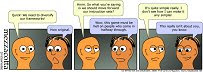
(Incidentially, take a look at the strip to the right, from page 3 of the original T&BB thread. It attracted such comments as “I can’t even imagine it with Garfield saying something” and even “This is one of those weird ones, where you know Jon isn’t actually supposed to hear Garfield, but clearly this is in response to something Garfield said. Huh.” Certainly that’s a common enough feature that it’s sometimes confusing whether or not Jon is or isn’t supposed to “hear” Garfield’s thoughts. Replying to the latter comment, one poster psychoanalyzed the resulting mashup:

I like it because it’s as though Jon takes a moment to consider what he said, mentally kick himself and then project that hatred onto his cat. It’s a neat little psychological study that I quite like. I’m not entirely sure that Jim Davis didn’t plan this all along and that we’re merely forging the next step of his global empire.

The kicker? The original comic – posted at left because the Garfield web site doesn’t seem to have a way to permalink to old comics, which is kind of ironic and stupid when you think about it because it forces people like me to “pirate” the strip, and forces √-G to link to the individual comic images, neither of which allows Garfield to benefit from its web advertising – doesn’t actually have Garfield saying anything in the second panel. In fact, all he says in the strip is “I didn’t say anything”. Jon’s remark actually was in response to nothing in particular, and much of his neuroses in the “modified” strip actually were intended, rather obviously, by Davis all along – or don’t exist even in the “modified” strip. Does this say more about Garfield (and if so, is it positive or negative), or about the people who like to bash it?)

Anyway, √-G is essentially a different mashup of a different comic each time it comes out. Some of them so far are really little more than changing the dialogue or the pictures in a slightly surreal way, and one really only shines a light on an old series of strips with two identical panels. But it’s somewhat fascinating nonetheless for anyone who’s been interested in Garfield mashups. And… I don’t know why I wasted time with other Garfield related stuff.

But I do have to sympathize with the Comic Irregulars’ plight. I too have way too many ideas than I would ever be able to work on. The web site is, in many ways, my own version of mezzacotta, a repository for all my many and varied ideas, be they the 100 Greatest Movies Project (still on indefinite hold), my street sign gallery, Sandsday, the football lineal titles, or my college football rankings. And then there are the projects I host right here on Da Blog. There are some ideas that, for some reason or another, I just can’t implement, at least alone. Here’s a brief start on getting started on a list of ideas I may not be able to implement myself, but that I’d like to see fruition in some way, shape, or form:

  • Election results based on my projection formulae. Would require a source of results and a group of people willing and able to call races based not on their own biases, not on unreliable exit polls, not on past performance, but on nothing but the results themselves.
  • Truth Court: Sorting out fact from fiction in politics based on hard evidence, and always open to new evidence or a new interpretation of old evidence. Like Mythbusters or Snopes, but more focused on questions like “Do people cause global warming?” and “Was the 2000/2004 election stolen?” and “Do gun control laws help or hurt violent crime?” and “Was 9/11 an inside job?” and “Does supply-side economics really work?” and “Who’s really to blame for economic and/or foreign turmoil, the current president or the preceding one?” and…
  • Similarly, a (bi/nonpartisan) web site dedicated to “keeping the media in check – and the blogs that watch them”.
  • The 100 Greatest Movies Project, currently on hold indefinitely on my end unless and until my old USB drive’s stuff comes back. Even if I have to shut it down, I’d like to see someone else take it over and do it justice; even if it does come back, I know for a fact I need a third person to do write-ups (I have two at the moment, including me). More here.

That’s just the ones for which I’ve solicited comment at mwmailsea at yahoo dot com (except the third). I have a bunch more ideas bouncing around in my head, some of which I just haven’t mentioned, some of which I’d still like to try to do myself, some of which I don’t feel I can reveal yet. I’m a veritable font of ideas in a wide variety of topics. I can only hope that I can bring as many as I can out into the open for you to peruse… and that they don’t turn out half baked.

The obvious solution: “We never tell the truth” is a lie. They tell the truth sometimes. They just slip once in a while.

(From Irregular Webcomic! Click for full-sized thought-provoking greeting.)

So I probably shouldn’t be posting another webcomic post so soon and bury my CAD one. I don’t think anyone has even stopped by Da Blog since I posted the CAD post, which means it’ll have been the most recent post for absolutely nobody.

But I did want to mention that this is the first time we have actually seen the Paradox Department, existence first hinted at in strip 671, on the heels of Death of Being Wrestled to Death By Steve being… wrestled to death by Steve, role increasing as the ongoing “IWC crisis” has built.

Now, I’m not suggesting, contrary to what I indicated in Tuesday’s post, that this indicates David Morgan-Mar had this storyline in mind as far back as… exactly four years ago, actually. Well, his planning of this storyline would have to be an extreme coincidence not to have had that date in mind. But anyway, it’s not out of the question that he would have this storyline in mind that far back: anyone looking at a theme that screams “long-term planning” need only look to the Death theme. Every shake-up of the Deaths has been made with the theme’s next appearance in mind.

And… that’s it. As the timestamp on this post indicates, it’s wa-a-a-a-a-a-ay too late at night here on the West Coast and I’ve been fighting off a headache most of the night, and this isn’t even that momentous a moment, but I felt moved to comment anyway…

I can post CAD-related posts at least once a month without even trying. Take that, OOTS!

(From Ctrl+Alt+Del. Click for full-sized introductory collage.)
Ah yes. Another one of these. Is it just me, or could I care less after the last one of these and certainly after the madness we just went through?

I know Tim probably wants to bring us through a comedown after the exhausting spell he put us through for most of the time from September through November, if not longer, but color me less than fully interested. I suspect I’ll read the first couple, and if nothing happens to get me more fully interested I’ll probably just drop out until the strip titles betray that it’s over.

I was interested in this considering the first time involved a “choose your own adventure” aspect, and while it involved sending in votes via e-mail, the prospect of repeating that did get me interested enough to see what was happening with the forums. Sure enough, there is once again a forum for the actual webcomic, after getting taken down in the aftermath of the miscarriage storyline.

Also, what should we read into the fact we’ve had two of these in a year, especially coinciding with the direction the comic has taken? Is this Tim’s way of saying “let’s have some wacky fun like in the good old days!”? Is this the only wacky fun we can expect from now on?

And for all my preaching about the Angst-O-Meter, there’s still a part of me that’s waiting with baited breath to see what’s next for the “regular” versions of Ethan, Lilah, and the rest. We might be able to see the cast again just in time for Christmas, but I still have a bit of a bitter taste in my mouth from how Buckley left us hanging after all the crap he put the characters through – his last strip in that sequence left Ethan in charge of the store, which seems to demand us finding out how he deals with such a circumstance. Not to mention the whole elopement thing…

It seems more than a little disrespectful to completely shake up the status quo, perhaps more than has ever happened in the history of CAD, in a couple of strips, and then wait until the Christmas season to even come close to showing the consequences. Buckley’s way of celebrating Christmas has, in the past, pretty much consisted of interrupting whatever storyline he already had planned to post a perfunctory acknowledgement of the season, but it seems like an odd time to end a month-long period of limbo amongst CAD fans, where we don’t even know what the status quo is anymore. Which may be part of the point.

Regardless, the main purpose of this post was to show you this, which I found Tuesday at my school’s main cafeteria:

Either there are a few CAD fans at my school, or Ethan’s little invented holiday has had more real-world legs than I might have otherwise suspected…

For added effect, have “Stone Cold” Steve Austin’s entrance music, or something similarly badass, playing as you read.

(From The Order of the Stick. Click for full-sized sexy shoeless god of war.)

Yes, it’s a second webcomic post this week! I’ve got another planned for tomorrow as well, so you get three webcomic posts for the price of one this week! Consider it your little Thanksgiving “second and third helpings”. And no, this isn’t just because Robert A. “Tangents” Howard felt moved to comment on this strip.

I’m afraid I’ve been remiss in not commenting on the previous strip, a strip so epic and pivotal at least one person on the forums suggested it was originally intended to be #600 but Burlew couldn’t condense the story enough.

Perhaps it’s somewhat fitting that last week I aired the complaints of many an OOTS fan that has complained about the story lagging, because all evidence is we may be looking at the light at the end of the tunnel. (Incidentially, I never intended for that post to turn into an OOTS complaint, or even a place where I defended OGTS sufferers, it just ended up that way.)

Of course the Haley/Celia/Belkar half of the OOTS has been approaching their own goal for some time, dating back to the end of our last stint with them. But when we returned to them, things were going… badly. No sooner did the long-awaited cleric show up than their benefactor promptly sold them all out to the Thieves’ Guild. Haley started the cleric on contacting Durkon and then took off to… well… attempt to hold off her former friends.

So we finally got the battle OOTS fans had been waiting for since the end of the last stint with the Haley-Celia-Belkar group: Haley v. Crystal. Which turns out to be rather disappointing, with Crystal having the intelligence of a, well, pickle and all, but still ends with Haley bowless and down for the count. And Celia powerless to stop her.

This stint with this half has really been about Belkar. Belkar was visited in his sleep by the long-dead Lord Shojo, the one character so far Belkar ever came close to identifying with. It’s a standard “vision”/”message from beyond the grave” sequence, but one with a rather unusual moral: “I need to pretend to have character growth!” Shojo’s advice essentially amounts to becoming sneakier, less overtly evil, and staying in line with what others expect of him outwardly, but fiddling around with the rules when it suits him.

It’s a word of advice that has been debated quite a bit on the forums, with fans looking to plumb its meaning, or if it’s really any different from what Belkar was like before, certainly before Roy died when there were still people who insisted that no, Belkar really wasn’t that evil after all. Quite a number of people, including Howard, have wondered if faked character growth will lead to actual character growth. But the general consensus interpretation is that Shojo has effectively been saying that Belkar needs to act Good in order to get ahead. But I can’t help but wonder if what’s really going to happen is that – despite Shojo’s own Chaotic nature – Belkar is going to look more Lawful than strictly Good – playing by the rules when it suits him, avoiding getting caught, but otherwise still participating with those around him only because they happen to be the ones around him. We’ve yet to see it put into practice, but with Belkar likely coming to Haley’s rescue in #612, we’re probably about to.

The reason I was remiss not to comment on #610 when it came out has less to do with its epic, recap nature, and more with what actually happens in it, the scope of which I only recently realized. In a move apparently intended to appeal to the legions of Belkar fans on the forums, Shojo’s last comments to Belkar challenge him to figure out who he is, as more than a bunch of numbers and letters on a character sheet. Belkar ultimately responds by calling back to one of the Belkar fans’ all-time favorite strips, one which established a lasting nickname for Belkar likely to last straight to the end of the strip, perhaps even more so now – just in time for the cleric to hear, just in time for most of the Thieves’ Guild to start banging down the door, just in time for the cleric to take the Mark of Justice off.

To put that moment in perspective, we were first introduced to the Mark of Justice all the way back in strip 295. More than half the strip’s existence has been spent with Belkar under the weight of the Mark of Justice, unable to kill anyone or stray too far from Roy’s body. #610 is, in more ways than one, an analog to strip 393, which in almost as dramatic fashion granted Haley her voice back, but for Haley’s voiceless stint to have lasted as long on a fractional basis to that point it would have needed to start in the late 100s, and for it to have lasted as many strips it would need to have started with strip 78, the actual version of which was during the original Linear Guild story arc (admittedly after the Guild was gone and the last loose end was Durkon’s return to the group)!

Much of that time was spent with the Mark as a subplot and an inconvenience that, most prominently, reduced Belkar’s role during the Battle of Azure City, apart from the aforementioned all-time favorite strip above. Its role has increased in the current book, arguably starting with just how bloodthirsty Belkar became upon leaving Azure City, and kicking into high gear once it was actually activated.

If I have a quibble with how Rich handled this whole thing, it’s that the dream sequence doesn’t feel like much of a climax to one of the longest-running subplots in the history of the strip. Shojo’s message seems almost to stand alone, if not even a deus ex machina, disconnected from anything Belkar might have learned from being under the Mark’s control. Belkar’s last few appearances with an inactive Mark show he’s arguably regressed, and he can’t learn anything from its actual activation because it occured in the memory-charmed Sunken Valley. Even the lesson Belkar does learn is effectively how not to learn a lesson at all, and – pending seeing exactly how it manifests – it doesn’t seem to follow from anything Belkar’s experienced in “real” life either.

Nonetheless, it’s out of the way and Belkar’s on the prowl, causing even people who were among the loudest “yes, he’s very much Chaotic Evil” backers to cheer him on as he… well… let’s just say turns into Chuck Norris in the strip above. Even the previously scared-to-death cleric seems to gain a new level of confidence just from being in the presence of the Belkinator. Not only does he cut through no fewer than ten Guild members, he woos an eleventh and downs a tub of beer (I don’t care what it’s supposed to be, I’m saying it’s beer) like any big-name Hollywood action hero. Rich might even want to be careful about Mary Sue-ization! I can’t help but wonder if part of the cheering for Belkar has come out of a sense that at long last, after upwards of a hundred strips of angst, it’s now fun to read Order of the Stick again – and the slow update schedule until recently hasn’t really hurt.

It’s too bad Belkar’s eventual death has been all but shouted more than a few times over the course of the past couple hundred strips…

(P.S. After my suggesting several times that Vaarsuvius may have de facto kicked Durkon and Elan out of the Order of the Stick, it now occurs to me that perhaps just the opposite has happened, and V in fact kicked him/herself out with Durkon and Elan potentially about to rejoin Haley and Belkar. Which might suggest he/she may be slowly becoming a villain, and also seems to jibe with previous statements indicating V was a last-minute addition to the cast, possibly returning Rich to something closer to his original plans…)

Nazi science sneers at my idea of sixteen comics for the price of one!

(From Irregular Webcomic! Click for full-sized Nazi grammar.)

Irregular Webcomic! has lured me back to reading it on a regular basis, and indeed has made it all the way to my RSS reader for the first time.

For this development you can thank – or blame, depending on your point of view – the fact that David Morgan-Mar has started tying his themes into a compelling, coherent story, a sort of “Crisis on Infinite Themes”, with a minimum of actual crossovers. To some extent, it begins with strip 2045, when Steve (of the “Steve and Terry” theme) discovers that the Loch Ness Monster has been the Lovecraftian horror Cthulhu all along, with another strand beginning five strips later, when the Mythbusters decide to take on the idea of time travel. (Although it could be backdated to 2033, when a future Hermione travels back in time to warn “present” Hermione of some dastardly future events in the Harry Potter fanfic of the Shakespeare theme’s eponymous Will. But that doesn’t have anything to do with what’s going on now… as far as we know.)

I swear all of that makes sense if you’re familiar with Irregular Webcomic!

All that was at the very start of September, so I can’t help but wonder if I myself had a hand in it when I suggested back in June that Irregular Webcomic was in fact a fitting title if it was seen as multiple webcomics, one for each theme, themselves updated irregularly. Did Morgan-Mar start subsequently thinking about tying his themes closer together as a result?

No wait, of course not. Because the groundwork for this story has been slowly laid over the course of well over a year.

It goes all the way back to August 20, 2007, when Morgan-Mar announced that “a major…character” would be killed off “before the end of the year. No ghosts. No witty banter with the Head Death before returning. Dead.” No wait, it goes back even further: strip 1610, dated June 24, 2007 (a full year before my observation, let alone the start of this mess), where the imprisoned Serron and Iki Piki (of the Space theme) find themselves joined by… future versions of themselves. Those “doubles” of Serron and Iki Piki are still around, trying to prevent catastrophic changes to the timeline.

In a nutshell, the character slated for death turned out to be Morgan-Mar himself, or at least his “me” character. After a lengthy sequence of bargaining with the Head Death, Morgan-Mar gets taken away by “Death of Inhaling Hatmaking Chemicals”, upon which we finally learn the culprit for his murder: Morgan-Mar himself again. We also learn that, apparently because he is the first person to be killed by a time-travelling version of himself, he is now “Death of Going Back in Time and Murdering Yourself”, and is charged with, well, going back in time and murdering himself. The last strip in this conversation ends ominously:

1 Me: What if I refuse to kill myself in the past?
2 Death of Inhaling Hatmaking Chemicals: CHOO’D CAUSE A PARADOX, SEEINGS WOT CHOO’VE ALREADY DONE IT.
3 Death of Inhaling Hatmaking Chemicals: AND THE HEAD DEFF DON’T LIKE PARADOXES.
4 Me: Oh… doesn’t he now…?

Neither the Death or Me themes show up again for almost a hundred strips, but sure enough, by the 2050s the strip gets afflicted by… strange… things, notably a time-travel theme. In strip 2055 the Fantasy crew, having been sent through a teleport gate from Footcrag to Cragfoot, find out that they’ve also gone back in time two weeks, and decide to go back on foot (which they’ve been doing for almost a thousand strips) and meet their past selves. The Mythbusters’ attempt to travel to the Jurrasic land them in the 80s instead and bring them face-to-face with their wackily-haired younger selves. Spanners suggests that the presence of time-travellers may threaten the entire universe (and I should mention that by this point, the Space travellers have been joined by a mysteriously-alive Paris).

While all this is going on, Cthulhu is entering the presidential race and challenging IWC’s in-universe US president, an Allosaurus… and might not have been Nessie all along after all, which might suggest he has something to do with this. Oh, and weird things start happening to the strips themselves.

It’s at this point that the Head Death gets involved, and we’re not done with the time travel yet, because the Pirates are tasked to track down Long Tom Short’s dead-in-their-time father, Medium Tom Short, and (through the use of a time-travel device right out of Doctor Who) wind up in the Nigerian Finance Ministry. So in sum, we’re looking at five themes (Fantasy, Space, Mythbusters, Pirates, and Nigerian Finance Ministry) dealing with time travel in some way, and the only other regularly-updating themes are Cliffhangers, Espionage (which, being an almost-verbatim retelling of the James Bond movies, has only ever crossed over with Death and Imperial Rome, the latter barely), Martians, Shakespeare, and Steve and Terry (and maybe Death). That’s either half or just under half – and Death’s investigating the whole mess.

Oh, and the meta-changes continue with four straight strips (and seven out of nine) including the line “I have a really bad feeling about this” (including the Martians, Cliffhangers, and Shakespeare themes, as well as a look-in on the Allosaurus’ ongoing race for president, filed under Martians. Incidentially, isn’t it well past time for the Allosaurus to have his own theme? All his/her/its earliest appearances are filed under Miscellaneous until the first Martian invasion, so you can’t follow his/her/its story by following one theme alone, and at this point the Allosaurus and the Martians are basically two different plots within one theme.). Something similar happens later with various conjugations of the word “curious”.

And more culprits/problems arise, including a time loop at the Large Hadron Collider, which ropes Shakespeare and Martians into the whole time-travel mess (not to mention creating more of a hassle for Death), so that’s eight themes involved and three not. Not to mention the re-introduction of Me/Going Back In Time and Murdering Yourself as an interrogatee in Stared At Angrily By a Giant Frog’s investigation.

(Do I even need to mention the coming confluence of at least three different Deaths in the Mythbusters theme?)

Oh, and as of today’s strip the time travel is seeping into the Cliffhangers theme now.

And Lambert starts coughing “Gollum!” a lot, which leads to him getting almost killed by his own party members, which – given the interpretation some of the fans have given to that – suggests this has been in the works as far back as May of 2007. Not to mention the first appearance of Gollum in late 2006

Look, can I take a timeout here? I just want to say I am astounded by the amount of long-term planning – or at least the appearance of it – that has gone into Irregular Webcomic! This isn’t an Order of the Stick situation where David Morgan-Mar started the strip intending to develop it into what it’s become, either. In his 2000th strip’s annotation, Morgan-Mar proclaimed shock at reaching a mark only really reached by the giants of webcomics, legends like PVP, Sluggy Freelance, and User Friendly. Morgan-Mar has never made any money on Irregular Webcomic, never sold any T-shirts or books, never even taken donations. As he put it,

I was just bored one day and thought, ‘Hey, this newfangled idea of putting comics on the web looks cool. I might try it.’ Five and a half years later, here I am typing this….I make comics because I enjoy making them. (If I didn’t, I would have given up ages ago!) I try to make them enjoyable for you. Sometimes I succeed, sometimes I don’t – I don’t let it bother me much.

And by all appearances, that’s entirely true. In Morgan-Mar’s first couple of strips, he literally has nothing to do. It’s evident he basically decided to throw up a small web site and put up a comic whenever it struck the mood (hence the “irregular” name). Eventually he starts throwing in tales from his role-playing games, the precursor to the Fantasy theme. That’s sprinkled in with other slice-of-life stories he felt like putting in comic form. Then he started doing a couple of parodies of Steve Irwin, using LEGO figures for the first time, and decided to throw a reference to that in the fantasy story. And threw more LEGO figures into the fantasy story as well. And (by this point already settling into a daily routine) started doing tales from his “science fiction game” as well, and while he’s doing sci-fi, why not throw in a Jar-Jar joke as well? And the Steve Irwin parodies become a fairly consistent feature, the spacefarers join the Star Wars conversation again, and then he decided to throw in an Indiana Jones parody, and gave him a name that wouldn’t invite lawsuits down the line, and the fantasy story starts seeing its members get more character development, and strips start referring to previous strips that aren’t adjacent

That was all in 2003. In those first 50 or so strips contain the beginning of no fewer than six themes. There are 16 now, all started within the first 1000 strips, although some (Miscellaneous, Supers, Imperial Rome, arguably Harry Potter and Nigerian Finance Minister) have comparitively very few strips. Generally, IWC switches between plots in the Fantasy, Steve and Terry, Space, Cliffhangers, Pirates, Shakespeare, Espionage, Mythbusters, and often Martians themes. Many of these use discrete story arcs, but not all. The Fantasy people have been going on a quest pretty much constantly since strip 510, all the way back in 2004, before some of the themes had even started – in response to even older ongoing plotlines, especially in Cliffhangers, which has had some sort of plot since almost the beginning – I haven’t read the whole thing but I think the Indiana Jones parodies have been on an ongoing plot since strip 63! Obviously most of these have been made up as they went along, but once Morgan-Mar started working on megaplots like these, it was only a matter of time before he started pacing them out – or at least connecting them so seamlessly it gave the appearance of a unified vision.

Take Loren Ipsum. Introduced in strip 1144, in the Shakespeare theme (in early 2006), rather unexpectedly for some fans who were used to Shakespeare characters being the names used for people in the Shakespeare theme, until her last name and the accompanying pun were revealed. Pretty much every appearance in the Shakespeare theme for a long time involves either her project to “make the US constitution ISO 9001 compliant“, or Will’s crush on her, and over the course of these strips it becomes obvious that Loren knows basically nothing about the world around, chalked up to “not leaving the government offices much”. Finally, in strip 1324, we learn Loren’s mother’s maiden name, and Morgan-Mar attempts not-so-subtly to bury a bit of spoilerage in the annotation: “In fact, Loren is a Martian. This will be revealed in strip #1500.”

Yes, Morgan-Mar, assuming this was in the annotation all along, is planning these sorts of things out 175 strips in advance, or half a year… and arguably, all the way back in those early appearances. Ipsum summarily gets reassigned and that’s all we hear of her for a while.

As promised, she returns in the Martians theme in strip 1500, as the Martians’ “sleeper agent in the US government”, and this kicks off arguably the second-biggest crossover in IWC history, involving not only the Martians and Shakespeare themes, but the Nigerian Finance Minister and Mythbusters themes as well. It’s also epic in length as well, spanning 175 strips, another half year extending into mid-2007, with the Martians eventually leaving rather than dealing with the paperwork.

They haven’t given up on Earth yet, though, in a plot that dates back to December 2007, this time involving a plot to smash the planet with an asteroid. (Minor nitpick: If it was going to smash the planet at the end of the presidential campaign, why hasn’t it hit yet? Oh, that’s probably more time fluctuations…). So now Ishmael and Loren Ipsum are joined forces on the team to deflect the asteroid… and Ishmael just became the first Earthling to realize she’s not what she seems.

Now, it’s possible that this current subplot wasn’t in the cards during the last Martian plot, or even that its role in the current madness wasn’t planned when the Allosaurus apparently ate Loren. But given the other evidence it’s far from impossible. And with the epic nature of this story, with the tentacles reaching back so far it makes “Loren the sleeper-agent” look like child’s play, and the fact it’s roping in just about every theme on the books, makes it feel like the entire post-Cerebus Syndrome IWC has been leading up to this storyline, which in turn suggests it could end up threatening the end of the entire strip. Morgan-Mar, after all, did say he wasn’t messing around with his “someone will die” guarantee, suggesting even if the strip goes on the “me” character is going to be a Death for a long time. And that, in turn, makes me intrigued enough to go on, to press on even through the slow moments, to get interested in themes I didn’t know a damn thing about before, to find out if IWC really is coming to an end or how the comic, at least in the case of some themes, can even continue.

Wait, Morgan-Mar is on record as saying he wants to at least match Bill Watterson’s mark of 3,160 strips of Calvin and Hobbes. He still has over a thousand comics to go. Well, it’s an entertaining, thrilling patch along the way anyway.

If this post is full of the HTML code for an ampersand in hyperlinks that get broken as a result, blame Blogger’s “draft” post editor.

(From The Order of the Stick. Click for full-sized lingering resentment.)

I’m here to talk about a serious malady sweeping the nation. It’s called OOTS Gamer Theory Syndrome, or OGTS.

The malady is restricted to readers and fans of the popular webcomic Order of the Stick, and is caused by falling under the perception that the strip is actually a chronicle of a D&D campaign, rather than merely being set in a universe that runs on D&D rules. Symptoms are generally only manifest on the OOTS forums, and include referring to “_____’s player” and “the DM” (which may or may not actually be a representation of Rich Burlew), and interpreting characters’ actions through the lens of the “player” supposedly carrying those actions out.

It’s reasonable to fall under this perception anytime (I myself once proposed that the strip would end with just such a revelation), as the distinction can be hard to grasp for new readers (especially those already immersed in D&D), and to some extent Rich has played with the notion of a GM being present from time to time, but for whatever reason it has become particularly common recently, with virtually every strip’s thread (and a few others as well) eventually including some post that looks at what’s happening from a “game” point of view, despite Rich being on record in stating that there are no “players” at all, and despite evidence ranging from NPCs as fleshed out as any PCs (especially the main villains) to the very existence of the prequel books. Rich even made reference to the phenomenon in a recent strip.

One result has been a mere shift in terminology: “_____’s hypothetical player, if there was a player…”

It’s hard to figure out what’s causing this sudden move to proclaim it merely a game. Perhaps it’s a result of a few people happening upon and reading too much Darths and Droids for whatever reason. Perhaps it’s a result of impatience with the seeming abandonment of the megaplot.

Or perhaps it has something to do with the specific content. At least one forum member recently complained that the strip had traded in being “consistently funny” for “player motivated drama”. More than a few people, including one thread I linked to above, have compared the current state of the OOTS to a gaming party in disarray, with everyone upset at the DM and the DM himself slowly losing control of everything. (Oddly, although the interpretation of OOTS-as-campaign has become popular, the exact nature varies: some see the split as partly player-driven – possibly as a means of filibustering a main plot they didn’t sign up for – some see it as the DM railroading the players and wasting everyone’s time, and some even see it as being the victim of circumstances.)

That may at first be just a variant of the megaplot being abandoned, but consider:

  • Celia has effectively slid into Roy’s role in the Order, if only in filling out the Order’s nominal six members.
  • Within the current book, we have seen what has been happening with Team Evil for exactly one stint. We haven’t seen the Linear Guild at all. Not since the first book has any book been so Order-centric.
  • Similarly, Vaarsuvius appears to be the only member of the Order that cares that much about the gates anymore. (Well, and Roy.) Durkon and Elan don’t even seem concerned about reuniting the Order, and Haley, Celia, and Belkar (and for that matter, V) are powerless to do anything about it, and are a bit distracted at the moment.
  • The whole sequence with Roy’s pseudo-ghost seems more pointless than the sidequest itself. Roy can’t affect the material plane, the use of his looking down on the mortal world as a framing device has mostly been abandoned, etc. This strip may be the most pivotal strip of his time as a ghost.
  • Vaarsuvius’ behavior has been seen as out-of-character by many fans. Either V’s player is sending a not-so-subtle message to the DM to get the plot moving, or he’s been taken over by someone else. (This is undermined both by V’s decision to splinter the group further, and by considerable evidence in earlier strips that, if not un-Good, V’s certainly not Lawful.)
  • Previously, there was a fairly straight line, with only a slight diversion for the climactic confrontation with the Linear Guild, from the revelation of the nature of the gates to the Battle of Azure City. (As I may have mentioned in the past, the end of the Azure City arc could well, had it ended slightly differently, been a potential stopping point for the whole strip.) The tone of the strip now is actually quite similar to what it was prior to that revelation, and could be seen as a reaction to the considerable darkening of the strip/campaign that didn’t come that long before.
  • The OOTS has been split for nearly a quarter of the strip’s entire existence, and Roy has been dead for more than a quarter. As I’ve mentioned in the past, Rich has never been shy about shaking up the status quo, but this shake-up is literally blocking the plot from moving. If you don’t have faith in the relevancy of all this to the main plot – and that faith has been waning with every strip, especially those focusing on the Therkla and Thieves’ Guild subplots – you might think Rich had written himself into a corner, intending a fairly brief diversion to cool down from the ramped-into-gear main plot and going out of control. Forget a breather episode, this is an entire breather book and most of the forum-bound fandom thinks it’s overstayed its welcome.

Last time I wrote about OOTS, I said that “this section of the OOTS’ story is going to have far-ranging consequences that could prevent some of those goals from ever being completely fulfilled.” I was referring to V’s decision to leave the Durkon/Elan branch of the OOTS in #599, which I suspected could result in the de facto permanent removal of Durkon and Elan from the OOTS. That’s one far-ranging consequence that may be being set up, but what about everything else? What was the point of introducing Kubota and fleshing him out just to abruptly kill him? What was the point of the whole Therkla thing? What’s the point of what’s happening now with the Thieves’ Guild? What’s the point of stretching out the split itself this long?

Not only is the fandom starting to get restless about their ability to believe that this will all matter in the end, it’s starting to take several leaps of faith to link this to the main plot. Kubota was just a feint to introduce Qarr; Elan and Haley’s relationship is going to be strained; the Thieves’ Guild is going to become a recurring villain group; by the time the OOTS get back together Team Evil is already at Girard’s Gate. The mere fact I’m making these leaps of faith rather than treating it as a diversion is a sign of how it’s gone longer than most people would probably have expected or liked.

The OOTS has drifted off the beaten path before, of course. Their lengthy encounter with the bandits has had zero impact on anything that’s happened since then, but it came before the Order met Miko, let alone learned about the Snarl, and can be excused by the strip still being at least partially a gag strip then. All their encounters with the Linear Guild have of course had next to nothing to do with the gates (so far, but that will almost certainly end the next time they show up, given evidence here and here), but the encounter in War and XPs, besides tying up a loose end from the pre-Snarl era, leads to Haley getting her voice back and keeps the OOTS distracted enough not to run off to the wrong gate – which in fact, given some of what we know about Girard’s Gate and the potential of the Oracle’s prophecy to be twisted, could well be what’s happening here. (More on how the Linear Guild’s encounters with the OOTS has really affected them in a later post.) So far, it’s far from clear even if this will have any long-term impact.

It’s possible that Rich had over-emphasized the plot from about #275 (or even #200) onward, and that the plot has only ever been incidential to the humor. In this theory, people who are complaining about the pace at which the plot is moving are misinterpreting the nature of the entire strip. But if so, it’s a widespread enough misconception that at least some of the blame has to be heaped at the feet of Rich Burlew, because he created the circumstances that are now ruining people’s enjoyment of what might be, beyond the surface, actually a fairly entertaining part of the strip’s history. And if it’s not a misconception, and Rich really is taking a long time on what might be a comparatively small plot point, it may well be the most major blemish on the Giant’s record. (The first snag in a new fabric of reality, perhaps?)

None of the people complaining, to my knowledge, have ditched the strip. And I’m not among those who isn’t appreciating the strip for what it is at the moment. I’m not one of the players complaining to the GM. But it’s clear that the player mutiny is growing to disturbing levels, and it’s something the GM may have to address with more than a wink and a nod soon. Ultimately, the spread of OGTS may be most directly attributable to Rich Burlew himself.

Self-promotion on Da Blog? MY PREROGATIVE!

(From Sandsday. Click for full-sized shameless self-promotion.)

In response to the link to Da Blog’s last webcomics post, someone decided to rap on me by claiming I had been “advertising [Sandsday] by spamming its URL across every webcomics commentary site he could find”.

Umm… excuse me? I made multiple attempts at pushing it on Websnark but that was because I had thought the previous attempts didn’t go through. YWIB utilizes a trackback feature so Da Blog showed up there automatically just because I linked to it; I never attempted to push Sandsday on there at all. Nor have I made any comments on Tangents to my knowledge, Sandsday-pushing or otherwise; if I had commented there it would have been to rap on Robert A. Howard for being so lazy at getting his site back up. I don’t even really know of any other “webcomics commentary sites”.

There’s a link to the strip in my Giant in the Playground forum (=Order of the Stick) sig, but that’s my prerogative; in the body of a post there, I’ve linked to Da Blog as many times as I have to Sandsday, and the latter case I believe was in a thread collecting links to as many webcomics as possible, so that was also my prerogative. If you count TV Tropes Wiki as a “webcomics commentary site” I probably have more links to Sandsday on there than on all other “webcomics commentary sites” put together, but one’s on my profile page (my prerogative), one was on the TV Tropes forum looking for feedback and advice (if that), one was on a “notable webcomics” list where the bar for inclusion was basically “a troper has heard of it” (and even then I asked the boards to alleviate my compunctions about it), thus also my prerogative, and there was really only one other case where I linked to the strip purely out of self-promotion. If I had placed links to the strip even in every case where it was actually applicable, I’d be as ubiquitous on TV Tropes as a strip with only 300 strips can be, with a presence far exceeding my (lack of) popularity, but I’m not that kind of self-promoter. (*cough*StickmanAndCube*cough*)

Even now, as I’ve added a second link, to today’s strip, it was on a discussion page even as I could have easily added it to the main article, and it’s buried way down on the page so any traffic spike will be minimal and early on. I’m far more concerned about the gap between Da Blog readers and Sandsday readers, so I’m looking to see if you – especially the people following my webcomics posts – have any advice on how to improve while remaining true to the core concept. Was my recent dalliance in political discussion a promising new direction or should I stay out of that field? Leave a comment on this post or on the Sandsday Feedback Open Thread, linked off of the strip itself, or e-mail me at mwmailsea at yahoo dot com.

Someone linked to me on the Halfpixel.com forums and I got over a hundred hits yesterday. And I missed it. Oops.

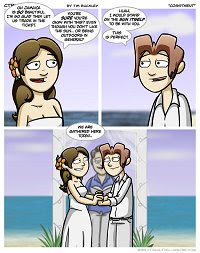
(From Ctrl+Alt+Del. Click for full-sized commitment. And click here for what I mention in the title. Oh, and this post contains spoilers. Oops.)

You notice I’m not even bothering with the Angst-O-Meter for this one.

My first reaction to this was: WHAT???

I couldn’t help but think of Lucas and anyone else who might have been invited to the originally planned wedding. This might actually raise the Angst-O-Meter depending on what happens from here. How might these people feel about being told the wedding was postponed, then finding out the bride and groom effectively eloped without them?

(In retrospect, the fact that Ethan and Lilah were going to use their respective tickets to go on a vacation might have been a bit of a tip-off that they weren’t just going to go on gondola rides…)

I’m going to keep reading for a few more strips to find out what, substantively and regarding characters other than Ethan and Lilah, will actually happen as a result of everything in this arc. There are a few ways Buckley can keep me on board for the long haul (this and Zeke’s destruction being a symbolic “growing up” for Ethan, for one) and there are many ways, very tempting ways, Buckley can turn me off for good (the entire arc turning out to be a shaggy dog story, various plot threads getting dropped like nothing happened, or really just rubbing me the wrong way at all).

The Angst-O-Meter: Day 5

(From Ctrl+Alt+Del. Click for full-sized mixed emotions.)

First, with the election approaching, for at least four of the next five weeks Tuesday will become webcomics day again on Da Blog, counting this post. Second, I’m linking to this post from here and here, so expect at least a slight bump in traffic.

With this apparent resolution, we can, presumably, all take a sigh of relief, and the Angst-O-Meter can come back down to 52%.

My frustration with Tim Buckley and the strip, however, is higher than ever.

Last time, I could have justified an Angst-O-Meter reading higher than the one I actually gave; this time, I could justify one lower than this, as there isn’t really much left to patch up. Zeke is still headless and Lucas still doesn’t completely trust Kate, but the main problem was always Ethan’s problems with Christian and Lilah. Those appear to have been taken care of, so for the moment at least, everything is back to some semblance of normal.

But the way things returned to normal, in a single strip, with a ridiculously expedited, bad-sitcommy, almost deus ex machina ending, that still does not sit well with me. Hell, this resolution is almost a single panel, and Buckley did such a good job of convincing people (well, me) that Christian’s words of departure were 100% correct that this resolution almost comes across as out of character. More to the point, it seems to prove CAD‘s critics right once again: the strip revolves around Ethan and nothing bad can happen to him for very long. The entire story arc may no longer represent a descent into First and Ten Syndrome, but only because it may have been turned into something far worse: the same as every other CAD story arc, only with a tease that it would be different.

If things immediately return to the status quo before this storyline it gives the impression that Buckley really is a bad sitcom writer who doesn’t really aspire to more than cheezy soap opera writer. If things immediately return to the status quo before the pregnancy and miscarriage, then people will pretty much riot. The only way for Buckley to save any face from this resolution – and there’s no way he can save face entirely – is for Ethan to realize he almost lost Lilah and perform some sort of soul-searching. But one of the points CAD‘s critics have long held is that real “change” is anathema to the CAD cast, especially Ethan.

The first time I ever wrote a post on Ctrl+Alt+Del, I said that the core of the strip and its popularity was not in being a gaming comic, but in being what Buckley called a gamer comic, in Ethan, Lucas, Lilah, and the rest, and their relationships. When Buckley performed the miscarriage, he said he wanted to “stress-test” what was in many ways the central relationship: that between Ethan and Lilah. I also said that too much emphasis on the “craft” elements of storytelling and art tended to miss the point and try for masterpieces when “kinda good” would do. Tim Buckley is hardly Charles Dickens or Rich Burlew, but he didn’t need to be. I was attracted because I became engaged in the plot, and because I wanted to see what happened next. I didn’t care about the accusations that Ethan was a Mary Sue or that he never really changed from being a manchild despite having impending changes that would require an actual adult to deal with. Those are nitpicks. All that matters, if you’re not going for the funny (which CAD is when it wants to be), is whether the plot is entertaining and/or compelling – no matter what era you’re in. And CAD passes that bar.

But this? This is insulting your audience. This is getting them emotionally invested in a story, wondering how Ethan could possibly extricate himself from this situation, if he ever did… and then pulling the rug out from under them, waving a magic wand, and putting everything back to normal.

I’m not leaving Ctrl+Alt+Del. Not yet. Let me at least see where Buckley is going with this. But this may be a situation where the right thing to say is “fool me once, shame on you. Fool me twice, shame on me.”