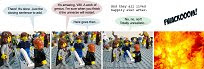
After Friday’s strip, my theory is that Oasis is a robot or cyborg of some kind. If that’s ridiculously blatantly contradicted by the strip itself, well, that proves my point.

(From Sluggy Freelance. Click for full-sized lots of missiles.)

I have a big beef with Pete Abrams of Sluggy Freelance fame.

I mean seriously. A big beef. Sluggy is one of the oldest webcomics on the Internet; it and User Friendly are the elder statesmen of webcomics, dating back to 1997. When I mentioned Sluggy as a representative of the sort of “wacky stuff happens” comic that makes up one of the two major branches of webcomics, counterpointing Penny Arcade‘s role for video game comics, back in my initial round of webcomics posts, I mostly mentioned Sluggy because it was the best representative I could think of and I couldn’t really think of whether there even was an equivalent to Penny Arcade. It turns out I may have been closer to the truth than I realized. Sluggy was perhaps the pioneer for Cerebus Syndrome in webcomics, and it got an early enough start to be a big influence on the “wacky hijinx” webcomics to follow. It’s not as nearly-mainstream as PA, but it’d be hard to find a webcomic more influential on more top webcomics.

But it’s as old as User Friendly, and if reading UF in 2006 monopolized my time and caused me to fall behind on things that actually matter, well, Sluggy has over two years’ worth more of strips now. And it’s more important to know what happens in them, because this is a far more continuity-laden strip than UF. Chances are that a given strip will contain at least one reference to a previous strip in a pink bar beneath the strip, showing just how interconnected Sluggy‘s mythology is. So it’s really critical that Sluggy eases the transition for new readers who want to join the Sluggy phenomenon but don’t have the time to read 12 years’ worth of strips.

Sure enough, look at the front page of the Sluggy site and it entreats you “New viewers, click here to view the Sluggy viewer’s guide!” And how does this “viewer’s guide” get people acclimated to the comic? By providing some sort of summary of the story so far, like Girl Genius or The Wotch? No, silly! By suggesting three potential jumping-in points to start reading: the beginning, “the sci-fi adventure” (a Star Trek/Aliens parody that wound up introducing Aylee to the strip) and Torg’s frolic into “The Dimension of Pain”… and both of these latter storylines take place within the first year. (Or you could just read the Torg Potter parodies separately, but where’s the fun in that?) Welcome to Sluggy Freelance, newbies! You want to skip some strips in your archive binge? Here, we’ll let you skip less than a year of a twelve-year run! Read at your own pace; we’re willing to wait a year or more for you to catch up to the current strips if you need it! Have fun!

Does Abrams provide anything else to get new readers acclimated to the strip other than an insultingly small head start? No! There’s not even so much as a cast page – Eric Burns(-White) won’t like that (2004-5 vintage Eric Burns, at least)! You’re pretty much stuck reading most of over 4000 strips! Have fun, kids, you’re on your own!

I get the feeling that at this point, Abrams is perfectly content writing for the audience he already has, especially since, as he’s been focusing on the “megatomes” there haven’t been any books collecting any strips after 2002 (only five years into the strip’s run), so his Defenders of the Nifty program has become an increasingly important source of income. Abrams has one of the larger fanbases of any continuity strip, so it’s very tempting to coast and not make things easier for it to grow, and be content with what he has.

This strategy may be doomed to failure. A recurring topic over the last month at The Floating Lightbulb has been looking at Google Trends data for various webcomics and webcomic sites, and a noted trend of various diverse comics declining – and Sluggy has been no exception. One of the many proposed theories has been massive archives scaring off potential newcomers to continuity strips, and there’s no archive scarier than Sluggy. I compared Sluggy to four other leading continuity comics, and the only one declining faster than Sluggy is Megatokyo, which is infamously anti-new-reader in its own way. (Order of the Stick and the rest of Rich Burlew’s site has lost half its audience since the start of the tracking period, but it’s so much further ahead of the rest of the field, only now falling to Megatokyo‘s audience at the start of the tracking period, that it’s hard to make a fair comparison.)

Perhaps the forumites could get together and create a short “cheat sheet” of a thread for new readers, or the Defenders could get together and create an officially sanctioned Sluggy wiki, or something. They can still read through the archives “at their own pace” but at least it’s easier to understand the current strips at the same time (which will help in getting them through the past strips). But no. Instead new readers are probably going through the current storyline wondering “who – or what – is Oasis and why should I care?” And they’re going to go back through the links in the pink bars, and those are going to lead them to strips that pose more questions, and they’re going to want to go back to more strips that provide background for these strips… only they won’t be able to because beyond the current storyline, those bars are (presumably) hidden behind “Defenders InfoShields” – they’re For Defenders’ Eyes Only.

Quick tip, Aspiring Webcomickers Everywhere: putting extraneous yet useful or at least appealing stuff behind a paywall? Good. Putting stuff that makes things easier for new readers behind a paywall, especially when it’s one of the very, very few bones you throw to new readers? Bad.

Meanwhile, your existing readers aren’t much better – it’s hard to remember twelve years’ and 4,000 comics’ worth of material, certainly hard to sort through it, so every bone you throw to new readers is also a bone you throw to your existing readers. (Which may help explain putting context links behind a paywall, but doesn’t justify it. Not that I’m asking Abrams to change that if he doesn’t want to.) Existing readers have the additional burden that Sluggy doesn’t have an RSS feed, a trend which, by the way, I actually understand a little bit: RSS is newer than its actual age would suggest, if that nade sense. In 2006, freshly moved into the dorms, I hunted around for a newsticker that would best emulate a TV news ticker and could be used long-term to keep me posted on the news, and settled on this. On its creator’s most recent post on his own blog (dating to… 2006!) he wonders what it might take for RSS to go “mainstream”, and suggests that some sort of RSS “killer app” (he suggests so much so that it would become synonymous with RSS and become a genericized trademark, so only geeks would know the technical name) might be the solution. I would propose that the release of IE7 (later that same year) and its internal RSS reader may have at least in part served as just such a “killer app”. Until then, I suspect a significant number of webcomics creators, certainly much of the general public, had barely even heard of RSS.

Sluggy deserves every ounce of praise it gets; I sometimes found myself looking at various points in the archive and reading significant stretches with interest. (Granted, they were mostly fairly early when the strip wasn’t as laden down with mythology, and a lot of the time it was to look at or for Aylee in one of her humanoid forms, but still. Yes, I really need a girlfriend.) And I’m intrigued enough by the current story arc, which promises to be a milestone one, that I’m planning on keeping on reading Sluggy until this arc’s conclusion. But I don’t have much of a reason to keep reading Sluggy beyond that. With my overcrowded schedule, I just don’t have time for another strip that demands an Order of the Stick level of attention, certainly one with so massive an archive, so much of a need to comprehend all of it, and so little help in doing so.

My Birthday (And Continuing) Book Wish List

Last summer, I made a list of books I was interested in with an eye towards pseudo-reviewing them and discussing them and their interesting ideas, or at least exposing myself to them. As it would be unlikely that I could buy them all (books are expensive, especially non-fiction ones, often running $20 a pop!), even after getting more gift cards from Barnes and Noble every gift-giving season than I had heretofore known what to do with, I would run the list on Da Blog as a “Christmas list” during a run of political posts in October and hope the mass of new readers I was hoping to attract would get them for me.


Then my USB drive stopped working and the planned run of political posts was a big bust anyway. Now that my drive has been recovered, a month out from my birthday on April 22, I’m posting the list – with some additions – as a birthday list, even though many of the books may be less topical and less interesting than they were before (especially before the election). It may seem odd that I would ask you to buy stuff to give to me (as opposed to buying stuff from me), but it’s with an eye to future posts on Da Blog (I hope), as well as other projects such as my idea of writing a book on the impact of the Internet. (Even though in most cases I don’t have much time to read any of them.) Besides, many of them should be eye-opening even if I never get them. I may institute a direct donation system of some sort at some point down the line. (If it weren’t for my distrust of PayPal, I’d have one already.)


If you want to get me anything, e-mail me at mwmailsea at yahoo dot com for a mailing address. I’ve organized the list by some broad topics:

 
MASS TRANSIT AND URBAN PLANNING
 
You may recall I started my abortive attempt at a series of political posts with a brief digression into global warming, which led to a brief discussion of mass transit’s role in correcting it. Originally that was going to turn into a larger project that would last until the start of the platform examinations, and I still want to revive that project in some form at some point. (The brief comeback of the platform examinations may have contained what was originally intended to be a hook into that revival.) I have three books on this sort of thing already I was thinking of reviewing, but there are still more I’m interested in:
  • Who’s Your City? by Richard Florida
  • Suburban Transformations by Paul Lukez
  • Cities by John Reader
  • Cities in Full by Steve Belmont
  • Any book about urban planning

POLITICAL BOOKS

The first book on this list isn’t strictly “political”, but it still ties in to related interests. Many of these relate to the battles in the Media Bias Wars.

  • 10 Books that Screwed Up the World (and 5 Others that Didn’t Help) by Benjamin Wiker
  • Bias: A CBS Insider Exposes How the Media Distort the News by Bernard Goldberg
  • The Political Mind: Why You Can’t Understand 21st-Century American Politics with an 18th-Century Brain by George Lakoff (and any other books by the same author)
  • Right is Wrong by Arianna Huffington
  • Gaming the Vote: Why Elections Aren’t Fair (and What We Can Do About It) by William Poundstone
  • Behind the Ballot Box: A Citizen’s Guide to Voting Systems by Douglas J. Amy
  • Declaring Independence: The Beginning of the End of the Two-Party System by Douglas Schoen
  • Going Green: A Wise Consumer’s Guide to a Shrinking Planet by Sally and Sadie Kniedel

BOOKS RELATING TO MY INTERNET BOOK PROJECT

These books are interesting in some way in terms of research for my book on the Internet, and so they’re somewhat higher priority than the others. Some have the Internet as their topic, while others are interesting filters to look at Internet culture through, or unavoidably touch on the impact of the Internet. There are a couple of books I didn’t list, and if I included any that aren’t impact-making or at least critically acclaimed, forget about them.

  • Grown Up Digital: How the Net Generation is Changing Your World by Don Tapscott
  • Generation Digital: Politics, Commerce, and Childhood in the Age of the Internet by Kathryn C. Montgomery
  • Wikinomics: How Mass Collaboration Changes Everything by Don Tapscott and Anthony D. Williams
  • The Wisdom of Crowds by James Surowiecki
  • The Tipping Point: How Little Things can Make a Big Difference by Malcolm Gladwell (and any other books by the same author)
  • Groundswell: Winning in a World Transformed by Social Technologies by Charlene Li and Josh Bernoff
  • The Long Tail: Why the Future of Business is Selling Less of More by Chris Anderson

JUST FOR FUN: COMICS!

Hey, trying to think all the time is a good way to burn my brain out. As you can tell by the fact I don’t have as many thought-provoking posts as I probably should.

  • Any installments of The Complete Peanuts after 1970
  • Garfield Gets His Just Desserts
  • Any Order of the Stick book (this is somewhat difficult; the online shop is the most reliable place to find them, and even that’s not 100% reliable; certain comic book stores may have them, but not all; gaming stores – specializing in D&D and their ilk – are more likely, but in the latter two cases availability may be based on whether or not they’re in print)

Also, I’d really like to be able to play The Sims 3 when it comes out in June (unless it’s widely panned), but although the “Franken-computer” I have for a desktop was built in 2004 and was state-of-the-art then, and has been pretty close to it for five years, it only barely has enough processor power to play it and definitely not enough RAM, and I’m not sure if it has enough video RAM. I’d prefer not to have to get an entirely new computer just to play one game, but…

Out with a whimper.

This is not the way I intended to do this.

For the first time since July 14 of last year, I did not have a post on a weekday yesterday.

I had been intending to continue The Streak until I hit the one-year mark. Oddly, that might have resulted in extending the streak into at least September and possibly (after college football season) December, because of at least one project I have in the works.

Honestly, after abandoning webcomics posts for March on the grounds I needed the time to work on a paper, I’ve been completely procrastinating. I spent most of yesterday sleeping, watched more TV than I should have or planned to, went out for a while and had no place to really use the Internet (nor, for the most part, did it cross my mind to), and used the last few hours of the official Tuesday playing games rather than at least work on the paper. Really, the paper’s barely started and I’m going to need a three-day blitz to write… eight pages? I hit a research bottleneck where I had to go running around for books to cite to make the point I intended to make (by not being what it calls an “indiscriminate collection of information” Wikipedia may actually be hindering the Web’s potential as a repository of all knowledge by attracting too many queries for it to itself) and that’s been taking up a lot of time I could use actually working on the paper.

(For the sort of research I want to use not just for this paper, but spending much of my life doing, I have a feeling I’ll need a lot of money for books… and I STILL don’t have a real job…)

I may well start a new streak with this post anyway – I have posts planned for the remainder of the week and may try to get a second post out today.

Sure it’s obvious, but it was necessary.

(From Ctrl+Alt+Del. Click for full-sized performance review.)

Normally, I defend Ctrl+Alt+Del. I defend it against accusations of Mary Sue-dom, I defend it against accusations that it’s unchanging, I even defend it against accusations of bad art.

But Ethan’s yelling mouth in the last panel… is positively grotesque.

As for the storyline? I’m watching it with interest to see where it leads, but it’s too early to form an opinion yet. Way too early.

As for the “weekly” webcomic post? Not looking good for it to happen on Tuesday, I’m afraid. Maybe later in the week, but…

This is a bit later than I originally intended to do this, but…

I’ve finally added a link graphic page to Sandsday. Now you can support Sandsday by adding a pretty picture to your site! The navigation is now significantly different, no longer using the main site’s sidebar.

The leaderboard (728×90) and skyscraper (160×600) images are bigger than I know what to do with at the moment, so I don’t recommend using them. Not that you would expect to use them for regular linking as opposed to ads in the first place.

(I have some idea of what I might do with the skyscraper down the line, but the leaderboard is a bit more vexing.)

Stewart v. Cramer: What the Media is Doing Unequivocally Wrong, No Matter What You Believe

Why aren’t real news people more like Jon Stewart?

The Colbert Report debuted in 2005. That means that The Daily Show had been earning rave reviews since well before that for its biting satirical take on the news that in some cases seemed better than the real news shows. Even before The Colbert Report, Stewart made a famous appearance on Crossfire a year earlier where he so called out the culture of news of the day it led to Crossfire‘s cancellation. (And his show put out America: The Book the same year.) But news organizations have changed so little since then that TV news is arguably poorer for the loss of Crossfire as a place where liberal and conservative views would be forced to confront each other (and made stronger for it) rather than stay within their shelters of Keith Olbermann and Rush Limbaugh. (I’d like to see some news network start a PTI-style show for news and politics.) As early as 2002, Stewart was rumored to be replacing David Letterman.

We’ve had Stewart helming The Daily Show for a decade now, and earning rave reviews the whole time, and a recurring theme of his tenure has been calling out and making fun of the mainstream media as much if not more often than politicians. (The media was a particular target of America: The Book.) And for being, as Stewart is wont to remind people, a “fake news show”, its popularity still would seem to suggest it’s something today’s youth actually want in their news. So why hasn’t anyone taken up the challenge? Why is journalism still as bankrupt as it ever has been in this decade? Why hasn’t anyone become the “real” Jon Stewart, or at least taken up his grievances?

This came into focus for me while watching Stewart’s interview with Jim Cramer last night. The interview went on so long that the unedited version had to be posted on The Daily Show‘s web site, but really, the interview could be condensed into one or two sentences. Stewart called out Cramer and CNBC for not digging down deep in its interviews with CEOs and challenging them to bring the goods, instead of “trusting” them and then “regretting” trusting them so much later. More broadly, Stewart both cast doubt on the ethical standards of people like Cramer who have had experience with the shadier side of Wall Street and suggested that experience could be used to actually enlighten viewers, and wondered if CNBC’s target audience was ordinary Americans looking to invest their 401k’s or Wall Street insiders.
This isn’t new stuff with Stewart. Regularly he will show pieces of a real news network’s softball interview with a newsmaker and ridicule it, or criticise the practices of the mainstream media in a similar fashion. But to flip it around, if Cramer were to come on an Anderson Cooper or someone else in the mainstream media, he wouldn’t be so heavily pushed – even if he weren’t a member of it. It says a lot that Stewart is doing a lot of the asking of truly penetrating questions and actual debate of guests in the media today.

Why do we have to tune in at 11 PM on the comedy channel to watch a comedian do it for only thirty minutes? Doesn’t Stewart’s popularity suggest there’s a real market for real, hard-hitting journalism, not pandering and demagoguery?

Last summer after reading True Enough, I decided I would start reading the two major media watchdog sites on both sides of the political spectrum, Media Matters for America on the left and Newsbusters on the right. I eventually stopped – I got the impression that Newsbusters was more obsessive about rooting out bias and had a larger density of posts, and for the first time I started semi-seriously considering the conservative claim of liberal media bias – but the impression I got from the sites dedicated to claiming the media was biased to the right or to the left wasn’t that it was biased to either side. It was just incompetent.

That led me to claim that what was really needed was for the media to fight back against claims of bias from both sides and lay out why they’re right after all. But part of the reason the media isn’t fond of doing that is because it’s all too fond of playing up the extreme differences between left and right. It’s as much a willing participant as anything in the red-blue divide with shows from the likes of Lou Dobbs, Keith Olbermann, and Sean Hannity. (Bill O’Reilly and Rachael Maddow might deserve at least a little more respect from their respective other sides.) And there may also be the factor that the media really is falling down on the job. Certainly it’s not just left and right complaining about it, or even minority groups like backers of third parties. Anyone you talk to will likely bemoan the loss of real journalism, of investigative journalism, of substantive journalism, of coverage of events that really matter rather than, say, Jennifer Aniston, of any virtue of journalism that doesn’t follow the almighty dollar.

The people running the news networks will likely say that sort of thing doesn’t sell. I think the popularity of Stewart says otherwise and that, given an alternative to the sort of hollow, flashy, scratching-the-surface, substanceless journalism they’re getting now, people will flock to it in a heartbeat. Certainly that’s the sort of thing my mom likes best about Stewart; I suspect it’s what America will find they like as well. (Although presentation matters; the fact it may matter more than content is how we got into this mess. Once, I was inspired by anti-American-media comments to check out BBC America’s “World News America” and found it boring as hell. And not entirely free from schmaltzy human interest stories to boot.)

Newspapers aren’t dying because they can’t make money on the Internet, except in the sense they don’t know how to capitalize on the Internet (and that they’ve been losing classified revenue to Craigslist). They may even be best off silencing their presses – besides the cost of the press itself, there’s distribution and middleman fees to consider – as the print versions have really become loss leaders more than anything else. They’re dying because they’re so incompetent that two groups that have never been such bitter enemies nonetheless both hate their guts, and because they’re getting new competition and scrutiny from blogs – and because they believe their “can’t make money on the Internet” excuse for their struggles, they aren’t realizing the real reasons and adapting and evolving to them. (I wrote more on this here.) Rather than getting better newspapers, we might end up with no newspapers at all. I mean, after decades of conservative accusations of media bias, how is it that the mainstream media is STILL doing stuff like this? Or this or this?

I hear that a major reason we need to save newspapers is because of all the “financial resources” they have to do real broad-scale reporting. If newspapers want to keep those “financial resources” they need to come up with new and better reasons for people to patronize them. And as for television news, they’re well overdue to take a long, hard look at themselves and figure out if they’re really doing the best they can. Stewart may be telling them – in word and deed – that they aren’t.

Fun with sports ratings

So, what else can we learn from the sports ratings post from two weeks ago?

  • We can learn that the number of people who watch the Super Bowl just for the ads is lower than you might think. Subtract the 29.0 for the NFC Championship Game, reflecting actual football fans, from the 43.1 for the Super Bowl and you get 14.1. Doubtless the actual rating contributed by people watching for the ads is lower, as there must have been some football fans not watching the title game. Still, a 14.1 is on par with American Idol, and even if some of the football fans weren’t football fans they might still watch for the commercials.
  • We can learn that outside the championship round, good matchups or teams matter more than being further advanced in the tournament – at least in basketball. The 8.7 for the Davidson-Kansas Elite Eight game nearly matches the highest-rated Final Four game (8.8) while the other Final Four game lags significantly behind (7.2). The highest rated non-Finals NBA game is a conference semifinal, admittedly on broadcast television. Last year, ALDS games involving the Yankees outrated a terribly-rated NLCS.
  • We can learn that the NCAA Tournament is the most powerful non-football, non-Olympics property in sports, more even than the NBA. The National Championship Game beat every game of the NBA Finals and World Series, even the rating for the shortened finish of the World Series alone. In a down year for the tournament and up year for the NBA, the aforementioned 8-range games beat three NBA Finals games, in a six-game series. Of course in the NCAAs, everything comes down to single games, but the 3.4 for North Carolina-Duke, the highest rated college basketball game, compares favorably not only to every non-Christmas Day game in 2008, but even to the “lesser” Christmas Day game. (Two non-Christmas games have garnered ratings of 3.8 so far this year.) You see why I claim that a playoff in college football would only be good for the sport.
  • We can learn that people do not always watch only games that matter in college football. Michigan-Florida in the Capitol One Bowl was more for bragging rights than anything else, but it outdrew every bowl except the BCS Title Game and the Rose Bowl.
  • For whatever reason, people watch the Kentucky Derby, comparatively ignore the Preakness, then when they find out the Derby winner won the Preakness they come back for the Belmont.
  • Golf is not baseball, the NBA, or NASCAR, and neither is the Triple Crown. Average rating for the NBA Finals: 9.3. Average rating for the World Series: 8.5, a rating depressed for a late night game. Rating for the Daytona 500: 10.2, .5 less than the highest NBA Finals rating and higher than the total rating for Game 5 of the World Series (admittedly a Series depressed by bad markets). The Belmont and Derby barely beat that depressed Series number by .4-.5, and the Masters by .1. Outside the Masters golf just doesn’t matter comparatively.
  • Every All-Star Game is trying to rip off the baseball one. And for good reason. Only one World Series game beat the MLB All-Star Game, even though the ASG is a farce. (Baseball is not as well adapted to an all-star game as you might think from its individualistic nature, because of the way pitching works.)
  • The Pro Bowl sucks, but it is still an NFL game.
  • NASCAR loses a lot of momentum as the season progresses, and moving to cable is a big reason – and it ruins the Chase. The lowest-rated full race on Fox receives a 4.4; the highest-rated cable race is a 4.3 (the Brickyard 400, which comes temporally after the entire slate of TNT races), and only one ABC race outpaced any Fox race.
  • On the same level as the LCSes is the Indy 500, the Conference Finals, the other high cable events, and the NCAA Tournament’s Sweet 16. Also up here are semi-high-profile college football games. The NFL has left this group in the dust; the lowest-rated game on any of the Big Four TV partners is a 5.9 for Monday Night Football between the Jags and Texans.
  • If the IRL doesn’t belong in that middle tier because it never creeps beyond 1.0 outside Indy, then horse racing doesn’t belong there either. It’s just that its big events have a more dramatic difference. The Indy 500 may actually be underrated as an event because of the overall reputation of the IRL.
  • The Stanley Cup Finals ranks behind the Indy 500 (in the US). But at its best, it can do better than tennis, which I think is actually overrated as a sport by ESPN and the like. The highest-rated tennis rating I could find was the Wimbledon Nadal-Federer classic at 3.5; two Stanley Cup Finals games beat it.
  • Now that NBC has moved the US Figure Skating Championships (3.3) to primetime, are they underrated as a sports property? How much of the value of tennis (US Open Women’s Final: 3.3) and the Stanley Cup Finals are created by primetime positioning on broadcast television? How should EliteXC feel about its relative inability to create even that much of a buzz on broadcast primetime (admittedly in relative late night)? I’d be interested in seeing what UFC did on broadcast primetime. Would it break the 3.0 barrier, and if so, would it do significantly better than EliteXC? (Ratings for UFC’s big numbered events on Spike hovering around 2.0 or worse should be taken with a grain of salt because they are often tape-delayed.)
  • Don’t read too much into the NFL Draft’s ratings. It’s on par with the broadcast networks’ pregame shows. The only reason most people watch it is because they’re just obsessed with all things NFL. Though keep in mind that the rating given might be an average rating; ratings for just the first round might be on par with the highest cable events.
  • Really, the only sports that matter are the NFL, Olympics, college football and men’s basketball, MLB, NBA, NASCAR, golf, and then a huge gap to most everything else. I don’t know how highly the World Cup ranks in general, but outside of the World Cup soccer still doesn’t matter, and neither does MMA, despite being “sports on the rise”. Here are all the events of other sports with ratings higher than 3.0: the three Triple Crown races, the Indy 500, two Stanley Cup Finals games, the Federer-Nadal Wimbledon classic, the figure skating championships, the US Open (tennis) women’s final, and that’s it. Only the Triple Crown races and Indy 500 are higher than 4.0. Even excluding the NFL and Olympics, there are 21 different events with ratings more than double that (8.0), including two of the Triple Crown races. EliteXC MMA (which doesn’t exist anymore), women’s college basketball, Euro 2008, and the Little League World Series (plus the Winter Classic) are the only new events to be introduced above 2.0. Both varieties of football outpace the other sports, and golf lags.