Bracket Ladder for January 18, 2011

Due to time constraints and how early in the season it is, this is pretty much just a demonstration of the demonstration of the concept. I just picked out the teams on the top three seed lines – that was as far as I got in about four and a half hours – so this is just a bunch of capsules of the top 12 teams, and because a lot can change between now and Selection Sunday I can’t even begin to assess where teams might end up standing in the long term. All these teams, with the possible exception of the very bottom team, have a reasonable chance to end up a 1 seed, so consider this your “1 seed bubble”. The “Featured” stuff next to each team is meaningless now, but I’ll explain their purpose next week. Also, the “good wins” and “bad losses” entries are almost arbitrary. They’re supposed to represent wins to teams ahead of or on the same level as yourself, and conversely losses to teams behind or on the same level as yourself, but this early in the season the definition of “same level” probably needs to be tightened; “same color” (which will eventually tie in to the “Featured” thing) obviously won’t work since all these teams would have the same color.

This edition of the Bracket Ladder is complete through the games of January 17, 2011. This means this does NOT include Tuesday’s games, including Alabama’s upset of Kentucky.

How to read the chart: Teams are listed in order of my assessment of their strength based on the criteria established by the selection committee. The large gray number to the left is the team’s seed in the NCAA Tournament if the teams were seeded strictly according to the list order. Teams may receive a higher or lower seed because of bracketing principles. The code at the right side of each team name represents the team’s conference and a running count of the number of teams that conference has in all tournaments. The row beneath the team name packs in a whole bunch of information. In order: The team’s record is on the far left in bold. RPI: Rating Percentage Index rank. SOS: Strength of Schedule rank. R/N: Record in road and neutral-site games. OOC: Record in games outside the conference. RPI T50: Record against teams in the RPI Top 25. Wv≥: Number of wins against teams with the same or better color (more on this later). Lv≤: Number of losses against teams with the same or worse color.

1 Ohio State B10 Featured
18-0 RPI: 8 SOS: 61 R/N: 5-0 OOC: 13-0 RPI T50: 2-0 Wv≥: 0 Lv≤: 0
I’m going to be honest with you. I’m only putting Ohio State at the top because otherwise I’d be putting a team that has lost there. Kansas and San Diego State haven’t impressed me with the quality of their wins; Ohio State has at least beaten a team in the RPI Top 20. Their strength of schedule overall isn’t great, so objectively they should probably be far lower, but at this fairly early stage there’s a lot of volatility and not much data to go on. Saturday’s game at Illinois (Saturday noon ET, CBS) is their best chance for a loss before my next update, and while it’ll improve their SoS profile it won’t improve their long-term prospects all that much. That won’t come until they play Purdue next week. Both games aren’t must-wins, but they’re better-wins because it wouldn’t take much of a collapse for them to shoot through the floor.
1 Pittsburgh BST Featured
18-1 RPI: 5 SOS: 18 R/N: 5-1 OOC: 12-1 RPI T50: 4-1 Wv≥: 3 Lv≤: 1
Pittsburgh has only three wins against teams in the RPI Top 40… but what great wins they are, against fellow contenders for the top few seed lines, helping to vault them ahead of the likes of Syracuse, UConn, and Georgetown. The Tennessee loss came to a team outside the RPI Top 25, but I’ll let that slide since it was on a neutral site and the 4th best team by RPI they’ve played so far, almost on par with some teams’ best wins. Monday’s game against Notre Dame (7pm ET, ESPN) won’t hurt them too much if they lose, but if they win expect them to stay in the seed discussion for most of February at least.
1 Connecticut BST Featured
15-2 RPI: 6 SOS: 12 R/N: 5-2 OOC: 11-0 RPI T50: 6-2 Wv≥: 1 Lv≤: 2
Syracuse and UConn, I found, was a case of splitting hairs. (Yes, I have three Big East teams on my top seed line that would be the top three teams if it weren’t for my commitment to have an unbeaten team overall . Don’t expect three Big East teams to be your seeds come March, though, once conference play gets going.) I chose UConn over the ‘Cuse pretty much solely because of UConn’s strength of schedule. Syracuse beat Notre Dame and UConn didn’t, but Syracuse was at home and UConn went to South Bend. They won’t settle it on the court until February 2, but until then if UConn can beat the team that foiled Pitt, Tennessee in the only game Bruce Pearl will coach in January (Saturday 2pm ET, CBS), they can improve their case for moving up further should Pitt lose one or two more times.
1 Syracuse BST Featured
18-1 RPI: 3 SOS: 22 R/N: 5-1 OOC: 13-0 RPI T50: 3-1 Wv≥: 0 Lv≤: 1
Syracuse would be my overall had they beaten Pitt, but they still beat teams in the RPI Top 20, something Kansas and San Diego State can’t say. They have a week to stew before facing another big challenge in Villanova (Saturday noon ET, ESPN), but if they want to really improve their chances of ending up with a the February 2 game against UConn is their best near-term bet.
2 BYU MWC Featured
17-1 RPI: 4 SOS: 15 R/N: 8-1 OOC: 13-1 RPI T50: 4-0 Wv≥: 0 Lv≤: 1
The next three form another “tier” like the Big East teams that was hard to tease out between them. For BYU, a better strength of schedule and one more RPI Top 40 win than San Diego State outweighed a rather concerning loss to RPI #53 UCLA that could really drag them down in the long run. (Don’t count out the chances of the Mountain West teams staying this high, either; they’re doing gerbonkers in the conference RPI.) Of course, that’ll all be (mostly) irrelevant once they play each other; the first engagement is next Wednesday the 26th (10pm ET, CBS CS), and this week BYU will get two tuneups against relatively weak conference opposition, though Colorado State (Saturday 9pm ET, mtn.) could be a real trap game.
2 San Diego State MWC Featured
17-0 RPI: 2 SOS: 27 R/N: 11-0 OOC: 13-0 RPI T50: 4-0 Wv≥: 0 Lv≤: 0
See BYU above; it pretty much tells the story, with the Aztecs’ only game this week being Wednesday hosting Air Force (10pm ET). I can’t tease out these top Mountain West teams until next week. The concern for the Aztecs is simply an iffy strength of schedule and only two RPI Top 40 wins, no RPI Top 20.
2 Kansas B12 Featured
18-0 RPI: 1 SOS: 17 R/N: 7-0 OOC: 15-0 RPI T50: 2-0 Wv≥: 0 Lv≤: 0
Kansas’ problem is that they’ve only faced two teams in the RPI Top 50 and one in the RPI Top 40. They have more to prove if we’re going to anoint them in any way. Texas (Saturday 4pm ET, CBS) is normally good for a good win, but while they’ll help they’re only 40th in the RPI. Texas A&M is the only opponent that would appreciably improve Kansas’ standing, and that game isn’t until March and is at home. Despite their RPI right now, if they don’t go undefeated, they’ll be very lucky to get a or even seed – and unless their only loss is to A&M, maybe Missouri, good luck getting a top four.
2 Duke ACC Featured
16-1 RPI: 10 SOS: 49 R/N: 5-1 OOC: 13-0 RPI T50: 4-0 Wv≥: 0 Lv≤: 1
The loss to a bubbly Florida State team and the fact that was the only team in the RPI Top 150 they’d played in a true road game, plus an iffy strength of schedule, almost had me drop Duke to the 3 seed. Duke has quite a few pelts (though no true prizes), a flawless nonconference, and compared to my 3 seeds a good road/neutral record, and might have edged out Kansas on the ladder if it weren’t for the fact the Jayhawks are, you know, unbeaten. A 1 seed is still possible, but if the ACC is anything like it was last year a slip to the 3 or below is more likely, especially if the Florida State loss is a portent of things to come. North Carolina and #36 Boston College are the only other teams in the top 60 of the RPI in the ACC, meaning the January 30 game at St. John’s becomes huge, possibly a must-win to keep 1 seed hopes alive. Luckily Duke avoids having to go to Boston, but it could take just two more losses (St. John’s and North Carolina in Chapel Hill) for Duke to be mired in the middle of the pack come Selection Sunday. Another loss to UNC or BC in the ACC Tournament would leave Duke with an uphill climb indeed for their title defense.
3 Kentucky SEC Featured
14-3 RPI: 12 SOS: 24 R/N: 5-3 OOC: 12-2 RPI T50: 4-3 Wv≥: 1 Lv≤: 3
The 3 seeds form another tier, and Kentucky and West Virginia in particular are a case of splitting hairs. Kentucky doesn’t have any major challenges before Georgia in a couple of weeks, so they just need to keep winning. (Which apparently they didn’t, but more on that next week.)
3 West Virginia BST Featured
12-4 RPI: 9 SOS: 5 R/N: 5-3 OOC: 9-2 RPI T50: 4-3 Wv≥: 0 Lv≤: 4
The Mountaineers have momentum on their side after winning against Purdue. Over the next few weeks they have a chance to earn wins against teams tough enough to test them, but not as tough as the top teams in the Big East. They don’t face a team truly worth worrying about until Villanova February 5.
3 Notre Dame BST Featured
14-4 RPI: 13 SOS: 11 R/N: 3-4 OOC: 11-1 RPI T50: 6-3 Wv≥: 2 Lv≤: 3
Notre Dame slips behind Kentucky and West Virginia, despite having better losses and better wins than either of them, thanks largely to the fact they have not won a single true road game. That means the Marquette loss could be an ugly portent of what might happen to the Irish once they enter conference play. Notre Dame’s better strength of schedule than Kentucky is trumped by the Wildcats beating the Irish head-to-head on a neutral site. Half of Notre Dame’s remaining road games are against teams ahead of them on the ladder. After hoping to escape Pitt alive on Monday (7pm ET, ESPN), Notre Dame may oddly find itself in a must-win at DePaul on February 3. A loss there may well have people in South Bend talking NIT. That assumes they survive this week’s home tests, neither of which are gimmes… it’s unlikely conference play will expose the Golden Domers as a bunch of poseurs, but it can’t be left out of the realm of possibility.
3 Georgetown BST Featured
13-5 RPI: 7 SOS: 2 R/N: 7-3 OOC: 11-1 RPI T50: 3-5 Wv≥: 0 Lv≤: 3
At this point, Georgetown has good wins, respectable losses, and a very strong strength of schedule. But probably the only reason I include them here instead of Villanova or Texas A&M is because their resume is good enough to at least challenge that of Notre Dame. If it weren’t running late as I was writing this Georgetown would probably show as slipping to the 4 or below. The Hoyas kind of got unlucky starting conference play with some of the best teams in the conference – Temple is still their iffiest loss – but they have only three RPI Top 50 wins and the dropoff comes fast, and no wins in the RPI Top 25. After the Seton Hall game comes no games until St. John’s and Villanova next week, which should show whether Georgetown really is who we thought they were.

Bracket Ladder: A new approach to bracketology

One of the most common arguments against a playoff in college football is that it would turn college football into college basketball, where – allegedly – the regular season is completely meaningless.

This is complete bullshit. If you’re going to use the “meaningless regular season” line, college basketball is not the place to use it. (That would be the NBA and NHL, which push more than half their teams into the postseason.)

There are about 347 teams in Division I college basketball. Only 65 get to play in the NCAA Tournament, or 18.7%. By contrast, major league baseball puts 26 2/3% of its teams in its postseason – even counting the NIT, college basketball is nearly as selective, putting 27.95% of its teams in the postseason. But college basketball’s regular season is far more meaningful than baseball’s because its teams only play 30 or so games. We can get a rough estimate of how meaningful the regular season is by taking the reciprocal of the selectiveness percentage and dividing it by the number of games. By that measure, college basketball’s regular season is more meaningful than that of the NFL.

(Incidentially, college football, if it adopted a 11/5 playoff, would still only put 13 1/3% of its teams in the playoffs and have a far more meaningful regular season than any other major sport. Right now, its meaningfullness index number is 5, which means it’s too meaningful because its number is over 1.)

So why does this perception of the meaningless college basketball regular season persist? Undoubtedly, a lot of it has to do with the subjectivity of the process, and its cousin, the unbalanced schedules played by college basketball conferences. In the pros, you know exactly the impact a given game will have on a given team’s chances to make the playoffs. You can’t know that for certain in college basketball. What’s at stake for Kansas entering today’s game? Are they already locked into a seed? Are they in trouble of sinking to a or ? Are they going to get an ideally situated region, or can they? We don’t know.

The fast-growing field of “bracketology” (a neologism invented out of whole cloth by ESPN) could help answer these questions and help us know exactly what to expect out of a given game. Unfortunately, most bracketologists post little more than their reckoning of where the field stands right now, not how close all the teams are to each other. So we know that North Carolina is (for example, since I’m writing this during 2008’s March Madness!) the second seed. Could they rise up to the overall ? Could they fall? How far could they fall, and how soon? We don’t know. The closest most bracketologists come, if you’re lucky, is a “bubble watch” feature tracking only whether teams are in or out of the field, not how high they are if they’re in. Often, even that only contains vague descriptions. Seeds matter too – almost all of the national championships in the modern era have gone to the top three seeds. Say what you will about Joe Lunardi and his tendency to get way more play than his accuracy would indicate, but if you’re willing to pay for ESPN Insider, he’ll give you percentage chances for every possibility you could care about. That’s way more than most bracketologists.

If. You’re willing to pay for ESPN Insider. (And the subscription to ESPN the Magazine Insider requires.)

Over the next two months, leading up to Selection Sunday, I’m thinking I’m going to run my own bracketology project, showing the information college basketball fans really want to know: what’s at stake. I’ll tell you exactly who has a shot at the overall seed, the range of seeds a team could get, whether a team’s in or could still be out or if they’re on the bubble or if they’re out but could still be in, using color-coded bars and all the information you could ever need. You’ll get to see exactly where your team is on a ladder extending from 1 to 64 and beyond, and how far they could climb or fall

I’m going to make an effort to use the same information the selection committee uses, but the NCAA seems to be more tight-lipped about what info the selection committee uses than I recall them being in the past. (Is the committee really using game scores now?) So I’m going to use the same information I use for my Golden Bowl selection process, courtesy of CBSSports.com’s RPI Breakdown pages: record, RPI, strength of schedule, out-of-conference record, road/neutral record, record in the last 12 games, record against other teams in consideration, quality of wins and losses. (I’m okay with using injury info and the like.) However, this is not an effort to attempt to predict what the selection committee will do, because the purpose is to demonstrate the format. Rather, this is a record of what I would do if I were on (or rather, were) the selection committee.

I’m spending today and tomorrow going through each team’s resume and forming an initial ranking. I hope to have a first, rough sketch of where I see the field by 5 PM PT Tuesday. And we’ll see where we go from there.

Predictions for the Pro Football Hall of Fame Class of 2011

The Pro Football Hall of Fame’s selections are performed by a panel of 44 leading NFL media members including representatives of all 32 NFL teams, a representative of the Pro Football Writers of America, and 11 at-large writers.

The panel has selected a list of 15 finalists from the modern era, defined as playing all or part of their careers within the last 25 years. A player must have spent 5 years out of the league before they can be considered for induction into the Hall of Fame. Players that last played in the 2005 season will be eligible for induction in 2011.

During Super Bowl Weekend, the panel will meet and narrow down the list of modern-era finalists down to five. Those five will be considered alongside two senior candidates, selected by a nine-member subpanel of the larger panel last August, for a total of seven. From this list, at least four and no more than seven people will be selected for induction into the Pro Football Hall of Fame.

My prediction for the Pro Football Hall of Fame Class of 2010 is:

Deion Sanders
Marshall Faulk
Andre Reed
Dermontti Dawson
Ed Sabol
Les Richter

Hall of Fame Game: Falcons v. Rams

Rating the Super Bowl Logos: Part IX

Previously in this series: Part I | II | III | IV | V | VI | VII | VIII

Super Bowl XLI: Tried to repeat the simplicity of the Super Bowl XL logo, but didn’t work out as well. Can’t say I particularly like the pylon taking the place of the “I” in the Roman numeral; if there’s one place I expect the serifs it’s there. That singlehandedly brings this logo down several notches. And what’s up with that weird twinkle up there? Grade: C.

Super Bowl XLII: Oh. Oh, dear God. How could one of the best Super Bowls ever, the answer to life, the universe, and everything, have one of the worst logos? It’s trying to look like the state of Arizona, but the stripes ruin the effect and it just looks like a bunch of random, disjointed bands. And why is it curving like that? The red and blue streaks with the stars feel shoehorned in, the Roman numeral itself is utterly dull especially with the ugly coloring and stops in the middle of one of the bands for some reason, and having the “Super Bowl” wrap above and below has never looked worse than here. And there’s one band above and two below! Oh god, the more I look at this the worse it becomes! What convinced them this was a good logo? I wouldn’t be surprised if it was their experience with this logo that convinced them to go with a single generic logo instead of unique logos going forward. (Here’s a hint: avoid crappy logos like this one.) And yet, even with all of that, when all is said and done, it still isn’t as bad as Scrappy-Doo. Probably. Grade: D-.

Super Bowl XLIII: Well, after the unmitigated disaster that was the last logo, you probably can’t blame the NFL for going incredibly generic for this one. I’ll be honest, when I first saw this logo, it was so generic I thought it was a fake, or Photoshopped, or a placeholder until they could get a real logo. It’s certainly inoffensive, I’ll say that much, but apparently it’s supposed to look like the specific stadium or something… I don’t know, all I know is that if they wanted a logo to serve as the generic logo of the Super Bowl going forward, you could do worse as a starting point. Besides, anything would be better than the abomination of a Super Bowl XLII logo. Grade: C+.

Super Bowl XLIV: The XLI logo, only without the pylon taking the place of the I, and bulky. Seriously, it looks like a battering ram. The bulkiness is especially apparent when you consider how the L wraps around the goal post. Oh, and the Roman numeral looks like it belongs on an 80s video game for some reason. It’s certainly inoffensive, but it’s sad that this is going to be the last game-specific logo. Grade: C+.

Super Bowl XLV: Get a good look at your new Super Bowl logo going forward. As a game-specific logo, it would actually be quite good, especially if they got rid of the Lombardi trophy and put the emphasis on Cowboys Stadium as the site of the game. As is, the Lombardi trophy kind of dominates the composition, and makes it look overly tall (and a bit suggestive). I wouldn’t have said no to the Lombardi trophy being used in past Super Bowl logos, maybe even as the “I” in a Roman numeral even though I criticized a similar practice in Super Bowl XLI, but apparently the NFL wanted to avoid tainting its trophy by associating it with a single Super Bowl. Personally, I don’t see how that would have happened, and it didn’t stop the NFL from using the logo for the entire league in XXXIV.

Which brings me to this logo as a generic logo going forward, where it falls short in key areas. The Roman numeral, once the key element of any logo, is still more prominent than “Super Bowl”, but it’s now very modular and lazy, and it still doesn’t stand out as much as it used to. The Lombardi trophy dominating the composition and making it too tall becomes even more of a sin, making you barely notice the other elements, especially at a distance. The grey color is just dull and boring – acceptable one year, but not year after year. And what’s the point of even including the stadium when virtually nothing around it will change? (I’ve actually seen quite a few Super Bowl logos recently that exclude the stadium).

But the worst part is that not only will each individual game no longer feel special in relation to the Super Bowl in general, the Super Bowl itself won’t feel special in relation to the rest of the playoffs! In addition to the general logo, the NFL is introducing new logos for the rest of the playoffs to match it, which means the Super Bowl logo will only differ from the logos leading up to it in which trophy it has to represent it and the vestigial inclusion of a Roman numeral. Admittedly the Playoff and Championship Game logos are much more subdued, but they also suck. But how much difference is there, really, between the Super Bowl logo and the Pro Bowl logo? Grade: C-.

Rating the Super Bowl Logos: Part VIII

Previously in this series: Part I | II | III | IV | V | VI | VII

Super Bowl XXXVI: A good enough logo for the first Super Bowl after 9/11. The United States and flag motif is used very well, the fonts are agreeable, it looks dynamic, and the whole thing really makes it feel like America’s game. Primo! (Sadly, it doesn’t look so good in 2-D.) This is going to sound insensitive, but 9/11 certainly saved the NFL from the awful logo they previously had in mind for this game. Yes, apparently that thing is not a fake and really would have represented a sizeable step backwards from the recent trend. Grade: A+.

Super Bowl XXXVII: Well, the lighthouse motif works a bit better than the Semaphore flags, and this time they managed to make the width of the Roman numeral not quite so distracting as in XXVII. (Now if there were more lighthouses over to the sides it would be a different story.) It’s a perfectly serviceable logo where the elements all make sense for what they’re trying to accomplish. I even like the big “V” in the Roman numeral. Grade: B.

Super Bowl XXXVIII: Simple, yet effective. Nice and symmetrical, with the orbit motif being easily recognizible and associated with Houston. The one thing that bumps it down is that it’s arguably too simple, and doesn’t feel special enough for a Super Bowl. And what’s for the vaguely electronic font for “Super Bowl”? Grade: B+.

Super Bowl XXXIX: Remember when I said that the XXXVII logo managed to avoid the Roman numeral looking too awkward? Yeah, you can’t say that for this logo. Whatever that thing at the top is, it’s barely recognizable (is it a bridge, or the stadium itself?), which makes it a perfect symbol for Jacksonville, and both it and the “Super Bowl” are dwarfed by that huge Roman numeral just sticking out there, with legs holding it up and the pointless little wave at the bottom. They actually made it worse that the “I” is stranded among the Xs. All in all, not the best effort. Grade: D+.

Super Bowl XL: A very different, simple approach. They deliberately went for the “car” look, with the “Super Bowl” looking vaguely like hub caps. You just have the huge Roman numerals and the red and blue stars that would be repeated for the next four Super Bowls. It’s the simplest logo in years, yet it still manages to look modern. Overall, a quite appealing logo. Grade: A.

Next time, we wrap up with Super Bowl XL’s cousins and the worst Super Bowl logo ever!

Rating the Super Bowl Logos: Part VII

Previously in this series: Part I | II | III | IV | V | VI

Super Bowl XXXI: Now this logo says “New Orleans” to me. Although it’s also a chaotic logo: the colors are too similar and weird in their own right (seriously, teal and purple?), the ribbons are hard to make out in close-up and impossible, and the Roman numeral just looks weird and hard to read. The crown would work better and maybe even save this logo if it were easier to make out. All told, there were probably better ways to say “Mardi Gras” than this logo. Grade: C+.

Super Bowl XXXII: Now they decided to get cute and have the Roman numeral represented by Semaphore flags, because… um… San Diego isn’t known for much. But I guess a sea mammal would be mistaken for Miami, and they couldn’t figure out how to represent comic book nerds in a Super Bowl logo. It actually works pretty well and is surprisingly readable (and it’s really surprising no one would mistake the II for a III), but it’s still kinda distracting. The compass rose points are almost pointless, and the “Super Bowl” itself, viewed in close-up, almost makes this look like a place where you can get fish and chips for $9.95. Which would be weird if they combined that with a comic book store. Grade: C+.

Super Bowl XXXIII: This logo almost looks like it belongs in Las Vegas. I knew Miami was weird, but not that weird (though admittedly this is probably the most Miami-like of any of their Super Bowl logos). While previous logos looked triumphant, almost trophy-like, this logo subtly goes in a different direction – literally. What is it even supposed to be? A casino sign? Yeah, because that’s what you want to associate with the Super Bowl. What’s with the little dots over to the side? What’s going on? At least it’s readable, and works for whatever it’s trying to accomplish, and is actually vaguely iconic as Super Bowl logos go, once again making it feel like a party, because when you really analyze it it looks like D material. Grade: C.

Super Bowl XXXIV: For the new millenium, the NFL basically just reappropriated its own logo for a Super Bowl logo. I’ll get into the stupidity of that later. It’s generic and works for what it does, though the tilt makes it look like it’s about to take off, but the real star of this logo is the awkward Roman numeral, now fat in a different way from some of the 80s logos. And the NFL logo has always looked like a highway logo and especially so here. I almost don’t get the point of appropriating it, because it’s clearly the NFL logo, but it looks different enough that a lot of its impact is dulled. Grade: C.

Super Bowl XXXV: I don’t get this. On the one hand, it’s trying for a pirate motif in Tampa, which is good because it’s appropriate and pirates are cool. On the other hand, the Roman numeral is really fat and colored similarly to the background, like it’s trying to hide. That’s something the tiny “Super Bowl” banner can’t really save. And what is it supposed to look like, anyway? Grade: D+.

Rating the Super Bowl Logos: Part VI

Previously in this series: Part I | II | III | IV | V

Super Bowl XXVI: A return to the XIX and XX era. This logo looks really retro; it almost looks like a jukebox. The Roman numeral isn’t grotesquely fat and in fact reminds me of the good Super Bowl XXII logo, but it’s not as readable for some reason on long shot, and I can’t get past the old-fashioned “Super Bowl” wording, and what’s with the weird motif of a football shooting up? Well, on the plus side, that’s the most football-related element we’ve yet had. Grade: C-.

Super Bowl XXVII: This is another milestone in the march to modern logos. This logo and the next one will slowly transition the Super Bowl logo away from using blue all the time. The rose motif is better integrated with the rest of the logo this time, and the effect would look really nice…except the Roman numeral is so wide and dominates the logo. It’s still a good effort, it just makes an odd mixing with the roses when the Roman numeral is like that. Or maybe my problem is that the roses are so far apart, I don’t know. Grade: B-.

Super Bowl XXVIII: Now we’re getting really modern. We’ve finally escaped the fonts of the 80s and early 90s, and now we have a serviceable circular logo of a peach (no butt jokes, please, although can you find the moon?) surrounded by a banner (which doesn’t really help the butt metaphor) with the Roman numeral. The circle would look generic if it weren’t for the peach that helps represent the host city, and the Roman numeral, despite the colors and blending together, is actually quite readable. Grade: B+.

Super Bowl XXIX: I’d expect this for a Super Bowl in Arizona, but more on that in a minute. This motif really doesn’t say “sun” to me. And what’s up with the way the Roman numeral bulges out like that? And what’s up with the font for “Super Bowl”? This logo actually looks pretty good from afar, but it is a bit generic and confusing, and doesn’t say anything in particular. Grade: B-.

Super Bowl XXX: This isn’t the best logo for getting away from the pornographic implications of the Roman numeral, but it certainly could have been worse. It actually reminds me of those Vin Diesel/Ice Cube movies from the early part of this millenium. The overall motif actually works pretty well if you know what it’s going for, although you could argue that it looks like a bunch of random shapes, the Roman numeral itself is kind of hard to read, and the “Super Bowl” is tiny. Grade: B-.

Rating the Super Bowl Logos: Part V

Previously in this series: Part I | II | III | IV

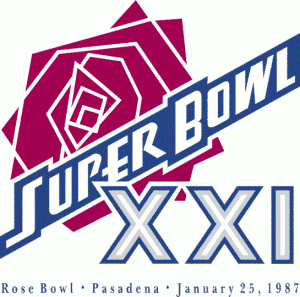
Super Bowl XXI: A very different approach from the last few, this goes for an even more retro look, while still achieving a new milestone for the future. This is the first Super Bowl logo that actively tries to represent its home stadium with the rose motif, which is very abstract and avant-garde. It’s also very asymmetrical, and I could do without the “Super Bowl” font. It barely even looks like a logo; it’s like they tried desperately to get all the elements they wanted to fit. There is a time and place for the diagonal phrase, but this wasn’t it. Grade: C-.

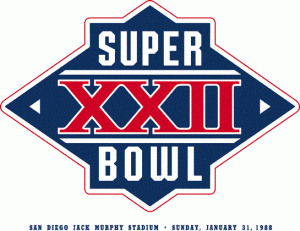
Super Bowl XXII: This one goes back to the same approach used for recent Super Bowls, to very good effect. It’s nice and simple, the “Super Bowl” font is retro but in a way that befits the toughness of the game, and unlike those earlier games, the Roman numeral isn’t fat and distracting. This is one logo that really makes the game look important, and I wouldn’t be surprised if this was the model for many of the 90s logos. Grade: A-.

Super Bowl XXIII: Is this a real game, or a video game? With the generic triangles, generic and blocky Roman numerals, and blocky, vaguely pixelated, asymetric “Super Bowl” (most apparent close up), I wouldn’t be surprised if this was made for the Atari 2600 (or at least the original NES). What’s up with the white poofy collar? Why are the triangles placed where they are relative to the Roman numeral? Why is “Super Bowl” so small, are they trying to hide that this is a recycled video game logo? Can I use Bo Jackson to pwn people’s asses in this game? Grade: C.

Super Bowl XXIV: Now they decided to really get modern, and instead of focusing on strict geometrical shapes, have an impossible banner wrapping around the Roman numeral at an angle. The banner kind of makes it seem like a party, but I can’t keep my eyes off the Roman numeral. It’s so blocky (especially viewed close up where you can see the interior gray lines), and vaguely reminicent of the horrible Super Bowl V logo, that it seems an odd fit with the informal “Super Bowl”. Points for effort, but it’s still an awkward logo. Grade: C+.

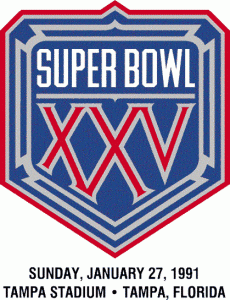
Super Bowl XXV: A return to the geometrical shapes. This logo re-uses many of the best elements of the Super Bowl XXII logo, and puts it in a vaguely pentagonal shape. The “Super Bowl” doesn’t wrap around the Roman numeral, which helps with readability, and the motif all around it helps it look like a real logo. It almost looks like a police badge or a shield. Once again, a simple logo that gets the job done. Grade: A.

Next time: Logos that looks like the recent logos!

Rating the Super Bowl Logos: Part IV

Previously in this series: Part I | II | III

Super Bowl XVI: Similar logo to the last one, but now it’s gold-embossed and in a fat font with sharp edges. They really tried to make this one look special. And yet… something seems off. Maybe it’s how 80s it all is. Maybe it’s the trapezoidal serifs on the Roman numerals. Maybe it’s something off-putting about the embossed look, like it kind of looks like it’s a logo for Publisher’s Clearing House giveaways. Maybe it’s how it manages to be complex and simple at the same time. But somehow, this seems like a step down. Grade: C+.

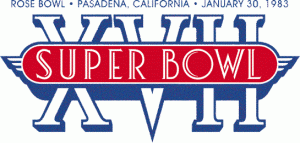
Super Bowl XVII: I guess if Pasadena isn’t known for making cars, it’s known for driving them, because this is the second straight logo for a Super Bowl at the Rose Bowl that looks like the front grille of a car, and the comparisons are even more obvious. “Haven’t you heard? The Super Bowl XVII is so much better than the Super Bowl XIV!” This is another candidate for “first modern Super Bowl logo” with the long rounded rectangle containing the words “Super Bowl”. I’m not necessarily feeling this one either; it hasn’t aged well. The long bottom of the “V” is the main thing putting me off, but there’s also how fancy they tried to make the words “Super Bowl”, which can make it hard to read, and the general perplexity of making the Super Bowl look like a car brand. I’m actually vacillating between whether this is a good logo or a bad one, but I’m kind of leaning bad. Grade: C.

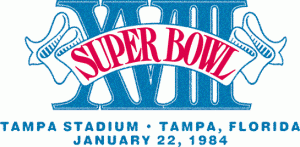
Super Bowl XVIII: Simple yet effective, with the “Super Bowl” banner curving impossibly against perfectly serviceable Roman numerals… and yet the font of the words “Super Bowl” kills it instantly. Just look at how wild those letters are and how they manage to make the whole logo cheezy. Although looking at it in long shot, the way the letters of the Roman numeral are crammed together doesn’t help. Grade: C+.

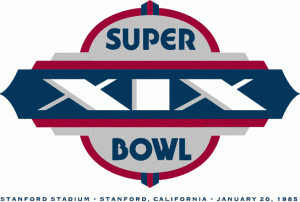
Super Bowl XIX: This is the opposite of the Super Bowl XVIII logo: the “Super Bowl” that flanks the Roman numeral is perfectly servicable, if in a funky 80s font, and the whole pseudo-circle motif really makes this feel like a big football game, but my god, that fat Roman numeral! It’s not as hard to read as you might think, but it’s still an ugly 80s number. Grade: C.

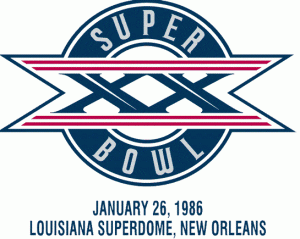
Super Bowl XX: Well, points for looking like the Broadway Video logo. And the Roman numeral, while still fat, isn’t quite as distracting as on the last logo and tries to fit in better. It’s still very 80s, but its simplicity manages to save it from being completely irredeemably cheezy, and instead gives it a certain retro charm. It actually looks like a logo from the 60s or 70s if it weren’t for the fact the Super Bowl didn’t have that kind of logo in that era. Grade: B.

Rating the Super Bowl Logos: Part III

See Part I and Part II of this series.

Super Bowl XI: Basically, a reprise of the Super Bowl VIII logo, only with red, white, and blue colors. I guess because this was the year AFTER the bicentennial and this game was held at the Rose Bowl instead of the South. Oh, and it’s also cramped even though the Roman numeral theoretically takes up less space. All told, this version probably wasn’t quite worth the lack of effort. Grade: C.

Super Bowl XII: Ooh, now they’re really getting fancy! See how it looks like the Roman numeral was signed? This may well be the first Super Bowl logo in the “modern” sense. Now to nitpick: I’m not feeling the font or colors, and the “signed” Roman numeral is painfully 70s and cheezy – and for that matter, hard to read, since it kind of looks like it says “X-11”. Points for effort, and this isn’t a complete embarrassment, but the Super Bowl logos still don’t have a good track record when they try. Grade: C-.

Super Bowl XIII: Simple and generic, but effective. I especially like the dots that form the Roman numeral like it was displayed on a scoreboard, which actually doesn’t lose its legibility close up. The red and blue motif returns as well. My one complaint, if it is a complaint, is the blocky lettering used for the words “Super Bowl”. All in all, however, the best Super Bowl logo done with any effort yet. Grade: B+.

Super Bowl XIV: Well, instead of signing the Roman numeral, they decided to sign “Super Bowl” itself and put the Roman numeral in fat block letters. It actually vaguely looks like the front grille of a Cadillac. “Yeah, I drive a Super Bowl XIV. What’s yours?” This logo doesn’t quite get me ready for some football, but the cursive here isn’t as much of a crime as that from two years ago, even if it is still cheezy and hard to read. Grade: C+.

Super Bowl XV: Went back to the generic route for this one, although the colors are aligned with those of the Saints. This logo is so painfully generic there isn’t much to say about it, neither offensive nor outstanding. I waffled between B- and C+ for this one, and if it didn’t immediately follow the XIV logo it might get a C+. Grade: B-.