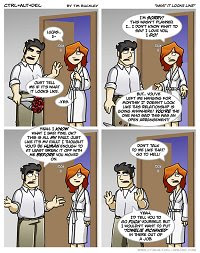
This makes three straight CADs I’ve posted on and four straight I’ve commented on.

(From Ctrl+Alt+Del. Click for full-sized imagined nut shot.)

Sure. Attack me for not recognizing someone we last saw in, what, 2004 now? Under a different art style?

I stand by the idea that CAD is ramping up the DRAMA~! faster than some people might be willing to put up with. Just look at the cross-cutting nature of the current storyline; there’s so much drama that we have to cram two examples of it into one storyline.

Is this more of what Buckley called the “stress-testing” of the relationship between Ethan and Lilah?

Tim Buckley probably isn’t interested in a word I say, but I have to get it off my chest anyway.

(From Ctrl+Alt+Del. Click for full-sized breakup.)

So it looks like Lucas and Kate are splitting up, rather suddenly, just as Lucas was about to tell Kate he finally does love her.

This as we, basically simultaneously (through cross-cutting), learn that Gamehaven, the store where Ethan works (well, sort of), has been sold to someone else… who, whoever it is, apparently doesn’t intend to keep it a video game store (unless there’s something I’m missing).

This on the heels of Ethan and Lilah starting to grow distant, itself on the heels of Lilah’s decision to postpone the wedding.

And of course, all of that comes on the heels of the infamous miscarriage.

In case you’re incredibly dense, all that – despite my hopes that the miscarriage would be a one-time bump in the road, and that while CAD‘s Cerebus Syndrome would continue unabated, it wouldn’t continue to descend into angst – would seem to add up to a full-fledged case of First and Ten Syndrome.

For all the hatred Ctrl+Alt+Del has engendered on the Internet over the years, mostly from a few really loud sources, it has, in actuality, been one of the most popular webcomics on the entire Internet. I believe one of Webcomics.net’s last rankings of webcomics by traffic, distilling the results of traffic-ranking services like Alexa, had Ctrl+Alt+Del behind only Penny Arcade in popularity – outpacing such giants as User Friendly, Order of the Stick, even PVP, even the web homes of newspaper comics like Dilbert and Garfield. People didn’t care that Ctrl+Alt+Del had allegedly bad art, or that it overrelied on violence because its jokes were over by the end of the first panel, or that Ethan was allegedly essentially Tim Buckley’s personal self-insertion Mary Sue. They laughed at the gaming jokes anyway, they enjoyed the wacky scrapes Ethan got into, and moreover, they followed the characters, and their trials and tribulations, with rapt attention.

The miscarriage arc changed all that – arguably going all the way back to Lilah’s announcement of her pregnancy back in February, which seemingly went against what everyone knew about the strip. There was no way – no freaking way Ethan would ever be mature enough to be a father. No way in the world. But when that point was rendered moot in the miscarriage arc, it basically broke the Internet, and turned everyone against Ctrl+Alt+Del. The strip went right from wacky hijinks, with basically no warning (and one easily-misinterpreted strip’s worth of buffer), into an angst-filled suckfest where everyone brooded over what had happened, prompting everyone to fear that full-out First and Ten Syndrome was imminent, if not already started… and back again, kicking right into a joke about D&D 4th Edition as though the main characters weren’t engaging in a round of soul-searching. Attempts to be touching and serious about the matter just fell flat on their face. It didn’t help that the miscarriage came across as a response to people’s objections to the pregnancy, as a hackneyed plot device to paint Buckley out of a corner.

And Buckley didn’t do himself any favors with his attempt to explain himself. Sure, he reassured readers that the strip wouldn’t focus on every second of angst, but that’s offset by the revelation that this was in the works at least as far back as the marriage proposal – which itself was planned as far back as the very earliest days of the strip when Lilah was introduced. Like Order of the Stick, Ctrl+Alt+Del‘s Cerebus Syndrome was planned from the beginning – only it wasn’t a transition to a coherent story like OOTS. It looks like this trip into Cerebus Syndrome will just be nothing but misfortune after misfortune – and right there, as he attempted to explain the miscarriage, and as he attempted to reassure readers the angst wouldn’t continue, he also dropped warnings that there was more to come. “I know who moves out and when”? “I know who dies and who doesn’t die”?!?

Characters don’t need to obsess over their misfortune to bring about First and Ten Syndrome (a term, by the way, I think is a bit too much of a finely-grained subset of Cerebus Syndrome for us to appropriate from Websnark, especially when it’s named after a TV show no one my age has heard of, but it’s useful for my purposes here). Recall the definition of First and Ten Syndrome:

A strip falls into First and Ten Syndrome when they take a shot at Cerebus Syndrome and miss. Rather than be a mix of the Funny and the Story with much better developed characters and more of a sense of reality, the strips fall into a suckfest of angst and misery, with bad things happening to characters we like and all sense of fun beaten out with a stick. While webcomics that fall into First and Ten can continue to have good — even great — moments, it’s an exercise in masochism to find them. (emphasis added)

I don’t read that to mean that every moment where something bad doesn’t happen to our heroes, is a moment where they whine about bad things happening to them instead. Nor should it, because a strip that’s nothing but whining has its own problems separate from whatever it’s whining about. What makes First and Ten Syndrome is the general tone or mood. If we’re not having fun anymore, if everything has to become a soap opera, if all the characters are just pathetic, that‘s when a comic can become unbearable to read and that’s when people start leaving in droves.

It’s true that Ctrl+Alt+Del still has moments when it’s fun and funny, but that arguably just makes the problem worse. It creates a dissonance between the gravity, or at least stress, of the situation and the humor brought to it. The Players and the one-shot game commentaries don’t seem to have decayed one iota, which makes it all the more odd that Ethan and Co. have very little to smile about. It almost seems that Buckley launched the Sillies in anticipation of the suckfest the main strip would become. These strips, the size of three-panel daily newspaper strips, are essentially gag-a-day exploits of the CAD characters, essentially frozen in time, with no mouths or even arms. Anyone who doesn’t like how the lives of Ethan, Lucas, and Lilah are collapsing before their eyes can look at the Sillies and pretend it’s still 2005.

It’s a good thing Buckley has the Sillies because otherwise he’d lose his one defense against the critics he already had. Buckley’s stock defense against people criticizing Ctrl+Alt+Del has been to proclaim how many more readers he has than they can ever hope to have, often in a belligerent enough tone to contribute to the hatred. But it’s a good point: Those readers have stuck with Buckley through thick and thin, often defending him against the likes of John Solomon. But for many of them, the miscarriage was the last straw, and for quite a few more of them, the recent events are the last straw for them, and there are many more last straws to come for others. I’m not among them – in fact I’m finally adding CAD to my RSS reader – but I can see it coming from a mile away.

Buckley may have a story he’s always wanted to tell from the beginning, with a path he’s always intended for it to take, but the beginnings of that story’s kicking into high gear have driven off many of his unwilling defenders. Perhaps Buckley is willing to sacrifice all his readers for his artistic integrity, but considering he’ll also be sacrificing the base of Ctrl+Alt+Del‘s financial success and the public face of his excuse to the John Solomons of the world, what will he really have left?

This is going to become very meta very fast.

I didn’t intend for this to be YWIB week here on Da Blog. My YWIB post was originally going to be one part to be released last week, with a followup on Powerup Comics this week, but the post on YWIB itself got split into two parts and delayed to this week. Nonetheless, I really thought I was done when I finished my post on Powerup Comics, but – probably unaware of what I was doing – Eric Burns(-White) has a rather interesting and relevant post on Websnark that aims to answer the question: Is it possible to criticize the critic? Hey, that’s exactly what I did on Monday and Tuesday!

Burns(-White) also believes it’s obvious the answer is yes, and starts by identifying three definitions of criticism that, to varying extents, we’re probably all familiar with. The first is your English teacher’s definition, what Burns(-White) calls the “analyst” or “scholarly” definition, deconstructing a work to figure out what it’s saying and how it’s saying it. The second is the “reviewer”, which basically says whether a work is good or bad. The third is “critic” as in being “critical”, essentially bashing whatever you’re, well, criticizing. To broadly oversimplify, Websnark generally tries to be definition 1, while Tangents tends to fall more under definition 2, especially as it’s tried to drift away from definition 1. (We all know what definition YWIB falls under.)

We’ve probably all seen all three of these definitions, and seen them get conflated and confused (especially if we’re aware of and looking for them), but what this post, pretty much unintentionally, put into focus for me was how interrelated these three definitions are, and how these interrelations contribute to the conflation (hey, I lost this post earlier today to a Blogger/IE7 bug and I’m retyping this post from memory while something else is on trying to at least continue to claim I posted it on Friday, and failing, so give me a break – I watch TV pretty much nonstop on Fridays from 2 PM to midnight). It can be hard to review something without giving reasons why you think it’s good or bad, which often means dipping into definition 1, and similarly, it can be hard to focus on what a work does, and certainly how it does it, without slipping into value judgments on whether or not it does it right. As for definition 3, that’s basically a modification of definition 2, and it can be hard to determine whether a disapproving review is definition 3, or a negative version of definition 2. If, as Burns(-White) does, you include “constructive criticism” under definition 3, it essentially becomes a conflation of definitions 1 and 2. YWIB has a lot more to do with definition 1 than definition 2.

Burns(-White) then demonstrates how all three definitions are themselves subject to all three forms of criticism, which I won’t get into except to say that Part I of my YWIB review was more definition 2, and Part II was more definition 1. He then finishes by stating that, to some extent or another, he’s written all three forms of criticism on Websnark, prompting the first commenter to respond:

And, if you’ll forgive me a moment of critique, you fall squarely in the first definition of critic. You’re too polite to go far in the third definition, the snark. And you focus too much on things you personally enjoy (or which are created by your personal friends) to be an effective reviewer for new or unheard of comics. And that’s fine — this is your blog, first and foremost, and people should be aware that they’re getting only what you want to write.

The webcomic world really could *use* a popular, unbiased, and wide-focus reviewer. But you ain’t it, and you should push back against people who want you to be.

This prompted a later commenter to respond: “When there are so many “reviewers/bloggers/news site owners” looking to do little more than get in the good graces of their favorite creators so they can hang out at cons together? Might as well ask for all of Bill Gates’ money while you’re at it.”

First off, I’d have to disagree with both Burns(-White) and that first commenter; if anything, Websnark fairly consistently falls under definition 2, even when it tries not to. It makes a point in the FAQ that the name is somewhat misleading, as it doesn’t really snark so much (other than “You Had Me And You Lost Me” I’d be hard pressed to find a single example of definition 3), and even when attempting to simply do analysis and deconstruction can often incorporate how whatever he’s examining made him laugh or how much he’s enjoying what the strip is doing. On occasion, Burns(-White) has even mentioned times when a strip just isn’t doing it for him, so he doesn’t praise every strip.

The major issue with being a “popular, unbiased, wide-focus reviewer” mostly has to do with the wide-focus part. There are a lot of strips that aim for specific niches. It’s hard to truly appreciate a strip like Penny Arcade or Ctrl+Alt+Del or even User Friendly if you’re not a part of the gaming subculture. On those occasions when xkcd refers to some obscure bit of math, if you’re not a math major you may find it hard to assess properly.

I’m not a definition 1 critic; I’m just too detached from all the esoterica of scholarly analysis to examine comics as closely as Burns(-White) is known to do sometimes. I’m just not that much of an English major. Yet much of what I’ve done so far has been, in fact, best categorized under definition 1, in part because of the areas where definitions 1 and 2 overlap and in part because I’ve seen myself as something of a successor to the once-dormant Websnark. Now that Websnark has started to come back to life again, and with the start of school coming up in less than a month now, I’ve been starting to think about possibly dropping my webcomic reviews.

I think, especially if Part I of my YWIB review is any indication, I’ve started to see myself as a definition 2 critic and even potentially the answer to the commenter’s call. But it’s very hard to be wide-focus enough to properly assess all the webcomics out there, and it’s always very tempting to slip into definition 1. Those are the main reasons there isn’t a truly unbiased popular webcomics reviewer out there, why “the Roger Ebert of Webcomics Criticism” (definition 2) is someone who fancies himself a definition 1.

(And now one of the commenters says another reason is that you’d need to either pay someone or have enough money not to need a job, rendering any other considerations irrelevant. Them’s fighting words.)

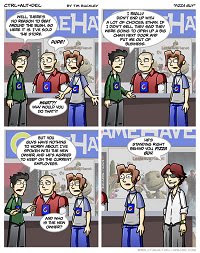
I actually had to type this really short review three times for different reasons.

(From Ctrl+Alt+Del. Click for full-sized pizza guy!)

What… the… hell?

After Wednesday’s suggestion that Kate may have found a new boyfriend, and now the tired old cliche of “selling the store”, I think I really am pushing back the Penny Arcade review back another week.

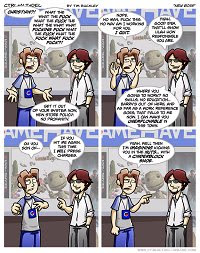
And wait… is that Scott, or someone else? Or is it… Heaven forbid… Tim Buckley himself?!? The hair is similar to that of Buckley’s avatar, the goatee doesn’t really match Scott’s…

Speaking of gamer comics with a reputation for crappiness, after reading today’s Ctrl+Alt+Del, I may have to push back the Penny Arcade review a week or two.

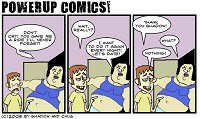
(From Powerup Comics. Click for full-sized blissful ignorance.)

As much as I’ve criticized YWIB over the past couple of days, I do sympathize with their frustration, and to tell you why I need to tell a little story.

Once upon a time, some people at the Truth and Beauty Bombs forums (the forums for Dinosaur Comics and some others, and the place that gave us the “Garfield without Garfield’s lines” meme, which eventually became “Garfield without Garfield” himself) decided to take a bunch of cut-and-pasted elements, throw them in MS Paint, and create the crappiest gaming comic they could. The result was Powerup Comics, and once it started picking up steam among the members, they started a DrunkDuck account and started storing their comics there.

But here’s the real punchline: Powerup Comics – intended to be a parody and the worst gaming comic ever – attracted people who treated it completely seriously. And liked it.

A comic intended to be the worst gaming comic ever, attracted actual fans.

When the people at YWIB reviewed Powerup Comics as an April Fool’s joke (which actually attracted some defenses of the comic from people not in on the joke), and ended the review by claiming that there was no point in continuing and so they were ending YWIB, I would not have blamed them for quitting for real. Heck, it’s enough to make me wonder if it’s a lost cause.

It’s hard to see what the strip’s fans see in it, unless they’re actually T&BB members furthering the parody. The art definitely falls on the “distraction” side of the line of badness, for lack of a better term; it’s blatantly an MS Paint copy-paste job, more so than others of the type, but instead of looking computer generated like sprite comics and Dinosaur Comics, it just looks like a 12-year-old drew it (or younger). My artistic abilities must be the crappiest in the universe, yet I actually could ape the Powerup Comics style. There’s the same propensity towards violence as Ctrl+Alt+Del, only so much more unnecessary as to seem completely random. Some strips have no punchline whatsoever (which is itself supposed to be the punchline), some have been done a gazillion times before.

I could go on, but I’ve made my point already. I’ll just point out that the YWIB folks may have inadvertantly hit on something without realizing it, and that’s the real reason for CAD‘s popularity, the distinction between Ctrl+Alt+Del and the mounds of crappy gaming comics they’ve reviewed. Say what you will about CAD‘s art, it’s positively Rembrandt compared to Powerup Comics or even Cartridge Comics. I could go on, but I’m on a bit of a clock here. Gotta go!

YWIB Part II: Wherein I nearly have a nervous breakdown.

Note to self: In the future, if I’m going to start a post that may become a two-parter, start working a week in advance. Not only has this post and its predecessor eaten up my time for the past week (and I have one more post coming tomorrow to make up for two weeks ago), I lost it at least twice, and the first time was the reason for writing Sunday’s Blogger feature request. Even though this post only really took me Saturday to write, if it weren’t for the fact that the crash occured in the act of copying this post out of Part I and into a separate post, I might not have posted either part. This is more of a supplement to Part I than an actual follow-up, so I recommend you read Part I first.

So how “objective” is John Solomon? Are his criticisms valid? After all, many of those problems could be water under the bridge if he wasn’t bringing too many of his own biases into the picture. If he was attacking comics for egregious enough errors, for errors that only a complete moron would think didn’t exist, I might be willing to forgive his errors in strategy and style. As such, let’s look at his review of a comic you probably never heard of, Cartridge Comics, because if I’m right a comic that committed such egregious errors should never become popular. (Although it does see PW ad rates of 50-60 cents, although that’s in part because it only allows bidding in 10-cent increments.) Before we enter, keep in mind that the strip has subsequently undergone a complete reboot as Cartridge, so some of this might not be completely extant anymore.

First complaint: it splits the work between a writer and an artist. The main complaint, aside from being a “gamer comic” but I have some of the same issues with that that I do with this, is that this is a problem because everyone else does it and it’s a hallmark of crap. When Solomon goes after “gamer comics” there is sometimes the implication that gaming comics are inherently bad, but here he only says that a lot of people split the work because Penny Arcade does, and Gabe and Tycho are (in his mind) competent at what they do while imitators aren’t. So far, (almost) so good, and I’ve spent one paragraph on it instead of four and a half.

Next complaint: “Even my rather meagre drawing talent is sufficient to replicate this kind of shit. Or this kind of shit.” Well, mine isn’t. Okay, so the drawing of Batman’s costume in the second one (what is it with some of these webcomics and superheroes, especially Batman?) is a bit oversimplified, but like Ctrl+Alt+Del, it’s passable. Once again, in webcomics, art is overrated. It’s possible to create complete chicken scratch that’s even recognizable that still turns off readers, but the bar is far lower than some critics claim. Solomon chronicles some examples here. Have a look at the first two examples. Cartridge Comics isn’t anywhere near as bad as that crap (computer-generated stick figures might actually be preferable).

Okay, so this one actually falls below CAD level, suggesting those two were bad examples (and at least one of them is linked to with the wrong date, and linked to again later, twice, with two more wrong dates and a bad description, suggesting some strips have been censored from the archive even more completely than with Dresden Codak, the result of the aforementioned reboot and ongoing shafting of self-admitted “quite shitty” comics into a side archive that itself eventually got deleted), and in fact it’s bad enough that it does raise the bar a little for the writing for me to appreciate it, but “muppets”? So the art could definitely use improvement, more than CAD ever could, and the artist could stand to learn some perspective. And the body bends and stretches in really weird ways, and there don’t seem to be any knees – but the art had developed enough by that 2007 strip that it doesn’t raise the bar for the writing anymore. The wonkiness doesn’t get in the way of my enjoyment of the strip. It’s a minor point. (And maybe the weird bending and stretching is intentional, which would probably get boiled down by the creators as “it’s a STYLE” which would just get mocked to oblivion by Solomon.)

On to Solomon’s criticism of the writing, and this section sees quite a few links to strips censored, and it’s more important I see the actual strip being referred to, not just any old random strip. I’ll only make mention of those strips I can see. Is the girl in this strip a “walking cliche”? It’s more than a little unfair to judge someone’s character off of one strip when it’s implied that character has made appearances in the past, but it appears she’s being portrayed as a little more than Ben “Yahtzee” Croshaw’s stereotypical webcomic idea of “The Girl“, supposedly based off the webcomicker’s mom and slightly disdainful of, but willing to put up with, the wacky antics of the male characters. She also appears to be obsessed with cleanliness. So she’s a walking pair of cliches. (Not that kind of pair, you perv.) Maybe Solomon sees that as only “half a fucking micron,” I don’t know and I don’t know if I would even be able to look at her prior appearances.

As for this strip, the basic setup should be clear, if a bit cliche: someone sends his roommate to turn down the neighbor’s noise, and said roommate is completely distracted by what said neighbor is doing. The punchline is a bit mystifying – “adding a topping to your pizza” doesn’t sound threatening – I’m guessing what got added was something bad, but it is a little hard to tell. But just because it makes no sense doesn’t mean it’s not a joke at all. And I don’t have any reaction to using Google image art as posters, as Solomon accuses the strip of doing. It looks a little odd if you look closely, but it’s not jarring.

Moving on… Misplaced breasts? Again, passable enough not to pull me out of it, and the first example doesn’t even seem to be a problem for me at all, though like Solomon accuses of the artist, I’ve never seen porn in my life and I hope I never will. But you shouldn’t need to have seen porn to figure out where to put breasts unless you’re talking specifically about the nipples. Just look at a picture of a woman, or something. (At this point, the artist could even look at the ridiculously-endowed webcomic-reviewer-avatar that sometimes appears in the PW ads.) But again, I probably wouldn’t have even noticed if Solomon hadn’t pointed it out. The alleged sprites are both out of the archive, and while the appearances by TV characters are all still in, I don’t have a problem with them either. Sometimes they’re part of the joke. I wouldn’t put it past Penny Arcade or Ctrl+Alt+Del to do that sort of joke. Okay yes, actually lifting the characters whole-cloth from their surroundings instead of drawing them yourselves and fitting them into your art style is jarring and just doesn’t reflect well on you, but I could probably run with it.

So maybe Cartridge Comics wasn’t a good example, because it’s probably improved since the reboot and it probably still isn’t that good. But I do know I like Bob and George. And by “like”, I mean “once I get much further than where the current annotations are I find it hard to stop”. So I’m sure I’m going to be in a position to defend it.

Let’s ignore that Solomon starts out claiming that “the only redeeming quality it possesses” is that it’s over yet subsequently says the first game parody storyline “wasn’t so bad”, and praises it at least one other time later on. “Poor art“: I’m not sure you can really call “poor art” on a sprite comic. You can’t compare sprite comics to non-sprite comics without making a value judgment on sprite comics in general, and you can’t generally compare sprite comics to other sprite comics without making a value judgment on the graphics quality of the games they come from, since they should all use the same sprites. Maybe you can say “good manipulation” or something of the sort, to get things you can’t get in the original sprites. Or maybe it’s staging or something. Anyway, in the strip in question, I’m guessing Solomon’s referring to the use of a “big gray block” as a “fridge” instead of, you know, making it look something like a fridge. At least a narrow rectangle representing the door or something.

Unlike what seems like everyone in the universe, I don’t have a problem with Comic Sans in webcomics, seeing as I use it myself. It’s worth noting that in my case Comic Sans contributes to the overall simple, cartoony feel of Sandsday. So remember kids, if you’re going to break the rules, make absolutely sure you know why you’re breaking them. But although I rejected the Comic Sans early Bob and George uses for Sandsday, after using it for maybe a week, I don’t have a problem with it here, in part because the color and the use of an actual box prevent it from really getting in the way. What I have an issue with is the small-size, tightly-spaced, all-caps, wall-of-text-inducing Comic Sans used by strips like Sluggy Freelance or General Protection Fault. And any strip that uses Arial or Times New Roman.

I can understand having a problem with a self-insertion character, and it’s true that the Author’s first appearance is basically a deus ex machina, but he’s not a Mary Sue there to steal the show; he generally only appears when necessary. For that matter, the Author is far from perfect; he had a nervous breakdown once, threatening to shatter the strip itself to pieces, and often gets ridiculed by his own characters. The Author turns Bob and George, such as its plot is, into a meta-plot that folds in on itself, bringing forth a new outlook on the relationship between creator and created. It’s not exactly 1/0, but it’s not having a walking deus-ex-machina Mary Sue derailing the strip either.

Although judging from his problem with the Author, Solomon probably wouldn’t like 1/0 either; he thinks it’s “retarded” to equate the author of a story to a creator god. If you prefer, John, the Author isn’t really a self-insertion, he’s just the comic’s local god. Or if that’s not enough for you, you can read up on willing suspension of disbelief and the idea we’re supposed to think a story depicts real events while we’re reading it, even if we know, deep down, it isn’t, and even if it contains flying saucers running around everywhere. Yeah, I know this kind of metahumor and knowing-you’re-in-a-comic-strip is supposed to break willing suspension of disbelief, but it doesn’t really seem to negatively affect Order of the Stick that much. David Morgan-Mar has even been known to insert his “me” character into Irregular Webcomic! plotlines as the ostensible “GM”, and as just a cartoonist. It’s a funny thing, the relationship between the reader and the comic. But it’s far from “objective” to say it’s “retarded” to equate the author of a story to a creator god. (And let me riff off the comments for a sec: What did Grant Morrison do right in Animal Man that Anez doesn’t do with the Author? Or more to the point, that isn’t done in 1/0?)

I’m going to ignore the hand-drawn comic because all parties agree it’s bullshit in every way possible. Let’s also ignore the suggestion that Anez just stick to parodying each Mega Man game in order and end the comic with the last game, and the idea that he screwed up that plan by bringing the Author back as Dr. Wily’s McGuffin. I won’t defend Anez sticking with his hand-drawn comic after the first attempt at it should have told him it wouldn’t work. But I will say I can’t defend Bob and George at the transplant of the title characters into the Megaman plotline, or the supposedly “shitty original character” of Mynd, if I don’t know why Solomon thinks Anez shouldn’t have imported Bob, George, or Mynd. In my view, he did a pretty good job of integrating Bob and George into the Megaman madness.

As for the crossover storyline, so far as I can tell there are no references to any fan comics there, since it’s not a crossover with a webcomic, and it’s mostly there so that Anez could claim to have had a crossover (coming at a time when it seemed crossovers were all the rage in webcomics). And by this point Bob and George is really a comic with Megaman characters in it, not a comic about Megaman, and game parodies were basically rare treats, so a bit of Cerebus Syndrome could probably be excused as long as it’s well executed, and by that point we felt for the characters enough to want to see them kick Mynd’s ass or at least stop him from destroying the universe. Maybe it crossed the line into First and Ten, and certainly there aren’t really punchlines bringing the Funny, but only people who really don’t like to see comics devolve into suckfests wouldn’t at least want to stick around to see how it plays out. It’s not like negating basically an entire running plotline and engaging such a sudden shift from funny to super-serious and vice-versa it almost makes the serious stuff seem funny, in a bad way, like some webcomics I know.

I can’t share your opinion on the chick saying “nyu” because I haven’t had your bad experiences with that word, or non-word, across the Internet. Perhaps because I stay as far away from 4chan as possible and don’t let it, or its bretheren, rot my brain. As for completely remaking the plot of Megaman 4 around Ran, that just creates more excitement in wanting to find out what the new plot is. And I haven’t gotten far enough ahead in my reading to see if the descent into mounds of exposition is as present as it seems in this strip, but all I can say is that I was okay with the ending, dating all the way back to “The Seventh Party”. And before you deride it as “Dragonball Z with (somehow) even more exposition”, keep in mind that DBZ was enormously popular.

Probably none of these comics are perfect. Probably quite a few of the criticisms Solomon lays into them for are valid criticisms. But there are quite a few that belie Solomon’s claims to “objectivity”, if only because they’re nowhere near deal-breakers. Solomon tears into quite a few comics that he sees as, not just mediocre or even bad, but BLARGH THE WORST WEBCOMICS EVER and they just aren’t, because if they were he wouldn’t need to ask why they were popular. Art is overrated, and Solomon even seems to recognize this, because at one point he claims that “while good writing can save bad art, good art can do nothing to salvage terrible writing,” yet he still bashes comics for having terrible art when, at the very least, they’re no worse than Cartridge Comics. As for plot, the issue Solomon has with the plot of Bob and George isn’t so much that it’s badly structured, so much as its source material (the happy-go-lucky Megaman games) and its level of exposition. Mounds of exposition is a point against a plot, but it’s hardly enough to say “this plot COMPLETELY sucks and I’m going to compare it to DBZ”. I didn’t even encounter a claim of bad dialogue I could assess properly; the closest I came to one (“nyu”) seemed to come down to personal annoyance, hardly “objective”.

It’s a bit of a shame that the people flooding YWIB to defend the strips Solomon attacks so often have tended to say little more than “u sux lol” because it’s tended to reinforce Solomon’s popularity when he can use his critics as a source of humor, distracting from the fact that he’s not only subjective, but arrogant. I said in Part I that it wouldn’t matter so much that Solomon’s reviews took the form of profanity-laden tirades if there was some meat on those bones, and the fact is there is, but it’s diluted by irrelevant points and personal opinions disguised as fact. Perhaps it’s prose writing, in the form of blog posts, that really needs the right combination of style (art) and substance (writing), and the fact is Solomon’s reviews just don’t have enough of the latter to make up for the off-putting style.
A comment on a blog, and a manifesto for this one.

Warning, this post contains uncensored obsenities.

Perhaps it’s cruel to pick on Your Webcomic is Bad and You Should Feel Bad when it hasn’t posted since April (which may or may not be part of an extended joke on Dresden Codak). Perhaps it’s needlessly keeping alive a meme that was stale from the start to pick on a site that was only really extant for five months, plus another two of much slower posting, and whose current hiatus spans its first birthday. Perhaps it’s a blatant ploy for hits, since YWIB uses a trackback feature that links to any post that links to it, which has resulted in more than a few people coming over and looking at my Dresden Codak post.

John Solomon never intended to create, depending on your point of view, the whipping boy or the alterna-Websnark of the webcomics community. YWIB was originally intended for a small circle of friends, essentially for them to go, “This is a pile of crap! Look and laugh at the pile of crap and the crapper that produced the crap!” But word started spreading around the blogosphere, and Solomon found himself bogged down with readers (which he continues to disdain the existence of) both praising and critical, neither one exactly as brain-using as the group surrounding Websnark.

The resulting dynamic is interesting to say the least. Solomon (or one of his friends) finds a webcomic, goes on a profanity-laden tirade against it and rips it to shreds (Solomon is more prone to profanities than his friends but the tone isn’t much different), and the fans of the blog go “gr8 j0b, u dun it agin!!!!” and the fans of the comic show up and go “u sux f0r r1ppn teh b3st com1c in th3 hole wrld!!!!!” Lather, rinse, repeat until you’ve lost all respect for humanity.

Although Solomon has said once or twice that he originally started YWIB to “entertain” a few people, he’s also, far more commonly, seen himself as a white knight saving webcomics from themselves, despite his own observation that most webcomic creators are not interested in listening to suggestions for improvement. In his eyes, the webcomic community is a place where everyone is nice all the time and where someone needed to come in and throw around some of the meanness common elsewhere on the Internet, that the majority of comments made towards webcomics beyond his own blog were made by “sycophants. Circlejerking little plebians who feel it is their solemn duty to fellate the creator for every single thing, regardless of quality or anything.” He would review comics that were popular “for reasons that God himself could not begin to fathom even if he spent all eternity working on it.”

Which might have been a good point, but from the very beginning he claimed that YWIB was “a wholly objective blog where I take it upon myself to discuss, at length, these webcomics and the multitude of reasons why they are excruciatingly terrible and are worse than Hitler.” He actually continued that “objective” tack, attacking people for claiming “it’s not bad art, it’s a STYLE” or “font choice doesn’t matter” or “you can’t be objective about ART”. So far as he’s not talking about the “broad content” of a strip, only the “plots, the dialogue, the art,” he’s sticking to that goal of being “objective”. And he can talk about the plots, the dialogue, and the art all he wants and still be “objective”. (Let’s not forget the font choice for the dialogue as well.)

I’ve said it before and I’ll say it again: Ideally, no comic that was “objectively” bad would get the popularity of a Ctrl+Alt+Del. I say “ideally” because in any medium, complete bullshit gets released and becomes inexplicably popular. Some people liked Epic Movie and Meet the Spartans enough that they’re now putting out Disaster Movie. Rob Schnieder kept putting out the same sort of shitty movies for years. Far be it for me to try to explain why. But although anyone can take whatever crap their dog shit on the sidewalk that morning, post it on the web, and call it a webcomic, webcomics do actually have a survival of the fittest system that weeds out the crappy comics, or at least keeps them with only one or two readers, and rewards at least a semblance of quality. Webcomics grow almost exclusively through some form of word of mouth. Yes, there are webcomics that advertise elsewhere on the web, sometimes in other webcomics, but those webcomics have the money to advertise in the first place. That means they already grew an audience, probably through word of mouth. That means people linking to it on forums, and sending it through e-mails, and recommending it on their blogs.

Neither YWIB nor Websnark ever really advertised anywhere, yet both became incredibly popular almost immediately. Neither Da Blog nor Sandsday has anywhere near that level of popularity, despite what I would consider to be some pretty spiffy webcomic reviews on the former and some actual linkspam on my part, and most of what it does have is off the back of one link from David Morgan-Mar’s LiveJournal. There aren’t enough people who are reading either, thinking “you know, this Morgan Wick cat is pretty cool”, and telling their friends about it through whatever means. That means one of two things: I just don’t have that critical mass of readers yet that starts feeding itself, or what I’m doing here is absolute bullshit that no one needs or wants to tell their friends about. If I eventually got that critical mass of readers while still putting out complete bullshit, I could see someone wanting to go around and tell people “why are you reading this guy? He’s got complete bullshit.” But I only have fifty readers on my very best days. I’m suffering enough; I don’t need someone going around telling people I suck. Besides, even if people do go around saying I put out complete bullshit, it’s not really going to stop people from coming if they enjoy what I write anyway; after all, like television and any other website, they don’t directly pay for it.

Yet Solomon tears into webcomics no one has ever heard of, which is just counterproductive. He may disdain the readers he has and accuse people who perceive “more readers” as a good thing as attention whores, but he must realize that they are attention whores, and when he goes into one of his trademark rants saying “this strip is absolute crap”, he isn’t doing anything that needed to be done, because the strip he’s pointing at didn’t have any readers. On the other hand, because he’s linking to it from his blog, there are now going to be people who are going to come over and read the strip, and some of them may decide they don’t agree with Solomon’s assessment and stay there for good, and perhaps even become the kind of sycophantic, “you’re doing a great job” fans that’s exactly what Solomon hates. Far from destroying a bad webcomic, he’s fostered the culture of bad webcomicdom. Perhaps it’s better, if you’re trying to improve the culture of webcomics to foster quality, to just point out what the webcomicker is doing wrong and how the comic could be improved into something better, if you think the comic could be improved into a quality product, and if it can’t best to just leave it alone and suffer its fate, only tearing into it as it becomes popular.

The flip side of it is when Solomon reviews a Ctrl+Alt+Del or a Dominic Deegan or a Shortpacked! and attempts to tell the masses “who can’t tell trash from gold” why their favorite webcomic is, in fact, shit. As mentioned before, the problem with the internet isn’t that anyone can put out a webcomic, it’s that anyone can read any webcomic, at least any webcomic that isn’t behind a paywall. Nothing Solomon or anyone else can do or say can decrease a webcomic’s audience appreciably, except maybe the creator himself (see Buckley, Tim, re: Miscarriage). If the person enjoys the webcomic, all it costs him is a little bit of time each day, so no matter how Solomon goes about his business, he isn’t going to persuade anyone to stop reading, and might make people start reading just by bringing attention to it.

To the extent he can show people the comics they read are bad at all, and actually dissuade people from reading them, it’s by showing them the good comics and what they do well that other comics don’t. If fans of some webcomics only like those webcomics because they don’t know any better, you could say “the art’s bad, the plot goes off in random directions, no actual person would say this dialogue”, but it’s not likely to change the person’s mind because all he knows is that he likes the comic. But if you expose him to a Gunnerkrigg Court (a comic Solomon is on record as liking) or an Order of the Stick, and you tell them “this is what good art looks like, this is a tightly-wound plot, this is what real people sound like” (or in the case of OOTS, “this is actually passable art for these reasons” and “this dialogue is actually funny, unlike the excrement you read” – I’d say “this is what expressions are supposed to look like” except that to some extent, Rich Burlew’s expressions bear a disturbing similarity to the infamous Ctrl+Alt+Del B^U), there’s a chance they won’t be able to go back to their old bullshit ever again.
 
Those aren’t the only problems with YWIB, and it would be beating a dead horse to point out that the tone and insulting manner he takes is a bit of a turn-off and tends to obfuscate the points he makes. But even so, I could still at least say he might be just a little misunderstood if he really was as “objective” as he claims. But as will become apparent in Part II tomorrow, he quite simply allows too many personal opinions and even personal pet peeves to influence his analysis.
 
I really think Solomon’s stated goal was a noble one, but if he is gone from the Internet for good I suspect it’s because he’s realized he’s lost. He completely failed. There are people who started looking to Solomon’s rants for recommendations for webcomics they might like, on the grounds that if Solomon hates it, it must be good. Almost from the start of the blog there were people actually asking Solomon to tear into their comics, apparently desperate for the hits they would bring. Some progress seems to have been made – at least one comic reviewed by Solomon doesn’t seem to be on the Internet anymore, and one of the comics whose review I will look at tomorrow has undergone a reboot, presumably chasing fixes for Solomon’s criticisms – but regardless of whether or not it was intended as parody, regardless even whether or not it’s still intended as parody, YWIB has become a self-parody even in spite of itself.
 
I do agree that we shouldn’t let webcomics be dominated by absolute bullshit, or let the webcomics community become too much of a self-congratulatory happy family, but if the creators of that bullshit are anything like, say, Tim Buckley, it’s sort of a lost cause to attempt to chase out or fix the bad apples. It’s still worth it to point out the bad apples – after bashing “Bobby Tangents” became a running gag on YWIB for supposedly sucking up to any comic he reviewed, Robert Howard has subsequently taken on a more critical tone – but if it’s necessary it’s probably not all that bad, and if it isn’t necessary it isn’t necessary. What’s needed is to reward and expose the good apples, and show what it is that they do right, and how we can compare that to the comics that do things wrong, and challenge the wrongdoers willing to listen to do things right. We could even work to improve webcomics in general if that site would update at some point since October. That’s the manifesto for Da Blog’s webcomic reviews, and that’s what’s really needed in the webcomic community. If Solomon ultimately helps to create a webcomic community that’s a tough but firm mother, not only working to get the medium respect as a medium but also challenging webcomics to earn that respect, perhaps his seven months of profanity-laden tirades wasn’t a complete waste.

(And really, folks, “John Sololame”? You pass up the far better “John So-lame-on” pun?)

Because there’s a chance this is the only post you’ll get from me today. Well, other than the Random Internet Discovery.

After what’s seemed like ages off – months, really – Eric Burns(-White) has been surprisingly active recently at Websnark. In fact, one recent post had all the trappings of Websnark’s heyday, complete with “click for full sized (insert description relevant to strip under discussion here)” and short, snappy description of the strip in question. (And he’s done another one since then!) I don’t think he dipped very far into the lexicon, but it was a far cry to the more in-depth analyses of the “State of the Web(cartoonist)” series, and a welcome change of pace from the lengthy exegeses on non-webcomic-related Internet controversies that had marked the last few months of seeming hiatus. Eric Burns’ audience was built on webcomics, and I think a goodly number of people reading the RSS feed probably read these exegeses and thought, “That’s great, but when are you going to talk about webcomics again, Eric? When are you going to talk about the Ctrl+Alt+Del miscarriage storyline? Or the recent racheting tension at Order of the Stick? Or Girl Genius? Or whatever the hell happened to Penny Arcade? Or or or…”

Well, on the aforementioned harkening back to Websnark’s heyday, I had left a comment saying as such. And on a recent strip marking Websnark’s fourth anniversary, Burns(-White) referenced that comment and referred to me by name.

Okay, so maybe this is a narcissistic, ego-stroking post. But if he’d bothered to link to Da Blog, it would have been an acknowledgement of a traffic bump! But it points to a reason why I’m doing webcomic posts: Websnark has loosened the slack, Tangents basically doesn’t exist right now, and I don’t know of another active site that’s really a close equivalent to either. (Okay, so Burns(-White) tells me there are “a f***ton of blogs about webcomics”, but damned if I know what they are.) But I can’t pick up the slack too much because I have other interests as well and I don’t have that kind of time.

I do feel this line may be relevant to me:

Well, for one thing, it means we can all stop taking things so fucking seriously all the time. I gave up drama a while back, and I’ve mostly stuck to that, and I’ve found I enjoy things a lot more than I used to. It means that the chances that Websnark — or any largely webcomics related blog — can claw up to almost six figures of readership again are pretty damn low. There’s too much out there, which means there’s too little need to congregate at one writer’s doorstep. It means that there’s no need to do this kind of thing… except of course if you enjoy doing this kind of thing.

Except. It’s still worth it to make sure everyone’s doing everything right, to keep webcomics honest, to show who deserves a biscuit and who deserves dog s**t, because market forces are the only way comics get forced out on the Web. That’s the stated goal of the site I intend to look at in my second webcomics post of the week. Whether it succeeds – and what its unwanted success in terms of readership numbers really means for the future of webcomic blogs, and webcomics – will be among the topics I intend to look at.

At some point down the line, I’ll go into more detail about this. Not right now though.

Project Wonderful’s top 30 highest bidding sites are all webcomics. That’s essentially every site that’s going for more than 10 dollars a day, and all but one of the over-$9 bidders. This being the exception.

In fact, every one of the top 10 is either a “skyscraper” (like my sidebar ad) or a “leaderboard”. (Somehow Menange a 3 manages to get impressive bid results from a banner, when my banner comes nowhere near competing with my skyscraper even though the former is in a far better position.) That’s got me thinking about potentially changing my “premier” ad to a leaderboard.

I know the really popular sites can afford their own ad services, and that webcomics often need advertising more than other sites, and such, but… damn.

(A skyscraper ad may be coming to Sandsday by the end of the week, though I still need to figure out how I would go about having both a master site and subsites.)