If the NFL decides not to schedule another tentative game for Week 17 primetime again, they should list “Game TBD” on their schedule page.
Never assume anyone has a positive IQ.
Author and Thinker
If the NFL decides not to schedule another tentative game for Week 17 primetime again, they should list “Game TBD” on their schedule page.
Never assume anyone has a positive IQ.
NBC’s Sunday Night Football package gives it flexible scheduling. For the last seven weeks of the season, the games are determined on 12-day notice, 6-day notice for Week 17.
The first year, no game was listed in the Sunday Night slot, only a notation that one game could move there. Now, NBC lists the game it “tentatively” schedules for each night. However, the NFL is in charge of moving games to prime time.
Here are the rules from the NFL web site (note that this was written with last season in mind):
Here are the current tentatively-scheduled games and my predictions:
Week 17 (December 28 Playoff Positioning Watch):
If you’re interested in fancying yourself a Jackson Pollock and creating your own work of “art”, have at it. There’s something more profound I need to get to.
This post (link courtesy Awful Announcing) takes a look at how the blog market could be affected by the present recession. It’s mostly written from a sports blog perspective, especially paid sports blogs, but it has implications for everyone else who blogs, paid or not, employed by a third party or merely doing it themselves, whether for fun or profit.
It takes an interesting perspective: Although some, like the blog collective Gawker, think ad revenue is likely to decline in the current recession, the post itself talks to several bloggers and draws its own conclusion based on a study, and they seem to all agree that the recession could help blogs. Some people might decide that, needing to cut costs, the Internet might be one of the first things to go, but AA’s own proprietor suggests the Internet might be one of the last things to go, because it has become so important to job searches – and thus could increase in importance to many people. Some of the bloggers talked to suggested that the blog population could rise as newspapers cut traditional journalists, making room for cheaper bloggers, and as laid-off workers of all stripes look for new lines of work.
Regardless of whether it becomes Great Depression II, this could be one of, if not the, most important recession in our history.
If some of these reactions are true, this recession could greatly accelerate the rate at which the Internet becomes the chief way people get their news, information, and entertainment. At the moment, the Internet is big enough that “old media” – newspapers and TV – are concerned about the impact of losing their audience to it, but not big enough that they’re comfortable with making money off it. If it ever can get that big – and this recession could greatly hasten the day that it happens – newspapers and television as we know them could become as antiquated as the telegraph.
And as the Internet and blogging grows, it has the potential to change the very way we live. We may well look back on the first decade of the new millenium as a time of great flux and transition, when the Internet was still in its relative infancy, or at least childhood and was still taking shape, still taking the form that would shape the twenty-first century. One thing I neglected to mention when I listed a number of ideas I have and might like to work on was a book coming out of my continual wonder at how dramatically the Internet has already changed our lives, and how it holds the potential to change our lives even more, affecting everything from the news to entertainment to politics to even the very underpinning of our economic system. I had been thinking about holding off on writing it until I had enough of a name that I would have any credibility whatsoever, but recent events – not least of which being the coming recession – have convinced me that right now is a unique moment in history in the evolution of the Internet, and “the fierce urgency of now” – to borrow a phrase from our president-elect – would seem to dictate that I get such a book written in the next couple of years, and preferably starting as soon as possible.
There’s supposed to be a second part coming out today, “focus[ing] on reactions from bloggers who blog as a hobby (i.e. for free) and from readers whose blog-reading habits may be affected by the economy,” and the post elicits reactions from anyone that would fall in either or both of those categories. I’ve sent this post to the blogger in question, but I want to hear from anyone that would have a voice in all of this, anyone who might use the Internet on a regular basis as an outlet, from YouTubers to webcomickers – not to mention, if possible, any advertisers who I imagine count for a significant amount of revenue. Send an e-mail to mwmailsea at yahoo dot com, or if you want to take it directly to him (and his second post encourages it), use the address on the sidebar of that page.
I should probably stop talking so much about YWIB&YSFB. It was popular for maybe five months last year, made a brief (and far less productive) comeback early this year, and hasn’t updated since. But when it was at the height of its (reluctant) popularity, one of its favorite targets, when it took aim at something other than the subject of a post, was Robert A. Howard, proprietor of Tangents.
Referred to simply as “Bobby Tangents”, Howard was regularly painted as a “c**ksucker” with a gender-switching fetish, apparently because he reads a disturbingly significant amount of gender-switching comics, which might have something to do with the fact that there are a disturbingly significant amount of gender-switching comics. When he did a review of Tangents itself, John Solomon compared him to the kid in the playground who desperately wanted to be anyone’s – anyone’s – friend, no matter the cost, because if you asked him to eat a bug, by golly, he’d practically cook up a bug sandwich if he felt it would make him your friend. (What’s everybody looking at me for all of a sudden?) So with Howard, as Solomon saw it, he would tell a webcomic author how great they are supposedly just so they would give him the attention, or at least credibility.
Well, ol’ Bobby Howard took that to heart, and he started shifting, becoming less of a suck-up and throwing in more actual criticism in his reviews, thanks in part to the influence of other webcomic reviewers who could call out a webcomic’s flaws without being, well, John Solomon. (I know Howard has talked about this somewhere, but I’m not sure if it’s in the part of the archive that’s been reposted to the new site, or if it was even on Tangents at all.) He’s even gone so far as written what amounts to a “you had me and you lost me” for College Roomies From Hell!! What I’m here for is to determine how well he did that, and take a general look at Tangents, because I wasn’t able to find an actual webcomic I could review for today (though I think I’m good for two weeks after this, by which point it’ll probably be time to revisit the world of OOTS), and as Websnark and Tangents are really the only two webcomic review blogs that have ever mattered, an examination of the latter is long overdue, especially when a review of Websnark might have been the very first post to win the “webcomics” tag and I’ve already reviewed YWIB already. (I haven’t reviewed Tangents already because of the lengthy hiatus while the site was down, which I complained about several times at the time.)
You wanna know what’s something I’ve noticed about Tangents from reading, really, a smattering of reviews?
The writing style.
Apparently Howard learned in English class that, when writing an essay, you are supposed to “hourglass” your argument: start with a broad topic, narrow the focus down to whatever you’re writing about, then bring things back out to a broad level at the end. Howard certainly has the first part of that down. He will start most reviews by talking about some general trend in webcomics, or about writing, or about some other topic that ties into the comic he’s reviewing, or occasionally about the comic itself. It’d be easy to consider a parody of Tangents just looking at the beginnings of his posts:
Games have been played since the beginning of time, but it has only been in the last quarter-century or so that people have taken to the idea of playing them on computers. As the video game industry has evolved and taken its place as a medium on par with any other, it has become natural that a medium which involves the one-time release of single, complete stories, like movies, would see the attraction of sequels and trilogies, and so forth. And like movies, it’s easy to see how this would lead to an overreliance on said series. Sandsday has brilliantly skewered this trend in its latest comic…
Part of that is that Howard’s style is different from that of Eric Burns. In Websnark’s heyday, he would review a specific episode of a webcomic, and often the same webcomic at least twice a week, or at least twice a month, with little more than “this is funny,” or saying something about the webcomic in general at the same time; Howard started out trying to do long-form reviews about entire comics, not unlike what I try to do in the regular Tuesday space, but for the sake of his own sanity, he has more recently moved on to shorter, more condensed and moment-in-time reviews – though he still tries not to review the same webcomic all too often, and he still tries to pull it back to the comic as a whole.
Still, he reviewed Megatokyo once on September 30 and again on December 13. He’s also reviewed Order of the Stick, Gunnerkrigg Court, The Wotch, and xkcd twice in similar timeframes. In fact, he’s reviewed xkcd at least four times over the course of this year, including once on October 13 and again on December 5, which begs the question: does he intend to review xkcd as often as I review Order of the Stick? (And that’s not even counting the reviews posted on Howard’s LiveJournal when Tangents was down, which aren’t part of the new archive. Yet. OOTS and the Court haven’t been reviewed twice since the new site went up, only once each.)
And the thing about this shift is that Howard has, really, started making Tangents more like Websnark, but he still seems to want to write his reviews like they’re essays. Once upon a time, Howard introduced the “secant” as a way of differentiating his moment-in-time posts from his webcomic-in-review “tangents”. As Howard started trying to condense all his reviews, by his own admission the definitions flipped, and while he attempted to rectify that situation, the truth is that not only had the secants become the lion’s share of the posts by that point, almost all the posts on the new site are tagged “secant”. The distinction, truly, means nothing anymore and I’m not sure Howard can get it back.
What’s more, the openings of Howard’s posts really presage something about the posts themselves. In many ways, Howard’s deconstructions of the medium makes Burns look downright normal. Sometimes, as with his recent Something Positive post, all Howard basically has to say is “this is somewhat derivitive, but hey, this part is funny!” But Howard’s most recent Megatokyo post is as much about how any webcartoonist can avoid “talking heads” as it is about anything having to do with Megatokyo itself. In fact, he has quite a few “how it’s done” posts, targeted not only at webcomickers but, at one point, at podcasters. A trip through the Tangents archives, especially more recent ones, could be considered almost “Webcomics 101”. When he reviews a story-based comic, namely The Wotch or Gunnerkrigg Court, he will go into an in-depth examination of his interpretation of the characters and where the story can go from here, which sounds downright normal unless you’ve actually read those posts. (Granted, it’s not that different from what I do with Order of the Stick, which surprisingly, Howard doesn’t seem to treat quite as in-depth.)
Maybe this is because of the weightiness of the other posts, but reading those posts that don’t attempt to explicate Howard’s feelings in depth, that spend the lion’s share of their time really just explaining the context without saying much about it, I sense a creeping pointlessness, dolled up in enough prose to attempt to hide it. We could continue the parody we started above by having it essentially say, “I laughed at this”, only hidden in a lengthy explanation of the entire history and even concept of the strip, or we could take the beginning we used and attempt to use it to write an entire theory of Life, the Universe, and Everything.
Howard’s biggest problem, I think, is that a significant number of his posts aren’t much different from Websnark in substance – but he has nowhere near Eric Burns(-White)’s sense of humor. If he had more of a sense of humor, some of his three-paragraph posts could be written in three or four sentences.
Now, this is probably a conscious decision on Howard’s part. Websnark was never originally intended as the Founder of Webcomics Criticism, only a place where Burns could comment on whatever funny things he found on the Internet, which happened to mostly be webcomics. So it’s natural that Burns(-White) would create an atmosphere where he was just shooting the breeze about the webcomics he loved, even if he did spend most of his time going through it with an English teacher’s fine-toothed comb.
But one thing webcomics have always been paranoid about is respect (any non-mainstream medium is), and while the Webcomics Community(tm) was quick to seize on Websnark as the first place to treat webcomics as worthy of serious discussion, no doubt there were many who were concerned that, in tone, Websnark didn’t take anything all that seriously. I think this may have been a more overriding factor in Tangents’ creation than Websnark’s “ignoring comics that deserved reviews” (although oddly, judging by the April 2005 posts in the new archive, Howard actually started out with a bit more of a sense of humor than he does now). If Websnark was the first place to treat webcomics as worthy of any sort of serious discussion, Tangents would be the first place to treat them as worthy of the discussion you would give 1984 or Wuthering Heights.
So Howard would write what amounted to English papers on the topic of webcomics (although the first time he writes about a strip, he will basically review it to some extent, and give some sort of recommendation on whether you should read it)… and the problem is that it’s probably the wrong style for when he wants to just write these short posts that basically say “I enjoyed this”. Howard still does posts, labeled “webcomic commentary”, that are substantially such deconstructions of the medium in general that they don’t even consider one specific webcomic as their example. But when you write superficial posts in an English paper’s style, you become a target for parody, even self-parody, and you remind people why people don’t talk that way in real life.
Funnily enough, not only does Howard display some humor in the aforementioned CRfH snark, it’s not boring and rather appropriately tears into what Maritza Campos did with her comic. In fact, it’s almost as funny as YWIB, only actually convincing. When Howard has something negative to say about a webcomic, his “Webcomics 101” style helps him point out exactly what turned him off to that webcomic, while still doing so in an entertaining style. Unlike Websnark, Tangents continues going strong nearly four years in, still doing webcomic reviews on a semi-regular basis, and for potential webcomic writers and artists Howard’s opinions can be eye-opening. And as I always say, none of what I have to criticise about Tangents is a complete turn-off. But – unlike Websnark – it’s not compelling enough to make my RSS reader.
On the other hand, my own webcomic reviews bear more than a few similarities to Howard’s…
These are how the minor bowls would be played as modified by Round 1 of the Golden Bowl Playoffs. These bowls may select from all teams that have at least six wins, a winning record, and either did not make or lost in Round 1 of the Golden Bowl Playoffs. Bowl names with modified matchups are in bold. I’ll be playing those games out after the real versions are played. The Cotton Bowl has been selected as the fifth BCS bowl, so the SEC’s third choice goes to the Outback Bowl no questions asked.
| BOWL | Team Selection Order | Teams | DATE/ TIME/ CHANNEL |
| EagleBank Bowl | ACC #9 | Miami (FL) | Dec. 20, 11 a.m. |
| Navy | Navy | ESPN | |
| New Mexico | Mountain West #4 | BYU | Dec. 20, 2:30 p.m. |
| WAC #3 | Fresno State | ESPN | |
| St. Petersburg | Big East (#6?) | South Florida | Dec. 20, 4:30 p.m. |
| Conference USA #5 | Memphis | ESPN2 | |
| Pioneer Las Vegas | Mountain West #1 | Utah | Dec. 20, 8 p.m. |
| Pac-10 #4(/5) | Arizona | ESPN | |
| R+L Carriers New Orleans | Conference USA #4 | Southern Miss | Dec. 21, 8:15 p.m. |
| Sun Belt #1 | Troy | ESPN | |
| San Diego County Credit Union Poinsettia | Mountain West #2 | TCU | Dec. 23, 8 p.m. |
| Pac-10 #7 (WAC #4 if none) | Boise State | ESPN | |
| Sheraton Hawaii | WAC #2 (gen. Hawaii) | Hawaii | Dec. 24, 8 p.m. |
| Pac-10 #6 (C-USA #7 if none) | Notre Dame | ESPN | |
| Motor City | MAC #1/2 | Central Michigan | Dec. 26, 8 p.m. |
| Big Ten #7 | Wisconsin | ESPN | |
| Meineke Car Care | ACC #5/6/7 (gen. 6) | North Carolina | Dec. 27, 1 p.m. |
| Big East #3 | West Virginia | ESPN | |
| Champs Sports | ACC #4 | Florida State | Dec. 27, 4:30 p.m. |
| Big Ten #(4/)5 | Iowa | ESPN | |
| Emerald | Pac-10 #(4/)5 | California | Dec. 27, 8 p.m. |
| ACC #5/6/7 (gen. 7) | Clemson | ESPN | |
| Independence | SEC #8 | Kentucky | Dec. 28, 8:15 p.m. |
| Big 12 #7 | Wake Forest | ESPN | |
| Papajohns.com | Big East (#5?) | Rutgers | Dec. 29, 3 p.m. |
| SEC #9 (Sun Belt if none) | Florida Atlantic | ESPN | |
| Valero Alamo | Big Ten #4(/5) | Northwestern | Dec. 29, 8 p.m. |
| Big 12 #4/5 | Missouri | ESPN | |
| Roady’s Humanitarian | WAC #1 (gen. BSU) | Nevada | Dec. 30, 4:30 p.m. |
| ACC #8 | Maryland | ESPN | |
| Texas | Big 12 #8 | NC State | Dec. 30, 8 p.m. |
| Conference USA #6 | Rice | NFL Network | |
| Pacific Life Holiday | Big 12 #3 | Oklahoma State | Dec. 30, 8 p.m. |
| Pac-10 #2 | Oregon | ESPN | |
| Bell Helicopter Armed Forces | Conference USA #3? | Houston | Dec. 31, Noon |
| Mountain West #3 | Air Force | ESPN | |
| Brut Sun | Pac-10 #3 | Oregon State | Dec. 31, 2 p.m. |
| Big 12 #5/Big East #2 | Pittsburgh | CBS | |
| Gaylord Hotels Music City | SEC #6/7 (Team’s Pref.) | Vanderbilt | Dec. 31, 3:30 p.m. |
| ACC #5/6/7 (gen. 5; must pick Chmp. Gm. Loser if >8 wins) | Boston College | ESPN | |
| Insight | Big 12 #6 | Kansas | Dec. 31, 5:30 p.m. |
| Big Ten #6 | Minnesota | NFL Network | |
| Chick-fil-A | SEC #5 | South Carolina | Dec. 31, 7:30 p.m. |
| ACC #2 | Virginia Tech | ESPN | |
| Outback | SEC #3/4 (East) | Mississippi | Jan. 1, 2009, 11 a.m. |
| Big Ten #3 | Michigan State | ESPN | |
| Capital One | Big Ten #2 | Ohio State | Jan. 1, 2009, 1 p.m. |
| SEC #2 | Georgia | ABC | |
| Konica Minolta Gator | Big 12 #4/Big East #2 | Nebraska | Jan. 1, 2009, 1 p.m. |
| ACC #3 | Georgia Tech | CBS | |
| AutoZone Liberty | SEC #6/7 (Team’s Pref.) | LSU | Jan. 2, 2009, 5 p.m. |
| Conference USA #1 | East Carolina | ESPN | |
| International | Big East (#4?) | Connecticut | Jan. 3, 2009, Noon |
| MAC #3 | Buffalo | ESPN2 | |
| GMAC | Conference USA #2 | Tulsa | Jan. 6, 2009, 8 p.m. |
| MAC #1/2 | Ball State | ESPN |
Early afternoon games:
#16 Troy v. #1 Oklahoma
Maybe it was the gusty conditions throwing Sam Bradford off his game, but Oklahoma, considered by many a prohibitive favorite to make the Golden Bowl, got more than they bargained for from the #16 seed. Troy managed to get inside Sooner territory on the first drive and Oklahoma could only score one touchdown in the first quarter, but that probably looked like a fluke after Chris Brown ticked off a 76-yard touchdown run to start the second. Oklahoma followed that up on their next drive by marching from their own 20 all the way to the Troy 2, only for Sam Bradford to be sacked on third and goal, holding the Sooners to a field goal. When Troy got a touchdown of their own, the whispers of a potenial upset started up again, even after the Sooners ended the half with another field goal to go up 20-7 – and they seem justified when Oklahoma starts the second half with two three-and-outs and Troy manages to go from near midfield to a touchdown in five plays, cutting the lead to six.
Oklahoma picks up another field goal but ends the quarter with another three-and-out, and despite Troy never scoring again, no one thinks the game is over until Bradford gets the ball back with 4:24 on the clock and proceeds to burn almost three minutes of that time before DeMarco Murray pounds through the line for a 13-yard score. Levi Brown proceeds to get intercepted on Troy’s very next play from scrimmage and Oklahoma escapes to the second round with a game that was a lot scarier than the final score would indicate.
Final score: Troy 14, Oklahoma 30 (I’m not counting Whatifsports’ rub-it-in field goal at the end)
#15 Buffalo v. #2 Florida
The Gators had no problem with the Bulls of Buffalo. They took a while to get going, allowing the Bulls to drive 59 yards for a touchdown the first time they got the ball, but that would be the last time Buffalo scored, and the Gators responded the next drive when Percy Harvin ran off a quick 46-yard touchdown. Buffalo threatened again the next drive, driving to the Gator 21 before being nailed for delay-of-game and giving up an interception. Florida scored five minutes into the second off that turnover, then intercepted Drew Willy’s next pass attempt and scored another touchdown off that. Florida added a field goal to end the first half with a 24-7 lead, then started the second half by forcing Buffalo to go three-and-out and returning the ensuing punt for a touchdown. The crowd in The Swamp engages in dueling “Bring on the Buckeyes!” and “Bring on the Raiders!” chants for most of the fairly pedestrian fourth quarter.
Final score: Buffalo 7, Florida 38
#11 Georgia Tech v. #6 Cincinnati
Many criticized this matchup when it was made, questioning why Cincinnati was getting such a high seed ahead of Texas Tech and USC and why Georgia Tech was in the field at all. The Bearcats seemed to vindicate the second question and make people reconsider the first. The Yellowjackets started the game with a 62-yard drive to the Cincy 10 only to miss a short field goal, then promptly coughed up a fumble the next time they had the ball and watched the Bearcats capitalize with a made field goal of their own. Georgia Tech did make a field goal to start the second quarter, but then saw Cincinnati run off three straight touchdowns and spike the ball too late on first-and-goal on the 3 to try for a fourth before going into the half. Nonetheless, the Bearcats went into the half with a 24-3 lead, and while Jonathan Dwyer started some thoughts of a Yellowjacket comeback with an 80-yard touchdown run on Georgia Tech’s first play from scrimmage of the second half, Cincinnati snuffed it out with a field goal, a three-and-out, and a long punt return that just barely got shoved out-of-bounds at the 1. The Bearcats run up another 13 in the fourth to ice the game.
Final score: Georgia Tech 10, Cincinnati 47
Late afternoon games:
#14 East Carolina v. #3 Texas
This was the team that upset Virginia Tech and West Virginia to start the season? This was the team that had just stunned Tulsa in the Conference USA title game? They were nothing to a Longhorn team out to prove they should have been in the Big 12 title game, as Colt McCoy made his final argument for the Heisman by going 13-16 with his arm and scoring three touchdowns, two with his arm and one with his legs. For much of the game it didn’t look to go that way. Vondrell McGee fumbled the ball on the Longhorns’ first drive but the Pirates went for it on fourth and three and didn’t get it. Texas went three and out and the Pirates proceeded to drive 59 yards only to miss a 37 yard field goal attempt. Texas scored on their next two drives but the Pirates got a touchdown of their own, and the Longhorns went into the half up 14-7. The Longhorns could only get one more touchdown in the third quarter but ran three off in the fourth to put the game away.
Final score: East Carolina 7, Texas 42
#13 Virginia Tech v. #4 Alabama
No two ways about it: Alabama gave the Hokies a shellacking in Tuscaloosa. The Crimson Tide scored on their only two drives of the first quarter and the Hokies only threatened once. The Tide let up on the gas in the second, just stopping the Hokies from fourth-and-goal on the one and not getting that lucky later on third-and-goal from the 2, but they methodically finish off the Hokies in the second half. It’s not pretty, but it’s still a big win, keyed by Glen Coffee picking up 158 yards on 23 carries, including a touchdown.
Final score: Virginia Tech 7, Alabama 34
#12 Boise State v. #5 Penn State
The Broncos were right at home in the biting, below-freezing temperatures, and gave the Nittany Lions a bit of a scare – at first. Penn State scored on their first two drives, the first being a blistering 60-yard touchdown drive, but the second hinging on Kevin Kelly making a 49-yard attempt. The momentum seems to shift after that, with Penn State going three-and-out three straight times and Boise State finally taking advantage with a 70-yard touchdown drive of their own, entering the half only down three and with their defense credited with an interception. The Nittany Lions find their offense in the third quarter, but can’t put the ball in the end zone and settle for three field goals while their vaunted defense keeps the Broncos at bay. The Lions offense finally reward them with a touchdown, and Joe Paterno’s squad ices the game with a drive that takes off 4:25 of the 4:51 that was on the clock to start the drive and ends with another field goal, one that leaves many wondering why Chris Petersen held on to his timeouts until his team was on offense with less than 30 seconds to make up three scores.
Final score: Boise State 7, Penn State 29
Primetime games:
#10 Ohio State v. #7 Texas Tech
Graham Harrell drove the Red Raiders 52 yards for the touchdown on Texas Tech’s first drive of the game, but after a Buckeye field goal, Ohio State forced a three-and-out and returned the ensuing punt 63 yards for the touchdown to take a 10-7 lead after the first quarter. But the first time they got the ball in the second, they went three-and-out and saw Texas Tech return the ball into Buckeye territory, then proceed to take advantage with a touchdown to retake the lead. Ohio State never scored again while the Red Raiders broke the game open in the second half. As the game became all-too-similar to a certain Los Angeles night to Buckeye fans, Texas Tech scored 30 points in the second half while Harrell made his own last pitch for the Heisman, going 32-48 for 320 yards and four touchdowns, and even running seven times for 14 yards. Ohio State’s first first down of the second half came over five minutes into the fourth quarter.
Final score: Ohio State 10, Texas Tech 44
#9 USC v. #8 Utah
Pete Carroll made his feelings clear during the post-game press conference. “I don’t see why they made us play the game in that (expletive),” the normally soft-spoken coach told reporters. “That game should not have been played. When you have a game this big, if you have an 8-9 matchup, and you’re not going to give home field to the team that’s proved themselves to be better over the course of the season, at least put it in the warmer-weather environment. There was no reason for that game to be played. We deserved better than that and everyone knows it.”
When he was interviewed by ESPN’s “College Football Live” the next day, Golden Bowl Selection Committee chairman Morgan Wick had only three words for Carroll: “Play better teams. Oh, and play better teams on the road. And don’t lose to a team that Utah beats next week, even if your loss is on the road, their win is at home, and both games are close.” Most sportswriters and TV commentators agreed with Carroll, while Utah fans indicated that it was their team that had “proved themselves to be better over the course of the season”.
You could be forgiven for briefly forgetting that USC actually won the game, the only road team to win an octofinal game – but the game was sloppy as heck, played with a couple inches of snow on the field in below-freezing conditions. It’s a wonder people weren’t falling down all over the place. USC drove 35 yards down to the 28 their first drive of the game, but David Buehler hooked a 45-yard attempt to the left. Buehler would later score from 36 yards and tack on two more (and miss another), but the game’s only touchdown would come on a 51-yard run by Joe McKnight in the second quarter.
The defense was the real key to USC’s eventual victory, holding the Utes scoreless, and leaving them without a first down in the second half until 5:46 was left in the fourth quarter, on a drive that ended when Brian Johnson lost a handle on the football and USC was able to recover to set up the last field goal – oddly, the only fumble of the game. Utah was still able to come back in two scores if they got two-point conversions on both, and managed to drive from their own 28 to midfield, but managed the clock badly in doing so: the drive started with 3:09 left on the clock, Johnson was sacked on first down with 1:33 left on the clock, took another sack on second, and by the time he was sacked again on fourth down only 48 seconds were left on the clock and Mark Sanchez could start taking knees.
Final score: USC 16, Utah 0
Quarterfinal matchups:
#9 USC v. #1 Oklahoma
Sam Bradford and Oklahoma’s high-powered offense, meet Rey Maualuga and USC’s best-in-FBS defense. With a pretty impressive set of personalities on offense as well, from Mark Sanchez to Joe McKnight, there’s a very real chance of an upset here as USC attempts to prove they deserved a higher spot in the national championship conversation. One potential source of Trojan concern: The game will be in Norman.
#7 Texas Tech v. #2 Florida
No fewer than three players with at least an argument for the Heisman take the field in The Swamp, as the same defense that held Terrelle Pryor and Beanie Wells to a combined 39 yards rushing now attempts to stop last year’s Heisman winner Tim Tebow. On the other hand, have Graham Harrell and Michael Crabtree ever faced a defense like this?
#6 Cincinnati v. #3 Texas
Cincinnati proved it could put up points as well as they could prevent them, but that was against Georgia Tech. To many, the Bearcats still have yet to prove they deserve their absurdly high seeding. But the only way they’ll prove it is by proving that if anything, they were underrated – in Austin no less. In the Golden Bowl Universe, Colt McCoy may just have won himself the Heisman against East Carolina, and he’ll pose quite a challenge to the Bearcat defense.
#5 Penn State v. #4 Alabama
Now we’re talking! This will be a low-scoring affair, I can guarantee that, when two fantastic defenses – and two of college football’s greatest coaches – take the field in Tuscaloosa. Looks like the Rose Bowl half of the bracket could continue to produce some absolutely amazing games, when this is coupled with Oklahoma-USC.
Modified non-BCS bowls coming tomorrow; quarterfinal results next Sunday.
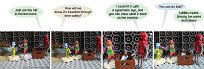
(From Irregular Webcomic! Click for full-sized parts and labour.)
Something else I forgot to mention about the ongoing Irregular Crisis:
When the “me” character became Death of Going Back in Time and Killing Yourself, most people may have expected him to show up in the Space theme eventually.
That was based not only on the Space theme being the only one involving time travel at the time, but also on the Space characters directly referencing “the GM” (“Me”)’s absence.
So far, however, the Space theme is drifting off in another direction, and it’s looking like “Me” will show up in Mythbusters first.
Did this deserve an entire separate post? Of course not! But you get one anyway!
In case you haven’t heard, this was a particularly exciting year in sports. When ESPN’s “SportsCenter” does its annual “Top 10 Games” countdown, they could easily extend it to a Top 20. With so many great games, I’ve taken it upon myself to take my own stab at mimicking the ESPN list and what it might look like.
Between some college football playoff-related features and Da Blog’s regular features, I think it’s reasonable to schedule the College Football Rankings’ release, as well as the bowl schedule, for Thursday.
#10: Beijing 2008 Olympic Games, men’s basketball gold medal match, USA v. Spain. The “Redeem Team” lives up to their name in a game Bill Simmons called “one of the 10 most dramatic basketball games of my lifetime. And nobody gave a crap or even knew. The game started at 2:30 in the morning ET and vanished into thin air. Only West Coasters and super-diehards stayed up to see it.”
#9: NHL Hockey, Winter Classic, Pittsburgh Penguins @ Buffalo Sabres. Could the NHL have asked for anything less than a shootout from the first (true) Winter Classic?
#8: College football, SEC Championship Game, Florida v. Alabama. If the regular season is a playoff, this was its semifinal – and it certainly played like one.
#7: MLB Baseball, ALCS Game 5, Tampa Bay Rays @ Boston Red Sox. For the moment, just forget about the fact the Sox couldn’t come all the way back to win the series.
#6: Beijing 2008 Olympic Games, swimming, 4x100m freestyle relay OR 100m butterfly OR 4x100m medley relay. The first two were dramatic finishes on Michael Phelps’ road to Mark Spitz’s record. The last was the one that broke it and had an exciting finish of its own. And I only have it at #6.
#5: College football, Texas @ Texas Tech. The Red Raiders came out to an early lead, only to see Texas come storming back to take a lead of its own. In the end, Texas Tech had the play of the year, and as it turned out, the one that kept Texas out of the National Championship Game.
#4: Wimbledon, men’s final, Roger Federer v. Rafael Nadal. This and the next two I could have put in any order. A five-set, record-length classic that ended with Nadal finally getting the best of Federer away from clay.
#3: Men’s college basketball, NCAA Tournament Final, Kansas v. Memphis. Finally, a National Championship game that lives up to being the culmination of March Madness instead of being a complete anticlimax!
#2: US Open Golf, playoff, Tiger Woods v. Rocco Mediate. 19 holes of pure tension, as basically an unknown gives Tiger every inch of challenge he has, and brings out Tiger’s best to put him on top. And Tiger was injured to the extent it’s still the last event he’s played!
#1: NFL Football, Super Bowl XLII, New England Patriots v. New York Giants. Perhaps the greatest iteration ever of the biggest sporting event of every year? How can it not be #1?
Honorable Mentions: IRL racing, Indy Japan 300 (Danica wins!); Euro 2008 quarterfinal, Croatia v. Turkey (or was it the semis, where Germany beat Turkey? Basically a sop to my soccer-crazed dad anyway); MLB Home Run Derby; ArenaBowl XXII, Soul v. SaberCats (about the only thing that could make it better is if it were the last one); some NBA game I’m forgetting; some obscure game I never heard of or just didn’t watch (possibly from MMA, boxing, the LLWS, Fresno State’s run, the WNBA, MLS, or the like)
NBC’s Sunday Night Football package gives it flexible scheduling. For the last seven weeks of the season, the games are determined on 12-day notice, 6-day notice for Week 17.
The first year, no game was listed in the Sunday Night slot, only a notation that one game could move there. Now, NBC lists the game it “tentatively” schedules for each night. However, the NFL is in charge of moving games to prime time.
Here are the rules from the NFL web site (note that this was written with last season in mind):
Here are the current tentatively-scheduled games and my predictions:
Week 11 (November 16):
Week 12 (November 23):
Week 13 (November 30):
Week 14 (December 7):
Week 15 (December 14):
Week 16 (December 21):
Week 17 (December 28 Playoff Positioning Watch):
 (From The Order of the Stick. Click for full-sized minty-fresh breath.)
So my time this week has been monopolized by various other things, such as the whole college-football-tournament thing, and the webcomic post has been pushed to Thursday as a result, and this is what happens when I don’t have much time to write it: I fall back on OOTS and produce something fairly hastily thrown together. And still take much longer to write it than my schedule should by all rights allow.
So what the hell is going on with Belkar? I touched on this once before, but as just about every single thing Belkar does is being viewed in light of Shojo’s challenge to him, I think it’s important to establish a baseline for what that actually means.
The most succinct interpretation of the matter I could find on short notice probably came from Robert A. Howard of Tangents:
One of the greatest flaws of Belkar’s character was that he has been a two-trick pony for the longest time. He was a violent comedic foil who had no social graces, no interest in blending in, and whose solution for everything was “stick a knife in it until it’s dead.” And it was getting old and boring. What’s worse, it was hurting the rest of the comic as well. The rest of the cast have undergone character growth and have had some truly intriguing stories behind them. Belkar? Outside of killing things, he was useless. The visitation of Lord Shojo (whether it was Shojo’s spirit, a manifestation of the curse Belkar was under, or even just a hallucination) ended up providing Belkar with a chance (and a reason) to grow, while staying fundamentally who and what he is.
Thus Belkar is going to pretend to have character growth. Yet I must wonder… in pretending, and while playing the same game everyone else is, some of that faked character growth may actually rub off. In the meanwhile, watching Belkar slaughter his way through a horde of low-level thieves, leaving the one girl alive after kissing her breathless, has actually become amusing again. What’s more, he may actually get to play the part of hero once again, and enjoy himself immensely while doing so. And while he is fated to die (according to the Oracle, whose death activated Belkar’s Mark of Justice to begin with), I can’t help but wonder if maybe he’ll gain a measure of redemption in the process… or at the very least enter into the Abyss ready to kick butt and chew bubblegum.
Okay. What was Shojo actually saying when he made his challenge to Belkar?
For starters, he invites Belkar to play
The Game, the big one. The one that each of us plays every day when we get out of bed, put on our face, and go out into the world. Some of us play to get ahead, some of us just want to get through the day without breaking character. It’s called “Civilization”. No, wait, there’s already a game called that… OK, it’s called “Society”. Your problem is that you don’t want to play the game at all, you want to sit on the couch and eat Cheetos while everyone else is playing.
To this point, it seems that Shojo’s point might be bigger than whether or not Belkar should be a “hero”, but whether he should simply live a life bigger than just stabbing everyone at every opportunity. Consider Belkar’s life immediately preceding being struck by the Mark of Justice: skipping out on the entire explanation of the Gates because he’d killed a guard and fled, leading Miko on a wild goose chase and slowly driving her more and more insane with fury, pretty much trying to get her to kill him out of blind fury for kicks. Belkar doesn’t even care about staying alive as long as he believes he can be quickly resurrected. The only reason he doesn’t simply kill the rest of the group is so he has people to back him up if he ever gets in deep, to be led to people to kill, because if he kills one the rest will turn on him, and as an audience to his deeds. (As I’ve said many times in the past, I have neither prequel book, but according to Wikipedia, the main reason he joined the Order in the first place is a variant of the first reason.) The purpose behind the quest doesn’t matter so much as “Those people? Bad. Take care of them.”
For further insight, look no further than strip #58, when Vaarsuvius gives Belkar Owl’s Wisdom so he can give Elan a couple last-minute healing spells. Before V dismisses the Owl’s Wisdom, Belkar briefly seems to undergo some actual character growth: “I’ve wasted my life on anger and needless rage, when I could have been healing. My eyes are finally open. From this day forward, I’m never hurting a living creature ever again.” (That last sentence would prove oddly prophetic…) With this piece of evidence, we can place a name to Belkar’s life through the Mark of Justice experience: “anger and needless rage”. He’s spent too much time consumed with both to realize his true potential, whether that involves “hurting…living creature[s]” or not.
Interestingly, that Miko chase I mentioned? Might be a perfect metaphor for what Shojo was talking about. Belkar cared only about his own fun, and missed something far more interesting and important in the process. As many people have suggested, this whole episode may cast into a new light why Shojo afflicted Belkar with the Mark of Justice in the first place.
Belkar interprets “playing the game” as “show[ing] up and play[ing] by everyone else’s stupid rules”, and Shojo replies, “Of course not, my wooly friend [Belkar at this point has metaphorically turned into a sheep]. You can cheat.”
Nudge die rolls, palm cards, “forget” penalties… but you have to sit down to play first. As long as the people at the table see a fellow player across from them, they’ll tolerate you. A crooked player is a pain in the ass, but someone who refuses to play at all makes them start questioning their own lives – and people HATE to think. They’d rather lose to a cheater than dwell too long on why they’re playing in the first place.
Now, let’s refresh your memory as to the nature of Shojo’s deception. We first encountered him as a senile old fool who took advice from his cat. There was some evidence he wasn’t what he appeared, but only a speechless Haley seemed to catch on. As Shojo explains to Roy, he puts on an act of senility in order to shirk any public responsibility for his edicts, which might result in certain upset parties putting an end to his life. Shojo also explains that he is “the commander of the paladins of the Sapphire Guard by virtue of my inheritance, not merit. In other words, I command the paladins. I have never claimed to be one. … Technically, I’m a 14th level aristocrat. Heck, I’m not even Lawful!”
Shojo explains that he hides his true nature from the paladins to get away with acts he feels might be the right course of action but which technically violate the code the actual paladins swear to uphold – taking the Gates as an example. Shojo felt that with two gates down, there was a clear and present danger to the others, but none of the paladins would be willing or able to investigate or reinforce them without violating an oath of non-interference in the other gates, so he created a complex scheme to bring in the OOTS and have them do his dirty work instead, including misleading Miko as to the true purpose of the arrest and putting on a show trial with a largely predetermined outcome issued by Roy’s own disguised father’s ghost.
(Incidentially, this is why Roy is pretty much blameless for not leaving open the possibility that Xykon might strike against Azure City when consulting with the Oracle: that’s not why he was hired. Re-read #290: Shojo did not even technically hire the Order to reinforce either of the other two gates, only to report on their status so Shojo would have an excuse to, presumably, send the Sapphire Guard to do the reinforcing.)
For two or three reasons, this isn’t completely applicable to Belkar’s situation. Belkar’s evil, his only “responsibility” is to the OOTS, and he’s far from in a position to make any decisions, or manipulate anyone. He barely even has any “true” motivations to work towards while technically still following the Order’s “arbitrary moral framework”. Even if viewed from the lens of his desire to kill as many bodies as possible, it’s not necessarily in line with the Order’s goals. The point is that Shojo wasn’t pretending to have the good of Azure City, or even the universe, at heart. If anything, Shojo had the exact same goal as the paladins – but he still felt the need to be deceptive in the way he achieved that goal.
The Order of the Stick has a place for non-Good members. Haley has described herself as “Chaotic Good-ish“, and even before going insane Vaarsuvius had a decidedly Neutral streak. For that matter, there’s nothing preventing Belkar from achieving anything just from being Chaotic Evil at all – Xykon is Chaotic Evil, and he has his sights set on nothing less than world domination, yet oddly, the old Belkar probably would not get along well with him, as he wouldn’t care so much about the mission as about the next target to kill.
The first of which is that Shojo wants Belkar to act more Lawful. Shojo was a Chaotic passing off as at least a reluctant Lawful, and it’s a Chaotic alignment that Shojo and Belkar have in common – rather important when Shojo starts the conversation by saying “We’re rather alike, you know.”
The second interpretation is that Belkar needs to stop acting like he’s above the alignment system entirely, and start acting Chaotic Evil.
There is a difference, although the TV Tropes description may be more helpful in illuminating it than anything in any “official” source (which may suggest it’s a wild misinterpretation):
Chaotic Evil characters might intentionally help the heroes save the world by doing terribly evil things. … Chaotic Evil characters are incredibly self-centered and evil, but can get along with good guys by being eerily charming at times. They are often crazy, but they don’t have to be. Only Chaotic Stupid characters will trek 500 miles to slaughter a random village for no reason. Chaotic Evil’s goals may well make no sense to anybody but himself, but he does have goals. He may “want to watch the world burn”, or prove that he’s the best, or the most feared, or get the most attention.
Of course, Belkar’s own interpretation practically matters at least as much or more as Shojo’s outward intent. But early indications are that, while he is turning into more of a team player on the outside, he hasn’t exactly abandoned his old ways entirely, and if anything, has only refined them. So what can we expect from Belkar in the future? A Belkar with a little more refined palate than Vaarsuvius’ “hate/lust” distinction, one who knows who his friends are and who his enemies are, one who appears to be a little more controllable in his dealings with the rest of the OOTS, but who’s still quick to slit the throat of any captured enemy and may even be more dangerous, in a certain sick, twisted way, than ever before.
(Hmm. Maybe I should take Shojo’s advice and do something with my life rather than post OOTS exegeses every month.)