Call it a non-review review.

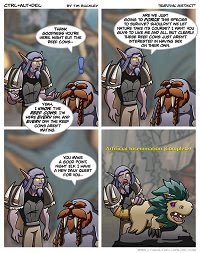
(From The Wotch. Click for full-sized cash-in.)

First, for the thumbnail I’m following what I call the Dresden Codak rule. When I reviewed DC the front-page image was a notification that the strip was on hiatus. This strip’s similar hiatus notification has a stronger case to be made the thumbnail, in that it will probably remain in the same spot in the archives rather than a netherregion.

Second, I hate to say this after a month without reviews (only “Webcomics’ Identity Crisis” and the state-of posts), but I’m not doing a webcomic review this week. Or next. When next a webcomic review appears – I don’t normally announce my webcomic reviews in advance, but – it will be on Sluggy Freelance, since I have plenty to say about Sluggy the site and Sluggy the comic and it should just flow onto the page (to the extent I may do it next week and leave the week after that empty). After that I’ll do the March OOTS post. (No, yesterday’s post doesn’t count.) I’m skipping next week because I have a paper I need to get cracking on for a class and working on Da Blog has really cut down on my time (and as I’ve said, I’m finding myself with less time than you’d think). I still have more posts I’d like to get through the pike than I really know what to do with.

The reason I’m skipping this week is a bit more interesting.

I never really wanted to review The Wotch – it’s no Penny Arcade in terms of popularity, and the stereotype is that strips where people flip genders a lot appeal mostly to people with a fetish for that sort of thing – but I felt that, since I used it as a thumbnail for a non-specific webcomic post, it was too much of a bait-and-switch that it wasn’t an actual review, and so I owed it to The Wotch to do an actual review some day. But even at the time, I said that “I might decide to write that review at some later date” (emphasis added).

As it turned out, the strip I used for that thumbnail was part of the denouement of that particular chapter. So as I followed along with the strip in preparation for reviewing it, I sat through maybe two strips of actual plot (bracketing fillers), several state-of strips, and a quick, three-page, probably-unrepresentative gag before the strip went on hiatus. Which, incidentially, was in late February. Which left me somewhat surprised the strip has been able to bang out three chapters a year at a once-a-week pace, considering I was around for what should have been half a chapter.

So I don’t have nearly enough information to write an informed review, and I don’t feel strongly enough about it to go trawling into the archive as a stopgap. I’m not going to wait around for several months more following a comic I wasn’t particularly interested in reviewing in the first place, so I’m cutting my losses and removing The Wotch from the “tryout space” of my RSS reader. So this week, when I had been planning on maybe reviewing The Wotch, since I didn’t feel I was quite ready to review either of the other two comics in the tryout space, I’m just leaving blank instead. (I don’t feel I have quite enough material to write a review of Sluggy right now; as soon as next week I think I would. Which sounds ridiculous now, considering I arguably had less material to work with from The Wotch.)

Because someone claimed Part V of “Webcomics’ Identity Crisis” didn’t count as February’s OOTS post. Also, mega MEGA spoilers.

(From The Order of the Stick. Click for full-sized four words… or maybe three. An epic strip deserves an epic post linked to from the OOTS forum, so look for a traffic influx.)

A lot can happen when you’re on a deserted island where the only other people to step foot on it are an imp, a pissed-off dragon, and three fiends.

If you’ve been reading The Order of the Stick at all in the current book (at least when it wasn’t focused on Haley, Celia, and Belkar), or even if you’ve been reading my OOTS posts, you know that Vaarsuvius has been undergoing a slow descent into madness out of his/her desperation to reunite the group and get Roy resurrected.

V has not slept tranced in a long time, with accompanying decline of his/her mental faculties, and quite a bit of physical deterioration as well, with his/her hair and clothes becoming dissheveled and (strangely purple) veins showing. He/she’s tried virtually everything to get something, anything through to her good friend Haley – homemade scrying spell, messenger birds, the works – but despite taking part in as many battles as he/she can to collect as much XP as he/she can, nothing’s cracked the Cloister she doesn’t even know exists (well, except the birds, but that didn’t end well). In the meantime his/her singleminded devotion to contacting Haley has led to becoming rather estranged from Durkon and Elan, and rather unwilling to tolerate any sort of distraction. This came to a head late in the 500s, the last time we checked in on that half of the Order, when Daimyo Kubota, chief villain for nearly a hundred strips, plotter to overthrow Hinjo, fresh from poisoning his ex-assassin Therkla to death, freshly surrendered to Elan’s custody, suddenly gets taken out by a single Disintegrate from Vaarsuvius, who asks, “Can we PLEASE resume saving the world?”

Kubota may have been a red herring all along, but his disposal is itself important as part of V’s ongoing descent. (And Elan’s character development, but that’s a story for another day.) Elan’s argument with V on the rightness of the move leads to V dismissing Therkla as a “bundle of experience points”, insinuating Elan had an affair with her when he categorically didn’t, and ultimately threatening to take out Elan himself. At this point, V becomes convinced (s)he could no longer continue his/her studies on the boat – not out of fear for retribution, but because of the constant distractions of having to deal with this quest or that one, and even more so, the lack of any help from Durkon or Elan (who (s)he doesn’t even guarantee (s)he’ll contact back should (s)he find Haley). Elan sends him/her off and covers for him/her despite having said he wouldn’t, and the real villain here, Qarr, takes off after him/her.

At this point – and this greatly added to the anticipation for #600 and the impact when it turned out to be a switch back to Roy and an anticlimax – it looked for all the world as though V’s infamous “four words” were imminent.

As OOTS has developed a rather complex plot, one of the guiding principles of forum speculation has been the prophecies given to the group by the Oracle of Sunken Valley. So far, two have already come to pass: Haley‘s, and Belkar’s. All in all, three prophecies were cryptic (Haley, Belkar, and V), while the other three were relatively straightforward (Roy (if unhelpful), Durkon, and Elan… although Elan’s leans more towards the cryptic side, and indeed is almost as cryptic as Belkar’s, it’s also not as conducive to speculation because people don’t like to think about the end of the strip). With two of the cryptic prophecies out of the way, that leaves V’s prophecy as one of the most talked-about single panels in the history of the strip (though Belkar’s prophecy got plenty of play back in the day).

Vaarsuvius asks “how (he/she) will attain ultimate arcane power”, and the Oracle responds that it will come “by saying the right four words to the right being at the right time for all the wrong reasons”.

For three hundred strips, nearly half the strip’s entire existence, that sentence has touched off almost as much debate as the question of V’s gender or the exact nature of that thing in the dark – and as V’s descent has progressed, forum speculators have taken to looking for any four-word string to come out of his mouth to, ultimately, turn out to be the four words that trigger “ultimate arcane power”, often completely ignoring the rest of the sentence. (To show how ridiculous it can get, one theory that was actually rather popular was that when V disintegrated Kubota, she actually said the four words as “Disintegrate. Gust of Wind”, the latter scattering Kubota’s ashes into the sea.) V’s descent into madness seemed to be a perfect moment of weakness, especially as #599 ended. Anyone could see what would happen next: Qarr would tempt V with the promise of ultimate arcane power, and V would say the right four words to agree to the deal.

As it turned out (and we would have to wait for an interlude with Haley’s group before finding this out), that’s not quite how it would happen… and it seems ridiculous in retrospect that the whole deal could be completed in a single strip. And we would have been a lot poorer if that was how it happened.

You see, Vaarsuvius may be sleep trance-deprived, but he/she’s not stupid. He/she can see what’s coming just as well as anyone else could. So when Qarr tempts him, not even with the catch being any sort of damnation (or hidden entirely), but merely helping him with “a certain project of my own”, V goes almost directly to the Disintegration finger. V wasn’t about to sell his soul over this minor setback; he’s going to solve his problem on his own, without any infernal assistance.

Funny how fast circumstances can change.

Right at that moment, an ancient black dragon shows up and proceeds to own V’s ass. She explains that she’s the mother of a dragon V killed nearly 450 strips earlier (nearly three fourths of the strip has passed in the interim), waiting and watching for V to first leave the boat and then use up all his spells fighting Qarr. But for her vengeance, she won’t kill V; that would be too easy. Instead, she’ll make V suffer the same pain she feels by eating V’s own children, bind their souls to herself to frustrate any attempt at simply reviving them, and leaving the material plane for good so V can’t locate her ever again.

The dragon pops out, and just like that V’s relationship with Qarr is drastically changed. Unable to come up with any way to save his/her kids even using Qarr, V is left practically begging him to arrange some sort of Faustian deal. Qarr warns him/her that the chances of success are low, the response time is long, and so will the process of filling out the paperwork even if it does happen, but almost instantly an envelope appears from the “IFCC”, and out pops three fiends in hoods and robes.

The fiends – representing the “Inter-Fiend Cooperation Commission”, out to broker a truce between the respective Lawful, Neutral, and Chaotic Evil fiendish populations, who see V as a test case to prove their point – look pretty much exactly like the fiends Sabine was seen reporting to upon learning of the gates, to the extent that the forums are basically taking the idea that they’re the same as given. They offer to perform a “once-in-a-century” “Soul Splice”, grafting the souls of three powerful conjurers to V’s own, giving V power that would “dwarf that wielded by any ar[c]ane spellcaster who has ever lived” (since it’s double the power of just one fiend performing the Splice), which V would have complete control over for as long as V holds on to it. V won’t even get eternal damnation, only time with each fiend equal to the amount of time (s)he holds on to the splice.

Would you take the deal? To save your children’s lives, and their souls?

With regard to the Seven Deadly Sins, it’s easy to associate Faustian deals with Avarice or Envy. Someone wants some goal – youth, money, power – and is willing to sell his soul to the Devil to get it. Occasionally it’s Wrath, such as wanting revenge against some particular person or group. It’s far from unheard of for someone to sell their soul for rather benign, understandable ends, such as reversing a spell of bad luck (The Devil and Daniel Webster), where usually the problem (if there’s presented as being one) is having too much of a concern for earthly things rather than the glories of Heaven, or even (theoretically) for noble purposes, such as to give up your own soul for that of another or for a greater good. At first glance, this deal might appear to fall into this last category, where Vaarsuvius is sacrificing his/her own soul for not one, but two or three others, and the chief objection to these being the “four words” on the forums was that saving his/her family was hardly the “wrong reasons”. Personally, I felt it was sufficiently wrong given the larger context and the other priorities, especially if you read V’s motivation in the context of revenge, but that’s just heartless old me. But even if it was, that wouldn’t be nearly as rich of a motivation, or nearly as tragic a fall. This is an odd case of a Faustian deal being made primarily out of pride.

Already frustrated by his/her inability to find Haley and Co., Vaarsuvius is out to prove that arcane magic can solve his/her problems, and that leaving his/her home to study it wasn’t a complete waste of time that only cost her his family. There may well be several ways to save the day at less cost, and if there aren’t it’s probably better for V to just cut his/her losses rather than do something that could have far worse consequences. (Nothing says the fiends have to have his/her soul after (s)he dies.) But V is stubborn and arrogant, as we already knew, and it is proving to be his/her fatal flaw. He/she is not going to admit defeat – not for finding Haley (hence his/her problems with Durkon and Elan), not for saving his/her children, and in a broader sense, not for his/her devotion to magic. Even saving his family is secondary to proving herself right. It’s like the old saying goes, “pride cometh before a fall”, and V is falling, hard.

Rich drives the point home in the current strip (titled, in a deliberate callback to the Oracle’s prophecy and possible reference to the forumites’ problems, “The Wrong Reasons”), when the fiends present V with the alternative: kill herself, have Qarr teleport the head to Durkon and Co., be resurrected, and describe his mentor to Durkon so he can get a message through to him and get him to intervene. (Oddly, despite having a hairstyle similar to that that made me think V was female, Aarindarius seems pretty clearly male to me.) “But,” the fiends warn, “but then you would have to admit that your magic had failed you yet again. That a cleric and a monster had to run and tell Master to come clean up your mess. Hell, you couldn’t even claim to have come up with the idea, since we just gave it to you!” And the fiends know V would never do that – and the ultimate “four words” pound the message home further. This isn’t just a standard plot twist, or even a standard re-use of the Faustian deal. This is Christian morality meeting Greek tragedy, the journey into the belly of the whale (I considered making the line at the top “click for full-sized mouth of the whale”), a desperate hero’s hubris doing him/her in and leading to what will likely be a rather dear cost paid.

In Part IV of “Webcomics’ Identity Crisis”, I claimed that webcomics were not doing enough to break out of its routines, to become great literature rather than just entertain the masses (something all of comics are arguably guilty of), and that not even The Order of the Stick was “much more than a neat story for the masses, with plenty of plot upon subplot but not much in the way of subtext or meaning,” not really enough of that intangible timeless quality that would allow it to stand the test of time.

O great and powerful Rich Burlew, I hast forsaken thee, for I was wanting faith, and I was a fool to do so, and I humbly bow down before thee and beg thee for thy forgiveness. For thy story is truly great and worthy to take its place in the annals of great literature, and ist indeed in the upper eschelon of the great fantasy tales, and thy name shalt be spoken of in the same sentence with Tolkien, Lovecraft, and Pratchett. And certainly its spot in the Greatest Webcomics once the medium matures certainly seems secure now. Burlew has already presented a sort of classic tragic redemption tale with Miko, but that was fairly standard material by comparison. This is the sort of resonant, classic tragedy that’s actually rather rare in fantasy (off the top of my admittedly-not-immersed head, only Tolkien even comes close! Not coincidentially he’s the only surefire author I could think of for the above list, and the only one people could easily agree on), and it shows just how surprising that should be, how well-fit the trappings of fantasy really are for this sort of thing.

Cleverly, Rich has left some room for error as to whether or not these are really the “four words”, because two of them are really a stutter, they seem shoehorned in at the last minute and not really relevant or causal, and the fiends’ alternative is hopelessly convoluted, not guaranteed to work, and even assuming the fiends are telling the truth about the circumstances would take comparatively too long. It’s plausible – V says the four words, to him/herself, right as time is running out on the offer and time resumes, and for very, very wrong reasons – but the debate is allowed to go on as we wonder whether there’s even more ultimate arcane power awaiting him, the current debacle only sending V spiraling down the path of despair as he gets a taste of true power, leading to even more wrong reasons and even wronger reasons.

Who says comics can’t be art?
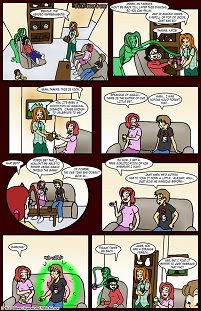
Because contrasting opinions are the spice of life.

David Morgan-Mar wrote a reply to my recent Darths and Droids post, as I’m sure you figured would happen. It’s actually rather illuminating, so if you haven’t already, check out the comments to the original post.

Yes, I’ve read today’s Order of the Stick. Post coming, probably early in the morning. Like Vaarsuvius, I’m tormented by distractions everywhere.

State of Darths and Droids: It’s Not You, It’s… Well, It’s Both of Us

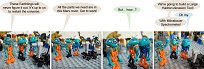
(From Darths and Droids. Click for full-sized things that go bump in the night.)

I may be leaning towards removing Darths and Droids from my RSS reader.

I’ve said in the past that Darths and Droids is incredibly innovative, taking the basic concept introduced to it by DM of the Rings and building a rich, layered metaplot on top of it, creating a comic I found more captivating than either its predecessor or Irregular Webcomic!

IWC has since moved into a rich, unified plot of its own, but that’s not the only problem I’ve been finding with Darths and Droids. I still believe every word of that description – I was remiss in leaving Darths and Droids out of any consideration for the greatest webcomics of all time last week, at least in those places where it would be on the same list as IWC. Yes, I mean that; it would rank low, but its sort of innovation is worthy of notice, and if it somehow sparked a wave of “RPG screencap comics” there could be no denying its influence.

But as it’s progressed, it’s gotten disjointed.

This problem started as we entered the climax of Phantom Menace, as the strip, following the lead of the movie, split into three separate subplots: the battle between the Gungans and the droids, Anakin and R2D2 taking off on their own little mission, and Qui-Gon and Obi-Wan squaring off against Darth Maul. The resulting cross-cutting can work when the comic is read all at once, but when the comic is read on Darths and Droids’ Tuesday-Thursday-Sunday schedule, each switch to a new plot, the one snippet of the story we get on a particular day, has no connection to what has come immediately before, and one is forced to think back more than a week to remember what we’re picking up on. Each strip becomes an individual moment in time. Imagine going about your day and remembering it’s Tuesday and Darths and Droids must have a new strip up, and seeing this. Oh, and imagine waiting two days later for this.

Once again, with a “long-form” comic you have to maintain that balancing act between making sure your comic makes sense read all at once, and also makes sense read in bite-size chunks. This is a major reason gag-a-day strips have held the edge over longer continuity strips to this point in webcomics.

Things calmed down a little after Qui-Gon was critically injured and we settled into Darth Maul’s flashback. That meant several strips of fairly linear, strip-to-strip storytelling. Even when we went back to cross-cutting afterwards it was mostly to mop up the aftermath. It was fairly slow-paced, but readable.

Then we went through an intermission of several strips.

Then came Attack of the Clones.

The Comic Irregulars are explicitly making each movie a separate campaign played out with several years between them. So we’re introduced to the players as they exist two years after the events of the first campaign/movie, including a Sally significantly older and wiser. It’s a significant change to the dynamic, one that’s been brought into sharp focus with the recent huddle-up involving all the PCs. It’s awkward seeing everyone all huddle up as an established group after ten game years apart.

When we actually get into the plot, it resumes the disconnectedness while maintaining a single plot thread. Now I admit, I’ve seen almost zero of Attack of the Clones, and what I have seen is nearer the end. But we basically launch into the story in media res and almost immediately are subjected to something that’s basically a gag. At this point, it feels like the Comic Irregulars are rushing through the story much faster than the occasionally stalled pace at which they moved through The Phantom Menace. They spent a lot of time in Phantom Menace trying to establish the characters and building hints of their personalities and relationships with each other. We got to know the various characters, we paced through the story and every single thing the characters did, and the characters, in turn, slowly learned about the world and the campaign. In Attack of the Clones, the Comic Irregulars basically barge into the story guns a-blazin’. We already know the characters, they already know about the world and we can take care of the campaign in one strip, so let’s take a pure utilitarian approach and get through the plot as quickly as we can.

In The Phantom Menace, the Comic Irregulars may have created a more captivating story than they ever intended.

Truth be told, that may be partly because they actually created a story. So far, Attack of the Clones has mostly felt like a bunch of disconnected moments loosely strung together. Each individual strip has mostly served the purpose of a gag. It’s almost been a reverse Cerebus Syndrome, where the strip has developed less of a reliance on the plot and become more gag-a-day in nature.

Consider the succeding sequence, where Padme/Jim meets with the Jedi Council and Chancellor Palpatine over the vote to create a Grand Army of the Republic. The first strip involves everyone discussing Padme’s character, and Padme walking in, checking the Jedi’s support for the Army, and trying to boss Palpatine around. The second strip creates the subplot of rebuilding the moon of Naboo, destroyed by the Trade Federation during The Phantom Menace. And strip #3 mostly involves back-and-forth dialogue between Padme and Bail Organa. All three are somewhat disconnected from each other, especially when read one at a time. The last strip in particular comes off as being disconnected even when read in sequence all at once.

I say that a “long-form” webcomic should take care to make each strip a complete, satisfying experience, but it’s a balancing act. If it’s too diffuse, it loses cohesion; it may come off like a complete comic when read all at once, but as a day-by-day comic, it almost no longer becomes a plot-based strip.

Two factors may make that sound absurd. The first is the popularity of gag-a-day webcomics, and the second is the specific fact that The Order of the Stick is very much gag-a-day and yet balances that out with an ongoing plot. But gag-a-day strips don’t have an expectation of a plot unless they’re undergoing Cerebus Syndrome, and OOTS substantially advances the plot with each strip, building a strong connection from one strip to the next, and still lets each stand on its own and end with a funny gag. The two share billing on OOTS while the Comic Irregulars seem to be sublimating the plot to the funny. (So you don’t think I’m showing my OOTS bromance too much here, I’ll also ask you to look at Sluggy Freelance. And the OOTS balance between plot and gags has been especially apparent in recent strips, as I’ll cover in a day or two.)

But perhaps more than any of that, is the problem that gag-a-dayness is not in Darths and Droids‘ DNA. The strip has been funny throughout The Phantom Menace, but it’s been a sort of punchlineless humor, where the humor has existed in equal amounts in every panel, a natural result of the personalities of the characters (especially Jim, Sally, and Pete, in that order), so if each strip ended with a gag, it did so as part of the natural progression of the story. That’s helped to minimize the extent to which the Comic Irregulars have had to contort the story to fit each page and actually built the sense of the strip as a long-form, drama-based, comic-book-style webcomic. While I’ve certainly laughed along with Darths and Droids, that wasn’t the reason I read the comic, and the plot is starting to fall out of focus, especially read one-installment-at-a-time (I didn’t quite grasp much of what was going on until I re-read these strips). I wonder if the Comic Irregulars are/were trying to move Darths and Droids in the direction of gag-a-day in order to avoid the Girl Genius/Gunnerkrigg Court problem, and are running into the limitations of that.

Now, it’s early in Attack of the Clones, and the basic situation is only just getting set up. The last two strips have had a bit more of a connection with each other, which bodes well for the future (at least the near future), and I think I have a better idea of where the plot is going and might better be able to follow the strip from this point forward. Part of the problem may have been the need to follow various strips I’m planning to write reviews of over the next month or two, and those strips distracting me to some extent from Darths and Droids. It might be a shame if Darths and Droids were to chase me away, because it’s become apparent, especially towards the end of The Phantom Menace, that the strip is going to be using a very different plot from the movies (on top of alternate interpretations and the things the players bring to their characters) and that would mean we might be in for more surprises than one might think. (I can’t tell from the strip; was the destruction of the moon of Naboo part of The Phantom Menace or not?) But Darths and Droids has recently hit a bit of a rough patch, falling into some easy mistakes made by continuity strips and weakened my investment in the strip. The bad news is it needs to spend some time to win me back. The good news is anyone else looking to dive in can learn from it.

State of Ctrl+Alt+Del: Our Little Manchild is All Grown Up

(From Ctrl+Alt+Del. Click for full-sized sperm quest.)

If you’ve been following just the main comic of Ctrl+Alt+Del, something happened that you may have missed.

Winter-een-mas came and went.

Back in November, I expressed my amazement that some people were organizing Winter-een-mas festivities at my school, complete with visual evidence. As it developed, the promotion for it became even more pervasive than it was when I posted on it, going from a simple table setpiece to include a massive banner hanging over the lobby of the Student Center (both of which are common with various things school clubs do around here), advertising an entire week of festivities (including weekends) on school property. If I still lived in the dorms it might have been a major event around here.

Except in the place where it got started.

Winter-een-mas used to be a big, multi-week deal, where Ethan would go on positively epic escapades; last year he met with the Gods of Gaming and the strip moved up to a once-a-week schedule while we were subjected to a parable. This year? Nada. Recognition of Winter-een-mas at all was relegated to the Sillies, which tend to update in one huge batch once a week despite being presented as daily, and which seem to have been almost abandoned entirely. The main strip continued apace as though nothing was happening, albeit focused on Ethan and the rest of the cast, as they prepared for the store re-opening and saw Zeke coming back to “life”. It seems to back up my contention that the Sillies were intended as a respite for people who didn’t like the strip’s Cerebus Syndrome and wanted the “old” CAD back.

Ctrl+Alt+Del is growing up (as is Ethan), and as it does so, it’s putting away childish things like Winter-een-mas. The strip is six years old, and if Ethan was mentally six when the strip started, he’s twelve now and maturing (whatever that word means) fast.

Ethan and Lilah are officially married now, although they’re planning a show wedding for everyone else, while Ethan prepares for (and dreads) GameHaven’s reopening under his leadership. Running a video game store involves a lot of responsibility, and for Buckley, getting Ethan out of that responsibility isn’t as easy as a miscarriage, and necessarily would involve gaining new insights into certain characters, including Ethan. So unless any “need” to have Ethan constantly avoid responsibility were to be brought into sharp focus within the strip, there’s no getting out of this one. Ethan is going to have to take some real, long-term responsibility and undergo whatever character development that involves.

Now admittedly, Tim Buckley’s track record with handling real change isn’t good, and in fact Ethan’s possession of the store came at the end of a lengthy storyline that, until that very last strip, looked to be mere sound and fury signifying nothing, except Ethan and Lilah’s elopement. Tim has plenty of outs: Ethan could get off to a terrific start with the help of his congregation, and/or leave much of the day-to-day operations to Lilah or Lucas. But call me naive, but I suspect not only is this the real deal, and will avoid going towards First and Ten this time, but word of the elopement is going to leak out and certain people will not be happy.

I’d be perfectly happy to eat crow if we go back to the main cast and find the store running better than ever and Ethan and Lilah’s second wedding coming off without a hitch. But between the mere fact we’re having a second wedding, and the passing by of Winter-een-mas… I can’t help but think Buckley’s critics may be the ones forced to eat crow, and Ethan is about to go through some real adversity.

It’s not going to be Order of the Stick, but it’ll be a big improvement over what Buckley’s critics think the strip is. I hope they’re watching. I know I will.

State of Irregular Webcomic: Dispatches from the Afterlife

(From Irregular Webcomic! Click for full-sized gibbering madness and destruction.)

So the destruction of the universe turned out to be, in a sense, much ado about nothing.

But it’s also serving as the impetus for a major change… in the short-term, at least.

After ten days of white turning to blue turning to red turning to black, which looked for all the world to be an artsy way of depicting the birth of a new universe, the black turned out to be… the Head Death’s eyes, positioned along with everyone else in the universe (including people from various points in time) in the Afterlife. So no, the universe hasn’t been reborn yet, and we’re forced to be tortured for a while more yet, wondering when and how it does.

After another week of the Head Death drawing things out by answering people’s questions, strips that all remained stuck in almost every single theme (with the curious and sudden exception of Me), he handed it over to a re-promoted Death of Insanely Overpowered Fireballs, and upon leaving, everything devolved back to the Death theme alone for no real reason. (Come on, like this strip doesn’t still belong in most of the themes.) Fireballs continues taking questions from the congregation for a couple more strips, before sending it back to the congregation.

So for almost all of January, Irregular Webcomic! didn’t fit my “sixteen-comics-in-one” theory. More than before the destruction of the universe, it was a single, unified comic with a single, unified plot I could follow from day to day. Starting with #2187, though, it returned to having several plots going on at once, with the caveat that since everyone’s dead, they all get the Death theme as well…and since everyone’s hanging out on the Infinite Featureless Plane of Death at one time, it’s really one plot peeking in at various parts of the plane, and everyone’s varied plots, and any two themes can cross over at any moment.

It evokes the dimensions the Irregular Crisis took in the lead-up to the destruction, where various themes started running parallel tracks. But now IWC is equally readable as a single comic or as a collection of smaller ones… and the experience isn’t really complete without the former.

On a similar track to that lead-up to the destruction of the universe, the various themes are starting to fall into parallel tracks, for obvious reasons. Everyone wants to either just plain escape the afterlife (and the Cliffhangers appear to have already done so), or restart the universe. Mythbusters, Shakespeare/Harry Potter, Martians, and now Steve and Terry all have parallel plans developing to restart the universe, most started within the last week or two, with the potential for more to come, while the Head Death’s meeting with the Paradox Department proceeds apace. All evidence is that the universe is going to be recreated, and we’re going to have a front-row seat for the new Genesis.

But it’s very possible Irregular Webcomic! will never be the same again.

But I can’t wait to see how we get there – and what IWC comes out the other end as… if anything.

Blog of Webcomics’ Identity Crisis: The Dark Cloud in “Good News”

Ursula Vernon’s Digger is moving to its own site, and Vernon treats it as a cavalcade of good news. Even the secondary announcement that Digger is becoming free is arguably burying the lead:

It will also be going off subscription, and over to advertising–Graphic Smash is pretty much abandoning the subscription model. I’m pleased that we’ll get more traffic as a result, and that people will finally get to read the whole archives for free, but I also find myself wanting to do something nice for all my faithful subscribers, who quite literally paid my rent a couple of times–without them, Digger would have been abandoned long ago, and I owe them big time for having sustained me and my comic so wonderfully and well. (emphasis added)

As it stands, there are already only three active webcomics that are still running on the subscription model at Graphic Smash, and Digger is one of them. If the remaining two become free as well, as may be implied here, it’s a bad sign for anyone else looking to put their webcomic behind a subscription wall.

Blog of Webcomics’ Identity Crisis: For the Love of Webcomics

(From Irregular Webcomic! Click for full-sized abrasion of large hadrons.)

It’s become apparent that my “Webcomics’ Identity Crisis” series is very much a representation of a moment in time, of the state of webcomics in February 2009. (Really January, considering the impeti for me to write it.) So here, I hope to keep a record of the more interesting thoughts on the matter floating on the Internet. There are plenty of other places to get a comprehensive record; this is a log of my ongoing thoughts as I hope to write a book on the changing face of the Internet in general. (It’s not getting its own label for the time being though, and I still have a full-fledged “State of IWC” post coming.)

Hey, David Morgan-Mar linked to me off his LiveJournal again! DMM is responsible for what has been one of only one or two major traffic bumps in Da Blog’s history when he linked to my full-fledged review of Darths and Droids. For someone who launched into webcomics in 2002, rather late compared to some of the giants of the field, he has always been something of an outsider (his first strip is basically him discovering the idea of webcomics) who’s been overwhelmed by the support he’s received from the webcomics community. As he stipulates in his post, he’s actually been surprised, almost oblivious, to Irregular Webcomic!‘s notoriety in the webcomic community.

This part gets to the heart of the post and is worth quoting in full:

And then I find myself thinking: Hang on. If there are a few dozen webcomic authors making enough money to live on, and I’m pushing for a spot in the top 50, why am I making no money whatsoever out of my comics? (In fact, why do I pay a webhost $40 a month for the privilege of putting my comics on the Net?)

To avoid any suspense, the simple answer is that I have never treated webcomics as a way of making money. I’ve never had any expectation that maybe one day I’ll be able to run ads and sell merchandise and make some money. That “business model” has never been something I’m aiming towards.

All I’ve ever wanted out of webcomics is to do something creative, share it with people, hopefully entertain a few people, and have it as a fun hobby. Over time I’ve added a couple of other desires: To educate people with the annotations I occasionally write to accompany comics, and to raise some money for charity.

But there’s this whole community of people out there, webcomic authors, critics, bloggers, and so on, who seem obsessed with the idea that webcomics can be (or already are) a way to make a living, and lamenting the difficulty of breaking into the field and building up the recognition to that magical point where you can quit your day job and live off merchandising. They analyse the developments in webcomics, pore over statistics, speculate about the future of the “industry” and what webcomics will be like in 2 years, 5 years, 10 years, and wonder how many people will be making a living off them and how easy/hard it will be for new talent to get recognised.

Well… sometimes it just bemuses me. I sort of know this community is out there all the time, but I don’t dwell on it, and I don’t really participate much in it. I just make my comics and put them on the net, and hope someone has a nice word to say about them. Sure, it would be really nice if someone offered me a full-time salary to quit my job and make webcomics, and I’d probably think seriously about doing so. But it’s not an end I’m seeking. I’m not taking the steps to try to get there.

So although apparently I’m part of the webcomics scene, I still feel like the meek outsider who doesn’t belong. I don’t seem to share the same aspirations as many of the vocal webcomics personalities. And I have to say that for the most part, I’m glad I don’t. I don’t want to obsess over the “state of webcomics” or whether webcomics are considered an artform or not, or whether webcomic authors can make money or not. I just want to spend a few hours a week enjoying my hobby.

Fleen also links to Morgan-Mar’s post (so I may be getting another, bigger bump) and I’m mostly going to cover the same ground as Gary Tyrell, but I also have a far more profound thing to say about Morgan-Mar’s topic:

David? A lot of the people in this community would really love to know your secret. (Also, don’t get too excited about being #55 in Comixtalk’s comedy list. First of all, I still hope that list isn’t ordered; second of all, if it is the only reason you’re likely to make the final list, let alone anywhere near that high, is the paucity of drama nominees.)

Irregular Webcomic! is nowhere near as easy to create as Sandsday. It’s not as simple as taking a bunch of random circles and squares and copying-and-pasting them onto panel after panel, and making funny jokes using them. You have to have the impressive LEGO collection, you have to set them up in the way you want to, you have to have the mad Photoshop skillz… Eric Burns(-White) goes into more detail just how much effort must go into each IWC here. And that’s just IWC; Morgan-Mar may get help on the other projects, but between all the plot points that need to be shaken out on Darths and Droids and organizing all the screen caps, and all the coding work that’s gone into IWC and mezzacotta, and basically everything David Morgan-Mar has his hands in the cookie jar of, and he notes in his post that he’s paying $40 on hosting costs alone…

If David Morgan-Mar wanted to open up even one revenue stream – a single Project Wonderful or even Google ad, selling just one or two tchotchkes, even allowing donations to himself rather than directing them all to the Jane Goodall Institute – he could probably make more money than most webcomic artists could ever dream of. But Morgan-Mar doesn’t make a single penny off his comics. (Okay, so there’s a tiny little ad at the top of mezzacotta, but still.)

It’d be nice if every webcomicker could simply make comics as a hobby effort and not only not worry about making any money, but consciously avoid even rather simple steps they could take to make money. (I don’t understand why people like Morgan-Mar and Rich Burlew are so insistent about not putting up ads; there are plenty of ways to make them non-intrusive, guys!) But webcomics (and blogs) take time to make, and they don’t pay the bills. You still have to go to a job, and that means time taken out of your schedule to make comics – and do other things. And Irregular Webcomic! isn’t done cheap.

So how is it that David Morgan-Mar can put together one comic by his lonesome, and contribute to several others, and pay for the hosting of all of them? And keep track of e-mails, forum posts, etc.? And not make a single dime off any of it, which means he’s doing it all while maintaining a day job?

Whatever it is, hats off to David Morgan-Mar: a webcomics success story in his very lack of success.

Webcomics’ Identity Crisis, Part VI: On Greatest Lists and the State of Webcomics

Finally, on to the second of the two topics that spawned this series.

The Floating Lightbulb is interesting enough that I’m considering adding it to my RSS reader. And I’m not just saying that to get onto its webcomic blog list. I have a feeling Bengo would probably berate me for focusing too much on the old popular, “self-promoting” comics and not enough on smaller comics that could actually use the attention, even though I do still have an open channel for people to e-mail me with comics they think I should review at mwmailsea at yahoo dot com, even if the comic isn’t their own. (Note, Bengo: for just the webcomics posts and not the other junk, be sure to include /search/label/webcomics in the URL!)

And really, that problem is at the heart of one of Bengo’s issues with Xaviar Xerexes.

I’m probably going to do a review of the Floating Lightbulb itself one day, and when I do I’m probably going to say that Bengo is a more cerebral John Solomon. Bengo doesn’t hate all webcomics – though the Floating Lightbulb doesn’t do much in the way of actual reviews at all – but he certainly seems to hate most of the personages in mainstream webcomics. In his eyes, most big-time webcomics creators are self-promoting jerks who probably cheated to get to the top and as such are bad role models, and most webcomic bloggers are ego-strokers, often with rampant conflicts of interest, who shill the same comics over and over again. Not every webcomic blog gets this charge, not even biggies Tangents and Websnark; mostly the vitriol goes to Gary “Fleen” Tyrell and Xerexes, proprietor of Comixtalk.

Xerexes has been working with his readers for the better part of a year now on a project to list the “100 greatest webcomics”. For Bengo, this project is more than a questionable idea producing an arbitrary and opinionated ranking. It’s serious business.

Back in November, Bengo published a lengthy list of objections to the project, and mused about it further about a month ago. One of Bengo’s bigger concerns is not merely that the list will route people to the same webcomics that are already popular while “impoverishing” smaller titles, but will mislead journalists in a similar fashion, “resulting in lazy, redundant coverage” and possibly discrediting webcomics itself (not to mention the list) if the aforementioned “bad role models” (not to mention just plain bad comics) are exposed and ridiculed (“THESE are the greatest webcomics?”)

I don’t think the situation is as dire as Bengo suggests, and Xerexes in his list’s latest incarnation has indirectly responded to at least some of his concerns. Bengo’s first post seems to be working on the assumption that the “greatest” list would in fact be a mutation of a “most popular” list. By contrast, Bengo would seemingly prefer it take the form of a “best” list, which would not only be forever under construction, but forever incomplete and to some extent influenced by popularity, since no matter how many webcomics you’ve looked at there’s probably some comic out there read by maybe five people that’s greater than whatever 200 webcomics you have on your list.

If we’re working on the sort of criteria that shaped the AFI’s greatest movies list (which all of these Internet “100 greatest” lists cite for some reason. My inspiration is VH1’s fixation with such lists, not exclusively AFI.), however, the exclusion of “quality” as a criterion in favor of popularity is to some measure excused by the fact that neither would really be as influential as influence, which is more influenced by popularity than in a medium as diverse as film. Making a “greatest” list as opposed to “best” or “most popular” also should make the list more useful as an entry point for journalists: we wouldn’t be saying these are necessarily the cream of the crop and the very best webcomics, but they are certainly important, and here’s why. One of the things I’ve been thinking about the role of the Greatest Movies Project is as a survey of film history for the layman; by moving from movie to movie, and reading what was said about each, a reader could get a better appreciation of “how we got here” and of the milestones of film history.

If Ctrl+Alt+Del were to make it on a “greatest webcomics” list, it wouldn’t be because of its popularity so much as the fact it’s had more influence on the form of copycat gaming comics, for better and for worse, than, say, Penny Arcade. (Mostly for worse, so if CAD is even in the top 75 of any list, I’d start sympathising with Bengo. And I’m at least a marginal CAD fan.)

But I do have some quibbles with Xerexes himself. For one, I don’t think webcomics as a medium are old enough or mature enough to support a full-on 100 greatest list; it’ll be definitely scraping the bottom of the barrel when you get to the bottom. You could maybe support a top 20, but I’d be hard pressed to think of enough webcomics influential enough to fill out even that list: Penny Arcade, Sluggy Freelance, Girl Genius, xkcd, PVP, Dinosaur Comics, umm, User Friendly, Order of the Stick (only because of the copycat webcomics it spawned), Irregular Webcomic… ummm… maybe Perry Bible FellowshipBob and GeorgeThe Devil’s Panties… does Dilbert count? can you tell I’m really reaching for candidates and I’ve only just now reached 13? Imagine the sort of webcomics Xerexes will have to come up with for the 80s and 90s!

More to the point, I certainly hope the lists he has now aren’t ranked yet, if not to fix some questionable-at-best rankings (Sluggy, quite possibly the most influential webcomic not named Penny Arcade if not overall, as low as on the comedy list, and Diesel Sweeties at ? OOTS at on the comedy list alone, so probably lower on the final one? Kevin and Kell, which I just mentally added to my overall top 20 above, at #19 on comedy, which means it won’t make it into said top 20 on the final list? Dinosaur Comics at on comedy? The drama list led by Nowhere Girl, a comic I hadn’t even heard of, whose main credential is winning an Eisner – worthy of my overall top 20 but hardly enough for ? Dresden freaking Codak as high as #12 on drama? CAD not listed anywhere when neither list has reached #100 yet, regardless of what you think about its quality? That’s before getting into the classification of some of the strips in one class or the other…) then to avoid rendering the release of the final list anticlimactic.

To some extent, Xerexes has already ruined the anticipation for the release of the final list by putting out his various draft lists and involving the people in the construction; for someone who’s been running a comics news site as long as he has, it seems odd that he still has to hit up his readers for ideas. The AFI precedes the releases of its various lists by putting out unranked lists of 400-500 nominees for its panel to vote on; Xerexes’ most recent list being split into separate comedy and drama lists may reflect the wisdom of that approach. (I can’t begrudge no further splits or longer lists when neither list has even hit 100 on their own yet. Incidentially, the relative paucity of dramatic webcomics may also hint at questioning whether webcomics are mature enough to have this kind of list.)

To go further, I suggest that when the final list is revealed, if Xerexes isn’t planning to do so already, rather than release the whole thing at once the same as the draft lists and not only defuse the anticipation but reduce the distinction between the final and drafts (another concern of Bengo’s), reveal each comic one at a time, accompanying each with a short essay on the webcomic in question and why it belongs on the list. That would allow the list to be a real resource to anyone looking to dip their toe into webcomics, and allow it to be a potential help to webcomics rather than a potential hindrance in the vein Bengo fears.

I also have a concern about apples-and-oranges comparisons, but not those of Xerexes (comedy v. drama) or Bengo (ongoing series v. finished series), though it’s similar to Bengo’s and he touches on this in the first post. I started this series (paradoxically, in Part II) talking about how there were, for a long time, two forms of comic (books and strips) and how webcomics have joined them. (Xerexes is on record as agreeing with me here that webcomics belong at the same table with comic books and strips.) I’ve seen “greatest comic books” lists and at least one “greatest comic strips” list, but you’d be hard pressed to find a single unified “greatest comic” list combining the two. There are just so many differences between the book and strip forms, and they’ve had such a different history, and that’s even considering the fact a lot of comic books are periodicals much like strips. (How do you compare Action Comics as a whole with Peanuts as a whole?) In a form with facets of both, how do you compare the two? How do you compare one-shot infinite canvas comics of the sort Scott McCloud supports and other one-timers fairly with more periodical comics? If you exclude the former, do you risk excluding some of the real pioneers of the medium? (Are any true pioneers like Cat Garza represented anywhere as is?)

I think that, done right, a “greatest webcomics” list could do a lot to ease newbies into webcomics and help legitimize it as a medium (or a form of a medium). (A “greatest comic books” list helped ease me into that medium.) If nothing else, it would be an entertaining excersize and debate. But I have, as I get the sense Bengo has, a bit of a concern whether or not webcomics have done enough to deserve such a list yet. Are there enough “great” or influential webcomics? Do webcomics represent a diverse enough experience or are they loaded with nothing but ha-ha? And perhaps most important, are there webcomics good enough, serving as good enough “role models”, to truly justify the praise given to them? Even on my “top 20” list above, how many would remain on even a top 100 list in just 10 years if the potential of webcomics are sufficiently explored by then? I say PA, Sluggy, Nowhere Girl, Dinosaur Comicsxkcd, and some comics (Girl Genius, Irregular Webcomic) that will prove more influential later than they are now… and that may be it. Odd as it sounds, even PVP, Megatokyo, and User Friendly will have to fight for a spot, and only time will tell if even comics as critically acclaimed as OOTS and Gunnerkrigg Court prove influential enough and stand the test of time enough to make the list and score a high ranking.

This is webcomics’ identity crisis: this basic insecurity over acceptance in the wider world of comics, and in the world at large, rooted in our own insecurity of our own worthiness and conflicted with our quest for a separate identity from comic strips and books. We seek acceptance because we seek validation for this silly little ritual of ours, that what we’re doing is truly worthy of being considered an art form. It’s a battle that’s been waged before by all new media since the beginning of time. Even theatre and printing were perhaps once dismissed as a vulgar diversion for the masses. Comics fought long and hard for acceptance in the pantheon of art and it wasn’t until the 80s and 90s when they started to get it, thanks to material that finally showed comics had grown up, not to mention the birth of a scholarly tradition of the material with Understanding Comics. Even within comics, comic books were once dismissed as inferior to the strip format until Superman came along.

Webcomics have its Superman (called Penny Arcade) but they still have insecurity. I still have insecurity. Before I started this series and probably even after I wondered why I was focusing on webcomics, such a sketchily-defined subset of comic strips or of comics in general… I considered doing a 20 Greatest Webcomics project before I heard of Xerexes’ effort but wondered if it was worth separating from comic strips and comics in general… Thoughts like these could be holding webcomics back. (Don’t even mention its place as a subset of Internet art.) Webcomics are still a young medium (for the most part, significantly younger than I am, so very literally in adolescence – film started getting introduced to the world in 1893 but Birth of a Nation blew the lid off its potential in 1915, so we still have six years or so to go), not only unsure of where its future lies but of what its basic identity is. It still clings to Scott McCloud’s advocacy, though it is starting to wean itself of that, and only slowly starting to round into permanent shape. It still clings to the past, to its mothers. Most of what it considers “great” is still ongoing – which means most of what it will consider “great” probably hasn’t started (or been discovered) yet.

At the same time, webcomics have a lot to be proud of. We’re ahead of the curve compared to a lot of other fields when it comes to the Internet and making it in this strange new medium. At least some of us have found a stopgap revenue stream, and even that is enough to bring hope and promise that will attract more people to our little corner of the Internet. The quest for revenue models has blessed us with a lot of wisdom everyone else on the Internet would be wise to consider. We’ve developed a tradition of criticism already that challenges webcomics and pushes them to be better. Our artistic aspirations drive us higher and higher, and we’re starting to get some webcomics really worthy of praise compared to other media. There’s still a ways to go, but we’ve built a good foundation. Which is why right now we have one foot in two worlds.

This is a critical, exciting time in webcomics, one I hope no one takes for granted. Not only is our form going through the difficult, exciting process of maturation, we may now stand poised for a potential revolution that will affect the course of our medium for all time. Between the ongoing recession (which will have a profound impact throughout the Internet) and the changing circumstances of the rest of the comics industry, the future is now, and it has the potential, depending on the influx of talent from refugees, to take all of us for a wild ride. Perhaps these new developments will be what finally gets webcomics out of its identity crisis and allows it to come into its own as a cultural and aesthetic art form.

And perhaps it’ll propel us ever closer to that day when we will look at a list of “100 greatest webcomics” and not bat any more of an eye than we would for an equivalent list in any other art form.

I can’t wait to see what it would look like, and I imagine it would include at least some comics we can’t even imagine today (though some fledgling comics earning those first snippets of praise and pushing into Tier 2 now, like Union of Heroes, may well rank highly when that day comes).

But I also can’t wait to see how we get there.

At any rate, it appears I’ve incorporated the epilogue into this sixth part. So I’m scheduling this post for a post time of Friday, even though I’m wrapping it up at 11:30 PM.

Webcomics’ Identity Crisis Part V.5: The Debate Rages

Part VI has little to do with the topic(s) that has (have) dominated the first five parts, but the debate on these things rages on. On the topic mostly of Part IV, Comixtalk points me to Valerie D’Orazio’s rather doom-and-gloom scenario for webcomics and the Internet in general, as well as Joey Manley’s response.

I have to imagine Manley didn’t read D’Orazio’s post very carefully. DC and Marvel are only ever presented as examples of companies that might take over webcomics; and even within the body of her post D’Orazio states that her scenario is more a prediction than a hope, no “backtracking in the comments” involved (though her simultaneous seeming exhortations to the mainstream media to adopt her plan could have easily confused Manley; she really is positing multiple predictions, either the “MSM” adopts her plan or they die). And Manley’s claim “no one at DC or Marvel would have picked up xkcd” is mostly irrelevant; since it’s so popular now, D’Orazio would argue, they certainly would. (But what happens to the Randall Munroes of the world after webcomics get corporatized? D’Orazio doesn’t really elaborate.)