So I think I accidentially poked myself in the eye last night and it’s still red and sore and anything I had planned for today may have to wait for tomorrow. Which includes some important things…
Because if I had any readers, this would be much-clamored for by now. I know I’ve been wanting it.
The speed with which this happened both impresses and … what’s the word… humbles me. (I mean, I’m being listed on this site scarcely a week after Evil Inc.!)
Thanks to Komix!, you now have an RSS feed, of sorts, for Sandsday, which you can access here. It’s a bit of a stopgap until I can figure out how to get a real RSS feed. (For one thing, if you use this RSS feed you have to put up with the Komix interface.)
The strip has an entire landing page at Komix, and you can utilize the Komix features with Sandsday if you feel the need to. (There’s even a discussion board if you want it.)
As it’s become obvious that Buzzcomix is likely NOT coming back, I’m clearing both links to it from the strip page (I don’t need the Buzzcomix Reader link anymore anyway) and replacing it with a link to Komix. Tomorrow? Link graphics.
2008 Year in Review: Sports Ratings Roundup
David Morgan-Mar called me a “webcomics reviewer” this weekend. While webcomics reviews are what I do with my “webcomics” tag, I don’t prefer to brand myself with that brush, and I don’t want to go down the path of an Eric Burns(-White) of becoming primarily known for webcomics while wanting to branch into more fields. So with that in mind, allow me to prove just how wrong Morgan-Mar really is!
Last year – well, really late two years ago – Sports Media Watch had what was, to me, one of the most useful posts of the year, including lists of the top-rated games on cable, the top-rated non-NFL games on cable, and every verifiable sports rating over 5.0.
Sadly, SMW did no such thing this year – especially sad considering the addition of the Olympics to the rating comparison – so I’m going to do so myself. And I’m going to do one better and include every rating over 3.0, and some over 2.0, to ever be recorded by SMW (and some other sources) over the course of the year, AND color-code it for ease of readability. (In so doing I may be risking Nielsen getting all up in my ass about it and needing to downsize this post in the future, based on their behavior with certain others.) I think it’ll be interesting to see the trends. Get ready for a lot of scrolling! Let’s see if I can force a jump and save you people reading Da Blog proper (who could probably care less) some trouble…
Blog of Webcomics’ Identity Crisis: For the Love of Webcomics
 (From Irregular Webcomic! Click for full-sized abrasion of large hadrons.)
It’s become apparent that my “Webcomics’ Identity Crisis” series is very much a representation of a moment in time, of the state of webcomics in February 2009. (Really January, considering the impeti for me to write it.) So here, I hope to keep a record of the more interesting thoughts on the matter floating on the Internet. There are plenty of other places to get a comprehensive record; this is a log of my ongoing thoughts as I hope to write a book on the changing face of the Internet in general. (It’s not getting its own label for the time being though, and I still have a full-fledged “State of IWC” post coming.)
Hey, David Morgan-Mar linked to me off his LiveJournal again! DMM is responsible for what has been one of only one or two major traffic bumps in Da Blog’s history when he linked to my full-fledged review of Darths and Droids. For someone who launched into webcomics in 2002, rather late compared to some of the giants of the field, he has always been something of an outsider (his first strip is basically him discovering the idea of webcomics) who’s been overwhelmed by the support he’s received from the webcomics community. As he stipulates in his post, he’s actually been surprised, almost oblivious, to Irregular Webcomic!‘s notoriety in the webcomic community.
This part gets to the heart of the post and is worth quoting in full:
And then I find myself thinking: Hang on. If there are a few dozen webcomic authors making enough money to live on, and I’m pushing for a spot in the top 50, why am I making no money whatsoever out of my comics? (In fact, why do I pay a webhost $40 a month for the privilege of putting my comics on the Net?)
To avoid any suspense, the simple answer is that I have never treated webcomics as a way of making money. I’ve never had any expectation that maybe one day I’ll be able to run ads and sell merchandise and make some money. That “business model” has never been something I’m aiming towards.
All I’ve ever wanted out of webcomics is to do something creative, share it with people, hopefully entertain a few people, and have it as a fun hobby. Over time I’ve added a couple of other desires: To educate people with the annotations I occasionally write to accompany comics, and to raise some money for charity.
But there’s this whole community of people out there, webcomic authors, critics, bloggers, and so on, who seem obsessed with the idea that webcomics can be (or already are) a way to make a living, and lamenting the difficulty of breaking into the field and building up the recognition to that magical point where you can quit your day job and live off merchandising. They analyse the developments in webcomics, pore over statistics, speculate about the future of the “industry” and what webcomics will be like in 2 years, 5 years, 10 years, and wonder how many people will be making a living off them and how easy/hard it will be for new talent to get recognised.
Well… sometimes it just bemuses me. I sort of know this community is out there all the time, but I don’t dwell on it, and I don’t really participate much in it. I just make my comics and put them on the net, and hope someone has a nice word to say about them. Sure, it would be really nice if someone offered me a full-time salary to quit my job and make webcomics, and I’d probably think seriously about doing so. But it’s not an end I’m seeking. I’m not taking the steps to try to get there.
So although apparently I’m part of the webcomics scene, I still feel like the meek outsider who doesn’t belong. I don’t seem to share the same aspirations as many of the vocal webcomics personalities. And I have to say that for the most part, I’m glad I don’t. I don’t want to obsess over the “state of webcomics” or whether webcomics are considered an artform or not, or whether webcomic authors can make money or not. I just want to spend a few hours a week enjoying my hobby.
Fleen also links to Morgan-Mar’s post (so I may be getting another, bigger bump) and I’m mostly going to cover the same ground as Gary Tyrell, but I also have a far more profound thing to say about Morgan-Mar’s topic:
David? A lot of the people in this community would really love to know your secret. (Also, don’t get too excited about being #55 in Comixtalk’s comedy list. First of all, I still hope that list isn’t ordered; second of all, if it is the only reason you’re likely to make the final list, let alone anywhere near that high, is the paucity of drama nominees.)
Irregular Webcomic! is nowhere near as easy to create as Sandsday. It’s not as simple as taking a bunch of random circles and squares and copying-and-pasting them onto panel after panel, and making funny jokes using them. You have to have the impressive LEGO collection, you have to set them up in the way you want to, you have to have the mad Photoshop skillz… Eric Burns(-White) goes into more detail just how much effort must go into each IWC here. And that’s just IWC; Morgan-Mar may get help on the other projects, but between all the plot points that need to be shaken out on Darths and Droids and organizing all the screen caps, and all the coding work that’s gone into IWC and mezzacotta, and basically everything David Morgan-Mar has his hands in the cookie jar of, and he notes in his post that he’s paying $40 on hosting costs alone…
If David Morgan-Mar wanted to open up even one revenue stream – a single Project Wonderful or even Google ad, selling just one or two tchotchkes, even allowing donations to himself rather than directing them all to the Jane Goodall Institute – he could probably make more money than most webcomic artists could ever dream of. But Morgan-Mar doesn’t make a single penny off his comics. (Okay, so there’s a tiny little ad at the top of mezzacotta, but still.)
It’d be nice if every webcomicker could simply make comics as a hobby effort and not only not worry about making any money, but consciously avoid even rather simple steps they could take to make money. (I don’t understand why people like Morgan-Mar and Rich Burlew are so insistent about not putting up ads; there are plenty of ways to make them non-intrusive, guys!) But webcomics (and blogs) take time to make, and they don’t pay the bills. You still have to go to a job, and that means time taken out of your schedule to make comics – and do other things. And Irregular Webcomic! isn’t done cheap.
So how is it that David Morgan-Mar can put together one comic by his lonesome, and contribute to several others, and pay for the hosting of all of them? And keep track of e-mails, forum posts, etc.? And not make a single dime off any of it, which means he’s doing it all while maintaining a day job?
Whatever it is, hats off to David Morgan-Mar: a webcomics success story in his very lack of success.
The gazillionth "I’m reducing my workload" post
I have four posts I want to get to over the course of the next week: the state of Ctrl+Alt+Del and Darths and Droids, and two sports-related posts. All but one requires me to be connected to the Internet to do most of the work. But those and the RID are all you’re getting over the next week and I may backslide on one or two of those.
After that, I’m going to try and refocus on webcomics reviews as my main focus of posting, in order to get work done on other things. I have a paper to do for a class I’ve been falling behind on the reading in, I have to try and find a real job, I have to work on a lengthy series for Sandsday, I have to work on a series of posts I have planned for the summer. I have to figure out what I’m going to do with my life.
I put too much stuff on my plate this quarter; my schedule is only supposed to be this full in the fall when I’m doing football-related stuff. I need to get back to basics in a sense. But between my RSS feeds, the above projects, my webcomic reviews, and another fairly major project that will partly spin out of the “Webcomics’ Identity Crisis” series… is anything really changing? Am I really reducing my workload?
Webcomics’ Identity Crisis, Part VI: On Greatest Lists and the State of Webcomics
Finally, on to the second of the two topics that spawned this series.
The Floating Lightbulb is interesting enough that I’m considering adding it to my RSS reader. And I’m not just saying that to get onto its webcomic blog list. I have a feeling Bengo would probably berate me for focusing too much on the old popular, “self-promoting” comics and not enough on smaller comics that could actually use the attention, even though I do still have an open channel for people to e-mail me with comics they think I should review at mwmailsea at yahoo dot com, even if the comic isn’t their own. (Note, Bengo: for just the webcomics posts and not the other junk, be sure to include /search/label/webcomics in the URL!)
And really, that problem is at the heart of one of Bengo’s issues with Xaviar Xerexes.
I’m probably going to do a review of the Floating Lightbulb itself one day, and when I do I’m probably going to say that Bengo is a more cerebral John Solomon. Bengo doesn’t hate all webcomics – though the Floating Lightbulb doesn’t do much in the way of actual reviews at all – but he certainly seems to hate most of the personages in mainstream webcomics. In his eyes, most big-time webcomics creators are self-promoting jerks who probably cheated to get to the top and as such are bad role models, and most webcomic bloggers are ego-strokers, often with rampant conflicts of interest, who shill the same comics over and over again. Not every webcomic blog gets this charge, not even biggies Tangents and Websnark; mostly the vitriol goes to Gary “Fleen” Tyrell and Xerexes, proprietor of Comixtalk.
Xerexes has been working with his readers for the better part of a year now on a project to list the “100 greatest webcomics”. For Bengo, this project is more than a questionable idea producing an arbitrary and opinionated ranking. It’s serious business.
Back in November, Bengo published a lengthy list of objections to the project, and mused about it further about a month ago. One of Bengo’s bigger concerns is not merely that the list will route people to the same webcomics that are already popular while “impoverishing” smaller titles, but will mislead journalists in a similar fashion, “resulting in lazy, redundant coverage” and possibly discrediting webcomics itself (not to mention the list) if the aforementioned “bad role models” (not to mention just plain bad comics) are exposed and ridiculed (“THESE are the greatest webcomics?”)
I don’t think the situation is as dire as Bengo suggests, and Xerexes in his list’s latest incarnation has indirectly responded to at least some of his concerns. Bengo’s first post seems to be working on the assumption that the “greatest” list would in fact be a mutation of a “most popular” list. By contrast, Bengo would seemingly prefer it take the form of a “best” list, which would not only be forever under construction, but forever incomplete and to some extent influenced by popularity, since no matter how many webcomics you’ve looked at there’s probably some comic out there read by maybe five people that’s greater than whatever 200 webcomics you have on your list.
If we’re working on the sort of criteria that shaped the AFI’s greatest movies list (which all of these Internet “100 greatest” lists cite for some reason. My inspiration is VH1’s fixation with such lists, not exclusively AFI.), however, the exclusion of “quality” as a criterion in favor of popularity is to some measure excused by the fact that neither would really be as influential as influence, which is more influenced by popularity than in a medium as diverse as film. Making a “greatest” list as opposed to “best” or “most popular” also should make the list more useful as an entry point for journalists: we wouldn’t be saying these are necessarily the cream of the crop and the very best webcomics, but they are certainly important, and here’s why. One of the things I’ve been thinking about the role of the Greatest Movies Project is as a survey of film history for the layman; by moving from movie to movie, and reading what was said about each, a reader could get a better appreciation of “how we got here” and of the milestones of film history.
If Ctrl+Alt+Del were to make it on a “greatest webcomics” list, it wouldn’t be because of its popularity so much as the fact it’s had more influence on the form of copycat gaming comics, for better and for worse, than, say, Penny Arcade. (Mostly for worse, so if CAD is even in the top 75 of any list, I’d start sympathising with Bengo. And I’m at least a marginal CAD fan.)
But I do have some quibbles with Xerexes himself. For one, I don’t think webcomics as a medium are old enough or mature enough to support a full-on 100 greatest list; it’ll be definitely scraping the bottom of the barrel when you get to the bottom. You could maybe support a top 20, but I’d be hard pressed to think of enough webcomics influential enough to fill out even that list: Penny Arcade, Sluggy Freelance, Girl Genius, xkcd, PVP, Dinosaur Comics, umm, User Friendly, Order of the Stick (only because of the copycat webcomics it spawned), Irregular Webcomic… ummm… maybe Perry Bible Fellowship… Bob and George… The Devil’s Panties… does Dilbert count? can you tell I’m really reaching for candidates and I’ve only just now reached 13? Imagine the sort of webcomics Xerexes will have to come up with for the 80s and 90s!
More to the point, I certainly hope the lists he has now aren’t ranked yet, if not to fix some questionable-at-best rankings (Sluggy, quite possibly the most influential webcomic not named Penny Arcade if not overall, as low as #6 on the comedy list, and Diesel Sweeties at #5? OOTS at #13 on the comedy list alone, so probably lower on the final one? Kevin and Kell, which I just mentally added to my overall top 20 above, at #19 on comedy, which means it won’t make it into said top 20 on the final list? Dinosaur Comics at #24 on comedy? The drama list led by Nowhere Girl, a comic I hadn’t even heard of, whose main credential is winning an Eisner – worthy of my overall top 20 but hardly enough for #1? Dresden freaking Codak as high as #12 on drama? CAD not listed anywhere when neither list has reached #100 yet, regardless of what you think about its quality? That’s before getting into the classification of some of the strips in one class or the other…) then to avoid rendering the release of the final list anticlimactic.
To some extent, Xerexes has already ruined the anticipation for the release of the final list by putting out his various draft lists and involving the people in the construction; for someone who’s been running a comics news site as long as he has, it seems odd that he still has to hit up his readers for ideas. The AFI precedes the releases of its various lists by putting out unranked lists of 400-500 nominees for its panel to vote on; Xerexes’ most recent list being split into separate comedy and drama lists may reflect the wisdom of that approach. (I can’t begrudge no further splits or longer lists when neither list has even hit 100 on their own yet. Incidentially, the relative paucity of dramatic webcomics may also hint at questioning whether webcomics are mature enough to have this kind of list.)
To go further, I suggest that when the final list is revealed, if Xerexes isn’t planning to do so already, rather than release the whole thing at once the same as the draft lists and not only defuse the anticipation but reduce the distinction between the final and drafts (another concern of Bengo’s), reveal each comic one at a time, accompanying each with a short essay on the webcomic in question and why it belongs on the list. That would allow the list to be a real resource to anyone looking to dip their toe into webcomics, and allow it to be a potential help to webcomics rather than a potential hindrance in the vein Bengo fears.
I also have a concern about apples-and-oranges comparisons, but not those of Xerexes (comedy v. drama) or Bengo (ongoing series v. finished series), though it’s similar to Bengo’s and he touches on this in the first post. I started this series (paradoxically, in Part II) talking about how there were, for a long time, two forms of comic (books and strips) and how webcomics have joined them. (Xerexes is on record as agreeing with me here that webcomics belong at the same table with comic books and strips.) I’ve seen “greatest comic books” lists and at least one “greatest comic strips” list, but you’d be hard pressed to find a single unified “greatest comic” list combining the two. There are just so many differences between the book and strip forms, and they’ve had such a different history, and that’s even considering the fact a lot of comic books are periodicals much like strips. (How do you compare Action Comics as a whole with Peanuts as a whole?) In a form with facets of both, how do you compare the two? How do you compare one-shot infinite canvas comics of the sort Scott McCloud supports and other one-timers fairly with more periodical comics? If you exclude the former, do you risk excluding some of the real pioneers of the medium? (Are any true pioneers like Cat Garza represented anywhere as is?)
I think that, done right, a “greatest webcomics” list could do a lot to ease newbies into webcomics and help legitimize it as a medium (or a form of a medium). (A “greatest comic books” list helped ease me into that medium.) If nothing else, it would be an entertaining excersize and debate. But I have, as I get the sense Bengo has, a bit of a concern whether or not webcomics have done enough to deserve such a list yet. Are there enough “great” or influential webcomics? Do webcomics represent a diverse enough experience or are they loaded with nothing but ha-ha? And perhaps most important, are there webcomics good enough, serving as good enough “role models”, to truly justify the praise given to them? Even on my “top 20” list above, how many would remain on even a top 100 list in just 10 years if the potential of webcomics are sufficiently explored by then? I say PA, Sluggy, Nowhere Girl, Dinosaur Comics, xkcd, and some comics (Girl Genius, Irregular Webcomic) that will prove more influential later than they are now… and that may be it. Odd as it sounds, even PVP, Megatokyo, and User Friendly will have to fight for a spot, and only time will tell if even comics as critically acclaimed as OOTS and Gunnerkrigg Court prove influential enough and stand the test of time enough to make the list and score a high ranking.
This is webcomics’ identity crisis: this basic insecurity over acceptance in the wider world of comics, and in the world at large, rooted in our own insecurity of our own worthiness and conflicted with our quest for a separate identity from comic strips and books. We seek acceptance because we seek validation for this silly little ritual of ours, that what we’re doing is truly worthy of being considered an art form. It’s a battle that’s been waged before by all new media since the beginning of time. Even theatre and printing were perhaps once dismissed as a vulgar diversion for the masses. Comics fought long and hard for acceptance in the pantheon of art and it wasn’t until the 80s and 90s when they started to get it, thanks to material that finally showed comics had grown up, not to mention the birth of a scholarly tradition of the material with Understanding Comics. Even within comics, comic books were once dismissed as inferior to the strip format until Superman came along.
Webcomics have its Superman (called Penny Arcade) but they still have insecurity. I still have insecurity. Before I started this series and probably even after I wondered why I was focusing on webcomics, such a sketchily-defined subset of comic strips or of comics in general… I considered doing a 20 Greatest Webcomics project before I heard of Xerexes’ effort but wondered if it was worth separating from comic strips and comics in general… Thoughts like these could be holding webcomics back. (Don’t even mention its place as a subset of Internet art.) Webcomics are still a young medium (for the most part, significantly younger than I am, so very literally in adolescence – film started getting introduced to the world in 1893 but Birth of a Nation blew the lid off its potential in 1915, so we still have six years or so to go), not only unsure of where its future lies but of what its basic identity is. It still clings to Scott McCloud’s advocacy, though it is starting to wean itself of that, and only slowly starting to round into permanent shape. It still clings to the past, to its mothers. Most of what it considers “great” is still ongoing – which means most of what it will consider “great” probably hasn’t started (or been discovered) yet.
At the same time, webcomics have a lot to be proud of. We’re ahead of the curve compared to a lot of other fields when it comes to the Internet and making it in this strange new medium. At least some of us have found a stopgap revenue stream, and even that is enough to bring hope and promise that will attract more people to our little corner of the Internet. The quest for revenue models has blessed us with a lot of wisdom everyone else on the Internet would be wise to consider. We’ve developed a tradition of criticism already that challenges webcomics and pushes them to be better. Our artistic aspirations drive us higher and higher, and we’re starting to get some webcomics really worthy of praise compared to other media. There’s still a ways to go, but we’ve built a good foundation. Which is why right now we have one foot in two worlds.
This is a critical, exciting time in webcomics, one I hope no one takes for granted. Not only is our form going through the difficult, exciting process of maturation, we may now stand poised for a potential revolution that will affect the course of our medium for all time. Between the ongoing recession (which will have a profound impact throughout the Internet) and the changing circumstances of the rest of the comics industry, the future is now, and it has the potential, depending on the influx of talent from refugees, to take all of us for a wild ride. Perhaps these new developments will be what finally gets webcomics out of its identity crisis and allows it to come into its own as a cultural and aesthetic art form.
And perhaps it’ll propel us ever closer to that day when we will look at a list of “100 greatest webcomics” and not bat any more of an eye than we would for an equivalent list in any other art form.
I can’t wait to see what it would look like, and I imagine it would include at least some comics we can’t even imagine today (though some fledgling comics earning those first snippets of praise and pushing into Tier 2 now, like Union of Heroes, may well rank highly when that day comes).
But I also can’t wait to see how we get there.
At any rate, it appears I’ve incorporated the epilogue into this sixth part. So I’m scheduling this post for a post time of Friday, even though I’m wrapping it up at 11:30 PM.
Webcomics’ Identity Crisis Part V.5: The Debate Rages
Part VI has little to do with the topic(s) that has (have) dominated the first five parts, but the debate on these things rages on. On the topic mostly of Part IV, Comixtalk points me to Valerie D’Orazio’s rather doom-and-gloom scenario for webcomics and the Internet in general, as well as Joey Manley’s response.
I have to imagine Manley didn’t read D’Orazio’s post very carefully. DC and Marvel are only ever presented as examples of companies that might take over webcomics; and even within the body of her post D’Orazio states that her scenario is more a prediction than a hope, no “backtracking in the comments” involved (though her simultaneous seeming exhortations to the mainstream media to adopt her plan could have easily confused Manley; she really is positing multiple predictions, either the “MSM” adopts her plan or they die). And Manley’s claim “no one at DC or Marvel would have picked up xkcd” is mostly irrelevant; since it’s so popular now, D’Orazio would argue, they certainly would. (But what happens to the Randall Munroes of the world after webcomics get corporatized? D’Orazio doesn’t really elaborate.)
Random Internet Discovery of the Week
I’ve encountered this site before. But surprisingly, I’ve never named it as an RID.
Webcomics’ Identity Crisis, Part V: The Survivor’s Guide on How to Turn a Comic Book into a Webcomic
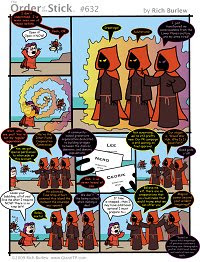
(From The Order of the Stick. Click for full-sized wildest imaginings. This line would have been so much easier if I had nabbed the previous strip…)
Finally, we get to the first of my reasons for writing this series in the first place. And yes, this counts as this month’s OOTS post.
Recently Diamond Comics Distributors, which basically holds a monopoly on distribution of comic books, announced some changes in their policy that have the effect of raising the bar for what might be called “independent” comic books.
They’re certainly not good – nearly doubling the dollar amount a comic would have to sell in order to be guaranteed a continued listing in Diamond’s catalog – but it’s hardly the first time Diamond’s raised its bar. Something about this time, though, has convinced people – as though the previous times didn’t – that Diamond doesn’t care about the little guy and only exists to benefit Marvel and DC – if even DC. According to Diamond’s latest figures DC only makes up 31⅔% of the comic market, compared to 46% for Marvel – basically, Marvel has a little less than 1.5 times the share of DC. (On a dollar basis, the margin is roughly 41% to 30%, so Marvel makes a little over 1.25 times the money of DC.)
Have a look at the most recent monthly sales charts for December and be depressed by the parade of “DC” and “MAR” in the publisher column as you go down. You can count on your hands the publishers other than those two to place anywhere in the top 200, in order of market share: Dark Horse, Image, IDW, Dynamite, Avatar, Boom!, Aspen, and Abstract – and the latter four all first appear between #176 and #200, and only Dark Horse and Image get primo placement in the front of Diamond’s catalog along with Marvel and DC rather than being tossed in the jumble with the rest. Even more depressingly, Dark Horse and IDW owe a lot of their standing to their Buffy the Vampire Slayer and Angel comics respectively, with Dark Horse getting an added boost from Star Wars; outside of Marvel, DC, the Buffyverse, and Star Wars, the highest-ranking comic is Dynamite’s Boys… at #96 and a quarter of the sales of the top titles. Those are the companies – basically, Dark Horse, Image, IDW, and maybe Dynamite – that could survive if Diamond induced a contraction of the market to the point that it started having a practical constraint on the business of Marvel and DC, and there’s little practical reason to think that it couldn’t.
For numerous commentators, from Steven Grant to Christopher Butcher to Elin Winkler to Brian Clevinger, the latest changes are the last straw: it’s time for everyone else to bail out of the direct market as presently constituted, certainly in this economy, and move on to… something else. You could stay in the direct market and hop onboard the Image train and keep creative control while getting Image’s marketing savvy and catalog placement, but it’s far from impossible that Diamond contracts the market so much your title can’t get by regardless, and if it can Image becomes too conservative to publish it anyway. You could just do straight-up graphic novels, which as I mentioned earlier in the series are a form of infinite canvas compared to the 22-page monthly comic anyway, and send it to the bookstore market, but the bookstore market, as personified by Borders and Barnes & Noble, still has even higher barriers to entry, and still doesn’t give comics the respect they deserve. (When I went to Borders in Downtown Seattle to look for Reinventing Comics, the arrangement of the graphic novel section disappointed and disgusted me, with an explicit division between “manga”, “superheroes” and a single heading (rows include headings, which include shelves) of “other graphic novels”. Barf.)
Or you could go into a distribution mechanism where your presence is guaranteed even with a readership of zero… but where there’s little to no money to be had even with quite a bit of momentum.
Webcomics.com is STILL down, but in the comments to a post on New York Comic-Con (which for some reason I mistook for the infinite-canvas post I mentioned in Part III until checking Google’s cache right now, and may have made myself look like an ass in my own subsequent comments… oops, one way it’s a good thing Webcomics.com is down right now) Scott Bieser remarked that the new Diamond rules could lead to a mass exodus of “long-form” talent to the web, spawning not one but at least two posts (both down with the rest of the site right now) of advice to long-form creators on succeeding on the web. One of the two posts (the one that by all appearances went into greater detail) apparently was posted too soon to be indexed or cached by search engines before the site went down, and as it appears to be the more detailed one I’d like to see other webcomics bloggers’ take on this issue, but there’s still an interesting tidbit, worthy of further discussion, on the piece of it that I can see on one of the cache pages. I’ll get to that in a bit.
So, welcome to webcomics, comic-book refugees! Now that you’re here, what do you do?
First, before anything else, read Parts III and IV of this series and decide for yourself whether you want to go for the infinite canvas and join Scott McCloud’s revolution. If you do, you’ll probably learn more from McCloud’s books than you ever will from me, though I have a few important cautions in Part III. If you don’t, it’s worth it to read McCloud anyway.
Still here? That probably means you’ve decided not to pack your entire story into one installment that you read on a single page. That, in turn, means you’ve decided to put each page of your story – probably made to fit the 8½ x 11 format for easy printing later (or half-pages of that to fit on one screen, as McCloud proposes) – on one at a time. That, in turn, probably means you’re releasing comic book pages on a comic strip model, where you release one page at a time on a regular basis, and all the pages together make a single, coherent story. (You could release several pages at a time and change nothing, but…)
You’re probably going to need to unlearn much of what you learned about the comic book format.
Typically, learning from the ones that have come before you is a good place to start. Girl Genius is widely considered, if not the best, at least a significant trailblazer. Gunnerkrigg Court is worth studying too. But there are things both strips do that could trip you if you aren’t careful.
If you placed your hopes on the direct market in the first place, you’re probably used to the 22-page monthly “floppy” format (and in fact I’m assuming you want to make a story that continues indefinitely, rather than something that’s completely wrapped up in one book). That in and of itself is going to have to go; it’s now the individual pages that you’re going to be collecting in graphic novel form later. There’s no need to divide your story into neat 22-page chunks.
In turn, the way you think about those pages is probably going to be drastically different. You’re probably used to seeing the page chiefly as a part of the whole – understandably. But if you’re releasing those pages one at a time, your audience will experience them one at a time. Those pages have to stand on their own. You may be able to get away with massive, dramatic splash pages in print, but if that’s the only thing in that particular update, you’re giving your audience very little, and they may feel cheated. You have to move the plot substantially forward, or otherwise leave your audience satisfied, in every single update. (I don’t mean that you have to contort your story so every update has some sort of big dramatic cliffhanger, contrary to what some may have thought about my webcomics.com comment, only that you can’t have updates where nothing happens either. And if you’re going to have “cover” images for each chapter there damn well better be a VERY good reason.)
I touched on this issue when I reviewed Girl Genius, but it also applies to the Court, and what I said there bears repeating here: one “long-form” comic that seems to understand the difference between the webcomic format and the print comic format is The Order of the Stick. Even there, though, there are three caveats that make me wonder whether anyone has found the balance. OOTS is as much a humor comic as it is a “dramatic” comic, so Rich Burlew can and usually does fall back on a joke to end each comic; and two big parts of Burlew’s solution are piling on mounds of text and using the infinite canvas to extend an installment to two or even three pages if the story warrants.
(Also look at 8-Bit Theater, which hardly skates the first problem and doesn’t do much for the second, but never falls back on the infinite canvas to my knowledge. The Wotch is reliant on jokes but not too reliant on words.)
The latter approach, though, is one that you should definitely consider if all else fails – especially since the very fundamentals of how you write, especially pacing, may have to change to fit the web. Considering each page as an “issue” in and of itself means paying less attention to how they fit with each other (which is nonetheless still important, but becomes more akin to how each issue links with one another). In Reinventing, McCloud laments on the various contortions his story has to go through to fit the print format, such as stalling tactics. Such maneuvers won’t be entirely eliminated by the web if you’re not going whole-hog into the infinite canvas, but maintaining them for no good reason is a big mistake and will only be more noticable. You may find yourself restructuring your story to take full advantage of what the Web provides.
(But in all of this, remember that unless you’re already pretty successful, most of your audience will be reading your story all at once in an archive binge. Ideally, your comic should provide a satisfying read both on a one-at-a-time basis and all at once.)
There’s one more thing about translating a comic book to the web that bears mentioning, and it both ties in with what I’ve just said and serves as a segue to the next topic. Someone once said, “Every comic is someone’s first”. I had thought it was Julius Schwartz, then I thought maybe it was Mort Weisinger, now I see a source that claims Mark Waid. Regardless, it’s just as true in webcomics as it is in comic books, and that can be daunting when every page takes the role of what used to be a 22-page issue.
You could take steps to make every single page accessible to new readers, but it will probably force your comic to something closer to a humor comic and definitely will involve significant contortion to the story. More likely, if someone doesn’t want to binge through your entire archives, you can take steps to ease them into the story gently. Include recap pages to get new readers reasonably caught up on the story so far up to the start of the current chapter, or maybe even up-to-the-page updates. Eric “Websnark” Burns(-White) is insistent on the value of cast pages, even woefully out-of-date ones, in acclimating new readers into the comic as well. If your comic itself is done right, you can intrigue new readers into what’s going on right off the bat, while also piquing their interest on questions like “Hey, why is Character X acting like that towards Y?” and getting them diving into the archives to answer those questions and getting more questions, and eventually becoming completely hooked. (I finally became a fan of OOTS after being linked to a point just as the Azure City Battle was starting and it carried me basically to the then-current strip, and started me on an addiction to the rest of the archives.)
Building an audience is somewhat easier on the web than in the dog-eat-dog world of traditional comic books, but there are new parameters to keep in mind as well. Because there’s no solicitations, and you’re not a smaller part of the broader once-a-week habit of visiting the comic store, you have to set and keep a regular schedule for yourself to release each page. I recommend at least once a week, preferably more, or else it will drift from the memory of your readers. Even if you have an RSS feed, if you update too infrequently you may be asking your readers to do too much work to remember what came before. Select a certain set of days each week to update, such as Monday/Wednesday/Friday, and hold yourself to that, especially if you don’t have an RSS feed (or Twitter). 22 pages a month breaks down to 5-6 pages a week, but you may have to have less; you should have a substantial buffer if at all possible, and know the pace at which you complete each page and plan accordingly.
For several reasons I went over in Part III, but also because of some of the factors I mentioned in the preceding paragraph, webcomics have evolved under a comic strip model. Translating comic books to that format will necessarily involve some contortions. But is it necessarily true, as Tim Broderick claimed in the piece I can’t access even a cache of, that “long-form generally doesn’t attract as many readers on the web as short form”?
I don’t think so. There are certainly a good number of badly-done “long-form” webcomics, and comics where the necessary contortions may have produced an inferior reading experience. And long-form comics present a number of challenges that short-form comics don’t have to deal with. But comics that provide an unbroken thread of continuity from page to page offer one big advantage over “short-form”.
If you’ve been reading my webcomic reviews, you know that I typically take more kindly to a comic with a lot of continuity than a simple gag-a-day comic. Gag strips may give me a chuckle each day, but there’s little reason for me not to just read the day’s strip and be done with it, forever – no matter how much that day’s strip made me laugh. A gag strip doesn’t leave me waiting with baited breath for the next installment, waiting to find out if Vaarsuvius will finally say those prophesied four words that give him/her Ultimate Arcane Power. “Long-form” comics, done right, can attract a lasting readership less subject to certain ebbs, flows, and changing tastes than simple gag strips.
Broderick may be living in a time when long-form comics aren’t as popular as short-form ones, but with this key advantage, I think that as more long-form comics work out the kinks of how to work on the Web, the reverse will come to be true – especially with a potential explosion of new experimenters. Long-form comics may have to go through significant mutation to get there, but there’s a reason for all the short-form comics that have gone through Cerebus Syndrome.
A simple game of connect-the-dots.
How was it possible that despite a far less compelling matchup than last year, including the until-recently laughable Arizona Cardinals, the Super Bowl still drew a bigger audience than last year?
Amidst people crowing “when it’s the Super Bowl the teams are irrelevant”, I was wondering why more attention wasn’t paid to the surprisingly large female audience – which seemed to explain the large audience but gave me more questions than answers. Where did all these women come from all of a sudden?
I may have a partial answer, at least. (Courtesy Fang’s Bites.)