On Tuesday the PGA Tour announced a “new competitive structure” beginning in 2028 involving “two distinct series of tournaments” that it billed as being linked by a structure of promotion and relegation: the Championship Series, consisting of about 23 tournaments with the ones managed by the Tour having 120-player fields and purses of at least $20 million, and the Challenger Series, consisting of about 20 tournaments with fields of about 144 players and purses of at least $4 million. This has been described as a “split” of the existing tour that will make it “look fundamentally different“, a “complete and total transformation“, and as “one of the most significant structural changes in modern golf history“.
But reading the Tour’s announcements, I was struck by two things. First, there was no mention of the Korn Ferry Tour, the Tour’s existing developmental, second-level tour, only the continued existence of the “Q-School” qualifying tournament that has long allowed golfers to qualify for the main tour and the KFT. Second, and more importantly, the Championship Series doesn’t seem to have that many fewer players than the main tour today. Which raises the question: is this really a “split”, or just a rebranding of the KFT?
To answer that question, we need to look at the context of how players earn their main-tour cards today. The top 100 players in the FedExCup standings earn tour cards for the following season, with the top 70 being locked in entering the FedExCup Playoffs and the remaining players attempting to secure their spots over the course of the Tour’s fall events, with the players ranked 101-125 receiving “conditional” status. In addition, the top 20 players in the Korn Ferry Tour standings receive main-tour cards, as do the top five finishers at Q-School, for a total of 125 main-tour cards per season. Another ten cards go to the players not otherwise qualified that finish in the top ten of the DP World Tour (formerly European Tour) Race to Dubai standings, bringing us to 135, though a) I would imagine most of those players would continue to compete on the DP World Tour rather than come to America full-time outside the majors and Players Championship, and b) only the top finisher is “fully exempt” on the level of the top 100 FedExCup standings finishers.
On that note, the Tour’s “priority rankings” used to determine eligibility for Tour events include several categories not reflected in the above. Winners of majors, the Players Championship, and the FedExCup are exempt for the next five seasons, while winners of the former World Golf Championships events and the most prominent “regular-season” events are exempt for three. Winners of other Tour events are exempt for two seasons with each additional win adding another year up to five in total, and only then do players qualifying through the FedExCup standings appear. All told, 85 players are currently exempt through winning tournaments in the past five years (or winning the PGA Championship or US Open before 1970), and by the time you get through the players qualified through the FedExCup standings you’re up to 121. Then after the players qualifying through the DP World Tour, KFT, and Q-School, you have some additional spots for high-performing college golfers, golfers who finished in the FedExCup top 30 two seasons ago, players who win three KFT events in a single season receiving main-tour cards immediately (but below golfers finishing in the 101-110 range in last year’s FedExCup after the fall), and some other categories.
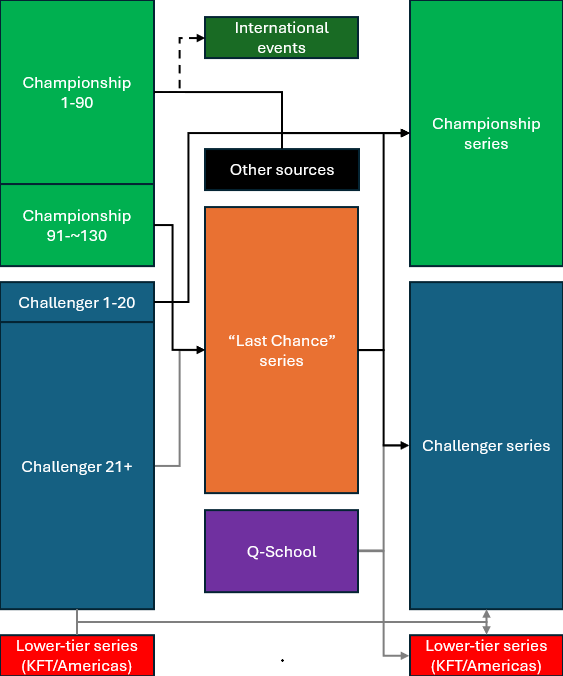
Still, if you stick to the players coming from Q-School and above you’re looking at 145 players in total, and with the implication that Q-School won’t provide access to the Championship Series directly, that’s 140 players with analogous qualifications to the new Championship Series. Championship Series events are expected to have 120 players on average, but the total number of golfers eligible for the Championship Series is expected to be around 130, a reduction of just 10-15. The top 90 in points keep their spots, replaced by 20 players promoted from the Challenger Series – the same number as get Tour cards from the KFT today – with the remaining 20 or so spots “determined through multiple criteria including tournament winners, medical extensions, career milestones and a new ‘last chance’ series”. Of course, these “last chance” events are just the fall events where players already fight to end up in the top 100 for next year, only now they’re joined by the top finishers in the Challenger Series not to earn one of the 20 automatic qualifying spots (which, if you go by the promotion/relegation metaphor, would be analogous to the playoffs between near-bottom higher-level teams and near-top lower-level teams in some soccer leagues).
As it stands, if we have 120-121 eligible players after going through the top 100 of the FedExCup standings, that’s 20 players that didn’t qualify via the FedExCup but did qualify through winning tournaments in the past five years. But it’s not clear that that’s what’s meant by “tournament winners”, because elsewhere it’s made clear that Challenger Series members can earn instant promotion to the Championship Series by winning multiple Challenger events (analogous to the KFT’s “Three-Victory Promotion”) or a major championship. Leave that category aside, and you still have what are currently 18-19 players with “major medical exemptions” deep in the priority rankings, on top of the fall season that currently serves to finalize 30 spots for the next season, plus whatever “career milestones” ends up meaning, smushed together into a 20-player band.
The effect of these changes, then, is not so much to split the Tour as to have stricter qualifications for it. On one level, once you’re in the Championship Series it’s easier to stay there, with 90 spots qualifying for the following season at the end of the regular season instead of 70. That means cutting off the pathways for players qualifying by other means; Championship Series events won’t have sponsors’ exemptions, past-champion exemptions, alternates, or Monday qualifiers anymore, being reserved strictly for players qualified for the Championship Series, and players entering the sport from Q-School or college will have to spend at least a year in the Challengers or, at best, the fall “last chance” events. For the top players, though, the bigger impact may be that winning a tournament, even a major, doesn’t ensure your place in the Championship Series beyond, at most, the following season, a point Tour CEO and incoming commissioner Brian Rolapp has stressed as “getting back to” “competitive meritocracy” that the Tour had “gotten away from”. As Keegan Bradley put it in a pre-event press conference for this week’s Travelers Championship, “You can’t rely on, you know, ‘I had a good year two years ago’, you gotta prove it every year.” That could be enough to incentivize star players to play in every or nearly every Championship Series event, and to understand what that means, we need to take a look at the state of the tour, and the sport as a whole, in recent years.
In 2021 the LIV Golf league launched with Greg Norman as CEO and financial backing from Saudi Arabia’s Public Investment Fund, and soon began poaching high-caliber star players from the PGA Tour, including major champions like Jon Rahm, Brooks Koepka, Bryson DeChambeau, and Phil Mickelson. The Saudi involvement may have improved the tour’s resources and caliber of players, but it was a death knell for the tour’s reputation; defectors were accused by fans and Tour-loyal golfers alike of taking blood money and participating in Saudi Arabia’s “sportswashing” of its poor human rights record, and the tour was seen more as an avenue for “sportswashing” than the result of any genuine discontent among Tour professionals, especially since LIV events saw basically no interest from fans to speak of, at least at first. Earlier this year the PIF announced that it was pulling funding for LIV, and while the breakaway tour is looking for alternative sources of funding, for the moment it looks to be its death knell.
Nonetheless, LIV was seen as enough of a threat that in 2023, the Tour began “elevating” several of its biggest events and identified them as “Signature” events the following year, with bigger purses, more FedExCup points, and more exclusive fields of 70 or so with more stringent qualifying rules. The idea was to advertise these events to fans as ones where they could expect to see all the biggest stars, of the Tour if not the sport as a whole, as opposed to before where star golfers basically showed up to whatever tournaments they wanted, with no consistency from week to week, with only the majors (and the Players Championship) guaranteed to have a significant number of the top golfers. Of course, this came at the expense of the non-signature events which became less likely than ever to see top golfers participate. Eight events are identified as Signature events in the 2026 season, with a ninth cancelled at the start of the season (and off the schedule going forward). The creation of Signature events has been a mixed success at best; Rory McIlroy and Scottie Scheffler didn’t appear in the same field between April’s Masters and May’s PGA Championship despite two Signature events taking place in between.
The new-look Championship Series will do away with the Signature event distinction, but will also shrink the total size of the season, which is one reason the Tour is presenting this as a “split” as tournaments left off the Championship Series schedule will become Challenger Series events. The tour says there will be 23-24 Championship Series events, 15 of which will be Tour-sponsored regular season events, though I’m not sure how their math adds up; if we add to the 15 regular season events the Players Championship, the majors, the Tour Championship, “an annual international team event” (referring to the Presidents Cup and Ryder Cup, which raises eyebrows for me given how late in the year they are and how their exclusivity and format makes them of limited usefulness for earning points), and the Olympics in years when it’s held, that only adds up to 22-23. (The Tour may be continuing to co-sponsor the Scottish Open with the DP World Tour, and that may make up the one that’s missing, although at least one article I read mentioned the Scottish Open as one of the tournaments they were speculating was competing for the remaining spots and one early report suggested there would still be two playoff events, though more on that later.)
Either way, it’s a drastic reduction from the 26-28 non-majors in the regular season (not counting “alternate events” held the same week as majors, Signature events, and other prominent tournaments) plus three playoff events (more on the playoffs later), and while the Tour has identified ten of the 15 regular-season events, the bulk of the remainder (at least three) are expected to come from the Tour’s efforts to hold more tournaments in larger markets (when Rolapp first introduced the plan at March’s Players Championship he noted that the Tour competes in just four of the top ten media markets), which would demote even more tournaments to Challenger status. With the Challenger series only said to have a minimum of 20 events, the majority of those events are likely to be former Tour events, so even if whatever’s below the Challenger series is essentially the same as today’s third-tier tour (PGA Tour Americas) in terms of the quality of the field, the actual tournaments making it up are likely to look like today’s KFT.
But increasing the quality of the tournaments that lower-tier players participate in is likely to be outweighed by lowering the caliber of the players participating in those tournaments, and sponsors aren’t buying what the Tour is selling, balking at the prospect of their tournaments abruptly becoming KFT events, with one tournament director explicitly saying that “[the Challenger Series] is just another name for Korn Ferry Tour”. McIlroy similarly compared Challenger Series events to “glorified Korn Ferry Tour event[s]” and suggested that with the threat of LIV fading, there wasn’t actually anything wrong with the pre-LIV Tour, other than perhaps the increased payouts seen in recent years. (The Tour tweeted a glowing statement from McIlroy simultaneous with the official announcement of the changes, suggesting the Tour had successfully pushed him to toe the party line.)
The Tour’s rebuttal, besides Challenger Series events being at “venues you recognize”, is that they’ll be for “healthy purses” – at least $4 million, compared to the $1 million purses of regular-season KFT events today (and more than the average purse of DP World Tour events) – and will “include a subset of the same 200 and change players we have today”. You have to go all the way down to the 40th category (out of 48) of the priority rankings to get to 200 players, including not just most categories of medical exemption but all the near-misses from the fall swing with conditional status and players with what could be considered lifetime achievement awards for 300 career cuts. If one were to be generous, they’d say that with top golfers only competing at a subset of Tour events as it stands, right now there are opportunities for twice as many golfers as participate at any one tournament to call themselves main-tour members by filling out the rest of the fields, enough that the Tour can siphon them off onto their own tour and only partially downgrade the quality of the KFT, especially with the LIV players probably being re-absorbed soon. But the lack of mention of the KFT in the announcements makes me wonder if the Challenger Series really is just a rebranding and upgrading of the KFT, and I can’t help but wonder whether it’ll really be able to support the increased payouts that are being promised.
The Championship Series would be held from February to August (i.e. during the NFL’s off-season) with seven off weeks where the Challenger series would, supposedly, have the spotlight to itself with “increased consequence, benefits, and exposure”. But I don’t see the tour’s network partners buying the “split” narrative, especially since there will be no equivalent of Buschwhacking – Championship Series golfers will be prohibited from Challenger Series events – and while the prospect of star golfers coming off of off years having to play on the Challenger tour might raise its profile compared to the KFT somewhat, I don’t see them wanting to give second-tier events first-tier treatment, and I think they’d force the Tour to schedule them for weeks with senior and women’s majors and other excuses not to have room for them on the schedule, effectively consigning them to air on Golf Channel only. (Some of Rolapp’s earlier comments suggested that the Challenger Series would avoid coinciding with the Championship Series more generally, allowing it to get more consistent exposure, but that seems to have been abandoned.) I could even see NBC picking up partial rights to the TGL (a version of LIV’s team format allowed to have PGA Tour golfers that’s played at a simulator in Florida, currently running from around New Year’s to late March) just so they can stick some late-season events (or at least the TGL Finals) in Championship Series off weeks instead of putting up with a Challenger event (CBS’ college basketball commitments probably preclude them getting involved at that point in the year). The rise of streaming services could allow the Tour to provide the Challenger Series more exposure than just “whenever Golf Channel has room on their schedule”, but it’s not clear that fans would actually be much more interested than they are in the KFT.
And then there’s the fact that of the four top-ten markets the Tour plays in now, only one, Los Angeles, hosts a Signature event, meaning there’s no guarantee that the ones in the remaining three – Houston, Dallas, and Fort Worth, plus the Tour Championship currently held at East Lake in Atlanta, plus the Canadian Open near Toronto that would be a top-five market if it were in the States – would actually get to keep their spots in the midst of the Tour’s big-market push, before even getting into the markets of Phoenix and Detroit in the top 15, at least as of 2024-25. (And if #13 Seattle and #17 Denver, mentioned as potential markets targeted for new tournaments in the Tour’s press releases, count as major markets, surely those two do as well – as should, for that matter, the #16 Twin Cities.)
The Canadian Open in particular is the oldest continually running non-major on the PGA Tour, while the Phoenix Open has often had the best attendance in golf and one of the most distinctive settings in golf in the “Coliseum” 16th hole, and all this doesn’t even include the tournament at Torrey Pines near San Diego, a course that’s hosted the U.S. Open twice and, at least in my perspective, has some degree of gravity behind its name. (The Tour announced that high finishers in the Championship Series would be eligible for “a limited series of elevated international events” in the fall including “prominent national opens”, which could imply that that could be the fate of the Canadian Open, a prospect explicitly raised in this analysis piece – and the main reason not to expect the same fate to befall the Scottish Open would be its popularity among golfers wanting to get links experience ahead of the Open Championship.) Would the Tour sacrifice those large markets to set up shop in others? Would they give up on one or more of the current Signature events to make more room for big-market tournaments? If not, would they take top-tier players away from iconic courses and historic, popular events if their sponsors weren’t willing to pony up the money (reportedly about $30 million) for a Championship Series event, or even rob Peter to pay Paul by leaving some big markets to chase others – ones that might have good reason not to be holding Tour-level events already?
The markets the Tour mentions as being under consideration for new tournaments are Boston, Denver, New York, Philadelphia, San Francisco, Seattle, and Washington, DC. (Apparently at one point the Tour was reportedly pushing John Deere to move their sponsorship of the event near their headquarters in the Quad Cities to Chicago, but the third-largest market in the country, and second-largest without a regular Tour event, isn’t mentioned in the Tour’s press releases after Rolapp mentioned it as one of the markets he wanted to expand into back in March. That’s telling, especially since Chicago has semi-regularly hosted the BMW Championship as part of the Playoffs but not since 2023. Nashville was also reported as being in the running for a while but was not mentioned either. It’s at this point I should mention that in Rolapp’s earlier comments 15 regular-season events was on the low end of what he seemed to be shooting for, suggesting lukewarm reception to the plan from even those tournaments and markets that would otherwise be considered for Championship Series events.)
Four of those markets are in the Northeast “megalopolis” where there’s already a signature event in Connecticut one can easily travel to, and it’s somewhat auspicious that the Tour brought up the prospect of a regular Tour event near New York City the week after a U.S. Open at Shinnecock Hills that reinforced NYC-area fans’ reputation for rowdiness from U.S. Opens and Ryder Cups at Bethpage Black. The DMV is far enough away from Connecticut that it might be a good idea to put a tournament there, but it already hosted a tournament for about a decade fairly recently, and one prominent enough I’d imagine it would be a Signature event if it was still being held: a limited-field “invitational” hosted by Tiger Woods. Which raises the question: how sure is the Tour that some of these markets are interested enough in golf to support the tournaments they want to put there? The other three, in the western half of the country, are all pretty geographically isolated, and the Bay Area is the only one in a top ten media market, but it also has Pebble Beach in relatively close geographic proximity. So with three of the mentioned markets having marquee tournaments in adjacent markets, how necessary is it to put tournaments in them, really?
I tried my hand at trying to figure out which tournaments might end up joining the schedule, taking the eight Signature tournaments as a base, and you can see the results in the table below. I kept the Byron Nelson in Dallas, which has the highest purse of any non-Signature Tour event at over ten million dollars, but ditched the Fort Worth and Houston tournaments and let the Byron Nelson be the sole Texas tournament; I also converted East Lake into the last event before the Tour Championship (giving it the name of the BMW Championship although the above-linked piece suggested that could move to the fall as well), bringing me to ten. For new tournaments, I pulled the trigger on returning to the DMV, and put tournaments in Seattle and Denver, the two geographically isolated markets without existing nearby tournaments.
NYC is big and prominent enough and Bethpage an esteemed enough course that I was going to set up shop there despite its problems, but that left one spot on the schedule, and I quite literally could not decide between Phoenix or Torrey Pines. (That’s not even getting into the other current playoff tournament at a consistent site, the FedEx St. Jude Championship in Memphis. Not only is it part of the playoff, it used to be a World Golf Championships event, attracting global fields comparable to majors, but I never seriously considered integrating it into the Championship Series schedule, and the best I could do was making it the Challenger Series season-ender. But if I was willing to drop one more new tournament, or give the Scottish Open some sort of special status, I’d probably keep it.) I’d almost want to extend the season by a week, either holding an event in the week between the conference championships and Super Bowl or pushing the Tour Championship to Labor Day, to fit more tournaments.
I ended up dropping New York to fit both in, in part because the sponsor of the Signature event that was cut has transferred their sponsorship to Torrey Pines, which might suggest it’s in line to keep its spot ahead of even the other tournaments I kept on the schedule. But that would mean that this push to put more tournaments in big markets would ultimately only add them in a single top ten market, one where the Tour retreated from holding a prominent tournament less than a decade ago, while taking two events away from them (three if you count the Canadian Open), resulting in one fewer event in top ten markets and the same number of such markets overall (or two fewer events in one fewer market). Among markets ranked 11-20, you’d introduce two new markets but take away two as well. All of which suggests that the Tour doesn’t really need to push into new markets, certainly at the expense of the sizable markets it already has; if you want to maximize the size of the markets you’re holding Championship Series events in, you’d stay in Toronto and Houston and only return to the DMV. (As it stands I am assuming the Canadian Open will end up moving to the fall.) Then you could hold Challenger Series events in some of the other new markets, allowing them to actually prove they deserve to hold a Championship event.
Here’s my crack at what the schedule may look like, using 2026 as a base and my best guess for where new tournaments would be held. (I put this together before reading in one of the above-linked articles that the Tour was trying to create off weeks before majors, rather than after three out of four like I have.) Tournaments in bold are major or near-major tournaments. Cities in parenthesis represent the market each Championship Series tournament serves. On Championship Series off weeks I’ve listed what I think CBS and NBC would schedule for each week in italics.
| Week | Championship Series | Challenger Series |
| 2/9-15 | WM Phoenix Open TPC Scottsdale-Stadium Course, Scottsdale (Phoenix), AZ | |
| 2/16-22 | The Genesis Invitational Riviera CC, Los Angeles, CA | |
| 2/23-1 | CBS: College basketball NBC: TGL events | Cognizant Classic Palm Beach Gardens, FL |
| 3/2-8 | AT&T Pebble Beach Pro-Am Pebble Beach Golf Links, Pebble Beach, CA | Puerto Rico Open Rio Grande, PR |
| 3/9-15 | THE PLAYERS Championship TPC Sawgrass, Ponte Vedra Beach (Jacksonville), FL | |
| 3/16-22 | Arnold Palmer Invitational Bay Hill Club and Lodge, Bay Hill (Orlando), FL | Valspar Championship Palm Harbor, FL |
| 3/23-29 | CBS: March Madness NBC: TGL Finals | The American Express La Quinta, CA |
| 3/30-4/5 | RBC Heritage Harbour Town Golf Links, Hilton Head Island, SC | Philadelphia event |
| 4/6-12 | Masters Tournament Augusta National GC, Augusta, GA | |
| 4/13-19 | CBS: Senior PGA Championship NBC: Chevron Championship | Valero Texas Open San Antonio, TX |
| 4/20-26 | Truist Championship Quail Hollow Club, Charlotte, NC | New York event |
| 4/27-5/3 | Cadillac Championship Trump National Doral-Blue Monster, Doral (Miami), FL | Zurich Classic of New Orleans Avondale, LA |
| 5/4-10 | THE CJ CUP Byron Nelson TPC Craig Ranch, McKinney (Dallas-Fort Worth), TX | Mexico Open Vallarta, Mexico |
| 5/11-17 | PGA Championship (course rotates) | |
| 5/18-24 | New Tournament-Pacific Northwest Sahalee CC, Snohomish (Seattle), WA | Corales Puntacana Championship Puntacana, Dominican Republic |
| 5/25-31 | CBS: UEFA Champions League final NBC: US Women’s Open | Charles Schwab Challenge Fort Worth, TX |
| 6/1-7 | The Sentry (formerly Farmers Insurance Open) Torrey Pines Golf Course-South, San Diego, CA | Chicago event |
| 6/8-14 | Travelers Championship TPC River Highlands, Cromwell, CT | ONEflight Myrtle Beach Classic Myrtle Beach, SC |
| 6/15-21 | US Open (course rotates) | |
| 6/22-28 | CBS: WNBA basketball NBC: Women’s PGA Championship | Texas Children’s Houston Open Memorial Park GC, Houston, TX |
| 6/29-7/5 | The National TPC Potomac, Potomac, MD (Washington, DC) | John Deere Classic Silvis, IL |
| 7/6-12 | Genesis Scottish Open The Renaissance Club, North Berwick, Scotland | ISCO Championship Louisville, KY |
| 7/13-19 | The Open Championship (course rotates) | |
| 7/20-26 | CBS: WNBA basketball NBC: Senior Open Championship | Rocket Classic Detroit, MI |
| 7/27-8/2 | New Tournament-Denver Castle Pines GC, Castle Pines, CO | 3M Open Blaine, MN |
| 8/3-9 | The Memorial Tournament Muirfield Village GC, Dublin (Columbus), OH | Wyndham Championship Greensboro, NC |
| 8/10-16 | CBS: NFL preseason NBC: Premier League, US Amateur | FedEx St. Jude Championship Memphis, TN |
| 8/17-23 | BMW? Championship East Lake Golf Club, Atlanta, GA | |
| 8/24-30 | Tour Championship (course rotates) |
The postseason format is actually one of the more intriguing elements of the plan, with the Tour announcing “a new-look Tour Championship featuring match-play format”. The existing playoff system, formerly four events and now three, has long frustrated fans and gone through numerous retools, including a system where point totals and performance in the earlier Playoff events would give you a handicap at the Tour Championship, which I thought was an interesting idea with iffy execution and was roundly criticized by fans. (The post I linked to in the previous sentence also has my idea for a points system that I still think would meet the Tour’s stated goal of being “more intuitive for fans and media partners”. The main change I’d make is reducing the bonus over second place for losing a playoff to 10 points instead of 20, and maybe finding a way to award multiples of 5 for every position in the top eight, even if that means bumping up second place to 60-70. The Tour also announced “a single, consistent points system across every event, unlike it is today with four types of events offering different point allocations”, implying that the majors, Players, and Olympics will be valued the same as regular season events, which I guess I’m okay with for the sake of simplicity.) Match play, on the other hand, is golf’s existing equivalent of a literal, actual playoff, and a seeded, bracketed format would provide real motivation to maximize your ranking even if you’re safely past the cutoff, something lacking from most of the Tour’s past playoff formats.
One point of concern could be that the former WGC Match Play Championship, as far as I could tell, didn’t really attract that much more interest from fans than other tournaments. But the popularity of the TGL and TNT’s “The Match” franchise (and to a lesser extent the Ryder Cup) suggests that fans can be captivated by match play under the right circumstances, and using it to crown the champion of golf for the entire year, coupled with the prospect of holding the Tour Championship on a rotation of courses, could help it take its place as the year’s “sixth major”, after the “fifth major” of the Players Championship, that I suggested was necessary for fans to take it seriously 16 years ago. Still, it might be a good idea to take some cues from the TGL and “The Match” in the later rounds, with enhancements like micing up the players and caddies and holding in-match interviews, and possibly gimmicks on selected holes.
(One reason to go with Labor Day weekend for the Tour Championship, even if it means dealing with college football and other sports trying to get marquee events in before the NFL season starts, is that the Match Play Championship, which had a 64-player field that seems like a good number for a championship for a 120-130-player tour with 90 players escaping relegation and 65-player cuts at most tournaments, started on Wednesday and played the semifinals early enough in the day on Sunday that it was relegated to Golf Channel and saw far smaller audiences than the Saturday quarterfinals, possibly not helped by the final being 36 holes. Back when the Tour allowed the Playoffs to overlap with NFL season, the Deutsche Bank Championship on Labor Day Weekend had a unique Friday-Monday schedule; a Thursday-Monday Tour Championship creates the opportunity for as many as three days of broadcast network coverage from the octofinals on, and possibly longer windows that would maximize exposure of the later rounds.)
I wasn’t sure how match play was compatible with a playoff consisting of more than one event – it’s not clear how to hold match play across two events, and having some events count more than others without them being majors was already one of the more arbitrary-seeming elements of the existing playoffs and would become even more so if you have stroke play events feeding a match play event. The Tour’s description of its “reimagined postseason” goes straight from recognizing a regular season champion to describing the new-look Tour Championship, and there’s no real indication of more than one postseason event, but its description of the Championship Series schedule does only describe the Tour Championship as “part of a reimagined postseason” (emphasis added). One idea that occurred to me as I was writing this, however, was to take a cue from the ongoing World Cup and have a pre-Tour Championship event drawing players into groups to play a round-robin format, with the top two finishers in each group advancing to the Tour Championship. But I don’t like this idea as much as going straight from the regular season to the Tour Championship, especially because it reduces the motivation for maximizing your ranking to maximizing the pot you fall into. I’d be willing to wait and see what the Tour comes up with, but my thinking is that the simplest format would be best: take the top 64 players and seed them into a single-elimination knockout bracket at a single-event Tour Championship.
I’ve criticized the Tour’s plans plenty in this post, from how their importance has been inflated to how that inflated importance masks what this really means for the tournaments being cast aside to whether the Tour’s push into new markets is really warranted or will ultimately be successful, but the postseason format points to the fact that I really am interested in how this will all play out in practice. If the Tour succeeds at creating consistent fields and a high-stakes environment at every Championship Series event building to an exciting postseason, it could reinvigorate the sport of professional golf. The question is whether that comes at the expense of the state of the game below that top tier.