Random Internet Discovery of the Week, plus an explanation

More phobias than you can shake a stick at!

Proving once again that even with my fun stuff I work on the wrong things, I didn’t get in Part II of my ongoing series today – well, yesterday(my typical webcomic day!) because I was distracted by another project. This part is fairly involved, and is going to be written mostly off memory, and I’m going to try to get it in tomorrow – well, today – plus Part III to make up for today – well, yesterday – but for all I know this could be my platform reviews all over again…

Another thing about the Super Bowl that NO ONE has noticed…

Everywhere I’ve gone, starting with the announcing team itself, people have lamented that if James Harrison’s long touchdown run to end the first half was called down at the 1, time would have run out and the play would have been for nothing.

Um… has anyone actually seen the play, and watched the clock, and the exact moment when the clock ran out?

THERE WOULD STILL BE ONE OR TWO SECONDS ON THE CLOCK! Watch that clock in the video below!

Webcomics’ Identity Crisis, Part I: Understanding Understanding Comics

Understanding Comics is incredibly addictive. I bought it on a gift card on Saturday despite having already read it cover-to-cover, mostly as a reference for my own ideas, and proceeded to read it cover-to-cover all over again. Oddly, I’ve been to two different Barnes and Nobles three different times, and the latter two times both Barnes and Nobles had Understanding Comics and its second sequel, Making Comics, but not the first, Reinventing Comics. As Reinventing is the book I’m most interested in for this weeklong series, as it’s the book with Scott McCloud’s thoughts on the then-burgeoning form of webcomics, I’m going to see if I can still procure it or at least read it. (Oddly, Reinventing is not even the first hit for its own name on barnesandnoble.com, Making is and Reinventing is third and has no cover image. So basically B&N treats it like the bastard stepchild of the series. But I did see it the first time I peeked into a Barnes and Noble to peek at Understanding, and even read a bit of the beginning…) At some point as well, I want to read other dissections of comics, such as Will Eisner’s McCloud-recommended Comics and Sequential Art and anyone following in McCloud’s footsteps, just to get more perspectives.

The funny thing about Understanding Comics is that it’s not just about comic books, but to some extent or another, about all art forms. And I’m not just talking about Chapter 7, which focuses on McCloud’s vision of the creative process for any work of art. As if to prove McCloud’s point (and then-novel idea) that comics were just as much an art form as anything else, McCloud discusses comics and other art forms side by side throughout the book. To take one example, part of Chapter 4, mostly a discussion of time in comics, casts the idea of the “motion line” in comics (and later refinements on it) as the answer to the question of motion on a static image some in the “high” visual arts had struggled with early in the twentieth century. But even that is a fairly weak example (and really, McCloud returns to the visual arts in particular throughout the book, as static painting/drawing and comics are cognate art forms (or cognate media), for a reason I’ll get to later).

Chapter 2 deconstructs the appeal of the cartoon (distinguished as an artistic style from the medium of comics) as an extention of the reader/viewer, by deconstructing the way we see ourselves, going so far as to completely ignore its ease of drawing, to explain its popularity not only in comics but in any form of animation. Chapter 3 compares the extrapolation of events between panels to the portrayal of events “off-screen” in those same media. In addition to the discussion of motion, Chapter 4 also compares and contrasts the concept of the present “now” with film and television and brings up the specter of “viewer participation” in media of all stripes. Chapters 5 and 6 discuss the very origins of language, and the latter effectively sees comics as a means of returning to the ideal union of words and pictures, and discusses the obstacles facing the genesis of any medium.

If I have an issue with it on first read, it’s mostly the clunkiness of the end of each chapter (except the first) and the end of the book. The “recaps”, perhaps inspired by the “hourglass” model of long-form argument taught in English class, are clunky and come off as unnecessary. This is why I have problems properly wrapping up my posts sometimes, because the main, predominant form of ending posts of the lengths I sometimes write is one that doesn’t appeal to me and I don’t think I’ve found anything better. (If anything, McCloud gets worse at this as he goes along; other than Chapter One, Chapter Two is the least clunky chapter ending.)

There are also some problems with the content, though I think I would have fewer of them than some others would. McCloud distinguishes between six different types of panel transitions but comes close to throwing out two of them: “moment-to-moment” is really a slow “action-to-action”, and the “non-sequitur” may not even exist, since either multiple non-sequiturs in a row become scene-to-scene, subject-to-subject, or even aspect-to-aspect, or a single non-sequitur that’s continued from is really a form of scene-to-scene. I might add that aspect-to-aspect is arguably a form of subject-to-subject that’s somewhat arbitrarily distinguished from it mostly in order to distinguish Japanese comics from their Western counterparts.

Also, I have some trouble with McCloud’s six-step creative process, especially the specifics of the third part, the “idiom”, which is never quite clarified as well as it could be. The way I see it, what McCloud means by “idiom” is all the stuff that can be used to describe the work other than the singular, basic “point” of it. To say that something “has a kissing scene” is different than to say it’s “about kissing”. But I wouldn’t be surprised if others have different interpretations, and especially, the distinction between that, “structure”, “craft”, and “surface” can be somewhat unclear, especially for non-comics media – and if you do distinguish “idiom” from the other three, you then have to distinguish it from “idea/purpose” and “form”! And I would suggest that “idiom” sometimes (especially in other media) goes hand-in-hand with “craft”. I often write stuff with no attention paid at all to “structure”, and let the ideas flow onto the page as they may. I decide the “surface” aspects will come out naturally as I write (and so I rarely edit) as well, so “structure” and “surface” come out naturally following “craft”.

Oh, and the “backwards” development of most comics artists may no longer be 100% true simply because of the Heisenberg uncertainty principle of Understanding Comics: since the book was released, people have gotten more self-conscious about the process. And despite its nature as a dissertation on all art, I don’t really see it as doubling as a manual for designing for the computer the way some people do…

But again, I came for McCloud’s thinking in Reinventing Comics which oddly, made him a god in webcomics but – by his own reckoning – tarnished his Understanding-built reputation and made him a pariah in the print field. And there is, from what I hear, plenty to deconstruct in Reinventing Comics. But first, I want to point out the irony in that Reinventing is de facto an attempt at doing for webcomics within the broader comics field what Understanding did for comics within the broader domain of all the arts: defend the former as a legitimate part of the latter.

In Part II, I’ll start examining the similarities and differences between webcomics and their print counterparts and begin examining the state of webcomics at the present time. As the series goes along, I hope to examine what McCloud got right that may not have been recognized yet – and what he got wrong and why.
Quick thoughts on the Super Bowl

  • If I were putting together NBC’s opening sequence, I would have made a few more changes to the opening song. For example, instead of “waiting all day”, how about “waiting all year”? And how can you pass up the fact that “forty-three” rhymes with “NBC” and so could have been inserted into the song with few other changes? You won’t get anything like this until Super Bowl 70!
  • I hate to disagree with Roger Goodell, but this game did not top last year’s game. This game does have the advantage over Super Bowl XLII, and XXXVIII, that the first half was not boring as hell. But while this game did produce some landmark, all-time Super Bowl plays, those individual marks can’t really compare with a great game – this game was just like any other Super Bowl from a pre-game angle standpoint, unlike XLII, and the Cinderella team didn’t win, which hurts its standing – in fact I was rooting for Pittsburgh to pull out the win just because it would have been too bizarre otherwise. There are in fact some similarities with XXXVIII, another game people wondered about being the best Super Bowl ever. One of these days I need to go over the game film, or at least the NFL Films distillations, or even compact game stories, of every Super Bowl and rank the greatest ever. FSN’s “The Sports List” did a ranking probably around the time of XL, maybe even before XXXVIII. Obviously, that list needs a serious update.
  • Is it too early to start talking about Ben Roethlisberger’s Hall of Fame credentials? Remember, in the lead-up to the Super Bowl people were talking about Kurt Warner’s Hall of Fame credentials now that he had reached three Super Bowls with two different teams. Now Roethlisberger has been to one fewer Super Bowl and won two, becoming just the tenth QB in NFL history to do so, and not completely throwing up in the second. Not to mention his leadership in the regular season. If there’s a knock against him it’s that he’s leading a team composed of a bunch of parts that might win Super Bowls without him, but then again that was the knock against Tom Brady for a while as well. If he so far as makes one more Super Bowl, is he a shoo-in for the Hall? And is it possible that his final drive in this game, which had Steve Young positively salivating on ESPN’s NFL Primetime, is the one that puts him in the Hall?
  • Speaking of ESPN, and lists, about your “Top 10” Super Bowl plays: Your own analysts, who clamored for Manning-to-Tyree to beat out Roethlisberger-to-Holmes for , are correct. What you should have done was rank the Harrison INT return significantly further back, in the middle or even near the back, since it was one of those sideshow gimmicky plays that come out of the blue every once in a while in the Super Bowl. By ranking it , you forced the Holmes play to to avoid consecutive plays from the same game. Probably the main reason you rated the Holmes play was because it actually scored the game-winning TD, but it arguably makes Manning-to-Tyree greater that it attained such greatness without actually scoring. (Incidentially, initially I rendered “Holmes” as “Burress”. What does that tell you?)
  • Am I the only one who noticed that the clock briefly stopped at two minutes left in the game when Roethlisberger barely got a play off, then started again as the clock operator realized there was a play going on, and the discrepancy was never corrected? How might that have influenced Arizona’s final drive? The game-ending fumble would have only occured with two seconds or so left on the clock! You think Arizona would be working a bit quicker? And am I the only one who thinks that on the play to the 5 on Pittsburgh’s final drive, the main reason the Steelers called a timeout was that the receiver (I think it was Holmes) was a little lazy getting back to the line of scrimmage, as though he didn’t quite realize the situation? The Steelers might have needed that timeout to set up a field goal with a few seconds left on the clock if the Cardinals had been able to get a stop. I think there was one other “Am I the only one who noticed that” in there, but damned if I can remember it now.

I have plenty to say about the ads in a later post, where I hope to hand out awards for the ads, and some comments on NBC’s modified banner for the game, which is also an opportunity to talk about ESPN’s new tennis banner it broke out at the Aussie Open. There were a LOT of great ads in the second half of this game. Lineal titles updated for the offseason.

Is my personal long national nightmare at the beginning of the end?

I don’t want to jinx anything, and I’m technically losing the services of the place where my dad has been working (I think I can still post the strip from here), but events may be being set in motion to solve the problems I’ve been having for the better part of a year.

I’m starting to try various things to solve my laptop’s hibernation problem. I just might be about to get at least some of my files back from my old USB drive after over four months. As for my Internet connection and job situation… well, recent events, not to mention the loss of the aforementioned fallback, are starting to make us consider… well, I won’t give the jerks downstairs any ammo, but suffice to say I may finally be getting motivated to get a real job.

The backlog for Da Blog remains, and I may well delay the OOTS post this week. A far more profound topic, cutting to the very core of webcomics, is coming up. The OOTS post may be delayed a whole week, or at the very least a day or two, because I feel a multi-part series coming on…

More football than you’d ever expect two days before the Super Bowl

(Editor’s note: This post was  reconstructed from scratch because WordPress’ importer missed it the first time through. I don’t think any comments were left with this post but if there were I apologize.)

Stewart Mandel of Sports Illustrated uses the Arizona Cardinals to back the BCS, or at best a plus-one, in a column on SI.com. In his eyes, if the Cardinals could tank once they cinched their division and then rendered their mediocre regular season irrelevant in the playoffs, what’s to keep Florida from tanking before the SEC Title Game, or Virginia Tech from rendering irrelevant their mediocre regular season and cruising to the Golden Bowl in Cardinal-esque fashion?

You know I’m a staunch backer of an 11/5 system for college football. While Mandel makes a compelling argument, I think it falls flat for a number of reasons. Ignoring the tanking-Florida argument because I’ve covered it before, it’s worth remembering that V-Tech wouldn’t automatically get a home-field seed just for winning a mediocre conference, meaning the confluence of good fortune that assisted Arizona would need to be significantly greater. Even with a home field 8th seed, V-Tech would either need three games to go their way (not two as Arizona needed), or make their own luck twice (not once as Arizona needed). That’s before considering how much home field has been diluted in the NFL, which you can’t say about the famous college football crowds.

I have more in my comment to the Bleacher Report article that tipped me off to Mandel’s article.

Meanwhile, the college football rankings are finally up, as are updates to both lineal titles.

Da Blog for the rest of this week

So after I proclaimed how much less stressed dropping the webcomic post for this week was going to make me, I’m realizing I’m as stressed as ever if not more.

Barring a calamity, Thursday should see the long-awaited posting of the final college football rankings and lineal titles. Friday should see the posting of another sports-related post, one which I actually consider is more vital to get out of the way this month. But it’s unlikely I get it out first, so I’m slating it for Friday, though you may see it before then.

Okay.

I’ve been bottling this up all week, but I have a big beef with Buzzcomix. And it’s not so much that they’ve been down for the second time in less than a month. As annoying as that is, because they really need to figure out what this problem is and solve it.

No, it’s the fact there isn’t even a channel to inform anyone what’s going on. The old Buzzcomix at least had a forum. I’m not sure the new Buzzcomix even has any sort of “contact us” link. Not that that would matter while the whole site is down, but not having a forum or anything of that sort means no way of letting us know what the problem is when the site does come back.

Even with the site down, they could let a site like Comixtalk know what the dealio is. I haven’t found anything in my admittedly brief search to indicate that anyone has any idea what exactly is going on. Did Buzzcomix run over their bandwidth? Were they a victim of a DDoS attack? Did someone have pornographic images? Is the site going back up by the time you read this, later today, tomorrow, at the end of the month, after a while to plug security holes, or ever? WE DON’T KNOW!!! And we basically have no way of knowing.

Well, at least we still have Top Web Comics.

So because I lost an early draft of this post Wednesday, yesterday I had to type it up in a “draft” editor that was autosaving but not rendering everything correctly. I had to use regular Blogger to add the strip image.

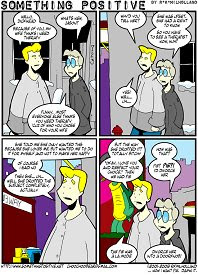
(From Something Positive. Click for full-sized pie.)

This is going to be a shorter review than some of my other ones.

Something Positive is funny in a way, because for me, it’s the opposite of xkcd. When I reviewed xkcd I started out doing a limited archive binge, and because I found myself with little to say, I decided to follow along with the strip at the pace it normally updates before reviewing it. It didn’t change my lack of anything to say, but that in itself was something to say. That incident gave me my policy of following along with strips for a spell before reviewing them, which has been taken to the point where I generally don’t necessarily archive binge anymore.

So with S*P, I’ve been spending the past few weeks following along with the strip, and when that left me with very little to say about it, I decided to go back to the beginning of last year and follow along on an archive binge. And at first, that didn’t change my lack of anything to say. At first.

Because I’m convinced Something Positive reads better all at once than as it updates.

Honestly, S*P is an odd duck to categorize. On the one hand, it’s a gag-a-day comic, and even there it’s a bit schitzophrenic. Sometimes it’s making commentary on geek culture, and when it does it can be hard to tell whether Randy Milholland hates geek culture with a passion, is in fact sympathetic, is one himself, or a combination of any or all of the above.

The flip side is when it’s a chronicle of the ordinary lives of its characters, and here, it oddly takes on elements of a storyline comic. Milholland is not shy about allowing his characters to grow, change, and undergo some form of character evolution. It’s tempting to compare it to Seinfeld or the like, but it’s different as well. Several characters have several ongoing plots, which move at a snail’s pace but still actually move. If there’s an appeal to the strip, it’s in waiting for all these plots to move while laughing at the geek-culture strips. It’s easier to appreciate all these shifts if you can read them in a single archive binge, where all the infinitesimal movements are less annoying, and a host of only marginally funny strips can have their humor add up and rope you into the strip.

Basically, the ongoing plots are the most compelling element of the strip, but they move incredibly slowly, so if you don’t have much patience at all that shouldn’t be a reason you follow S*P. Conversely, if you find the geek humor funny you might decide to read it for that reason, but because of the plots that humor isn’t as common as you might like and isn’t always as funny as it should be.

And Milholland has a lot of characters and a lot of plots. It’s even more daunting, and potentially confusing, when fairly minor characters get significant screen time and their own plots largely independent of the (nominal) main cast. During my binge I often had a hard time keeping all the characters straight. (How many red-heads does Milholland have in his cast anyway???) Milholland has a fairly prodigious cast page (though it has some gaps, including Aubrey, who you’d think would be first in line to get an actual page considering she’s one of the original three cast members) but it leaves me with the impression that Milholland has spent a little more time than you’d expect with characters whose connection with the main cast was always a little thin in the first place. (Mike would fall into this category.) This may have something to do with who the fandom has latched on to, but still. And these are just the ones Milholland maintains plotlines for; there are boatloads of other characters that only show up at “Old Familiar Faces” time.

I also have a little bit of an issue with the art, although I think I have more of an issue than I otherwise would with Milholland’s text-laden panels (which Ctrl+Alt+Del is so criticized for) and irrelevant art because recent strips that happened to fall within the time I was following it hammered home the point for me. Two strips in particular, one of which saw a last-minute script swap-out and the other one of which Milholland just couldn’t decide between two scripts. In both cases, the art is exactly the same in both versions. Seriously. Milholland basically could take any four panels of Davan and Aubrey talking and plop in whatever dialogue he needed. He could create the new Dinosaur Comics, even! And they’d probably go on and on about whatever their problems were and how to fix them and some snarky remark and… and there are quite a few strips where the dialogue could be swapped out for something else! It’s tempting for me to ask “why make a webcomic if the art doesn’t matter? Why not go into prose?” but that would disqualify half of webcomicdom, including Dinosaur Comics, which is beloved partly because the art doesn’t matter. (On another note, be sure to check out my webcomic!)

I don’t think I hate Something Positive nearly as much as I’ve made it seem in this review. I can certainly imagine it being an enjoyable diversion for someone, and I did have a few laughs and found myself constantly clicking the “next” button wherever I was in the archive, but I’m not sure I can completely endorse it either. I don’t want to say it’s mediocre at best, but I think I do have some deal-breaker problems with it, or at least a series of smaller problems stacked one on top of another that mixes with just not being quite compelling enough. But I think my state of mind is affecting my judgment here, because of all the stress I’ve been under recently, and because of that there will be no webcomic post next week so I can recharge my batteries, catch up on past stuff, and allow my next webcomic post to be on Order of the Stick so I can stick to a realm I’m comfortable in and already know what I’m getting coming in.