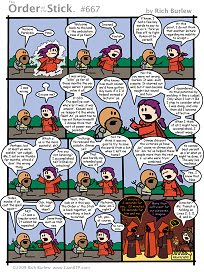
Please don’t tell me the only point of Roy remembering everything about his trip to the Oracle was to fill a plot hole in Panel 2 of 698.

(From The Order of the Stick. Click for full-sized coordination.)

Back in September, I stopped following OOTS and instead started on an archive binge from beginning to end.

Last month, I finished it.

Now, part of the reason for the binge taking so long was because of a side project I was working on at the same time, related to the binge but in retrospect distracting from its intended main goal. Once that side project caused the binge to slow to a crawl, I elected to postpone it until I had more time to work on it. Which, thanks to various other miscellaneous distractions, turned out to be this February, and in retrospect I should have postponed it even longer, because the related effects may turn out to be far more far-reaching (more on that later). But there’s a part of me that wonders if the length of the binge may have been a subconscious response on my part to the sub-par quality of the strip as of late.

In retrospect, I may have just barely missed one of the greatest single stretches in the history of webcomics, the stretch collected in the War and XPs book collection. If, as people have suggested, OOTS’s Cerebus Syndrome can be dated to the trial sequence at the end of the previous book (an increasingly dodgy proposition, as I’ll get to in a moment), and OOTS’s Cerebus Syndrome is a defining feature of what makes the comic great (as opposed to a series of D&D in-jokes), then the Golden Age of OOTS can be fairly exactly pinned down to that one book. A case could be made that you could pin it down to that stretch anyway – everything from about comic #380 to the end of the Battle of Azure City is pretty much one long Wham Episode. It’s almost stating the obvious that the greatest comic in the history of OOTS so far came from that stretch, whatever that comic may be. But in any case, book 4 seemed to be a significant disappointment. As awesome as V’s final descent into madness was, it seemed the exception and not the rule.

Now, OOTS being off its game is a little like The Simpsons being off its game, at least from the perspective of those who kept voting “Never Jumped” for that show on the old Jump the Shark site. OOTS’ worst is still better than the best of a lot of comics (the likes of Dresden Codak, 8-Bit Theater, and Scary Go Round come to mind – those of you who just shouted Ctrl+Alt+Del may remove yourselves now). Still, book 4 was marred by clunky dialogue, questionable characterization, a disturbing density of strips that are painful to read, and a general lack of the heart that characterized previous books. (Book 4 is perhaps more OOTS-dominated than any book since book 1, and is the first book in which the Linear Guild doesn’t directly appear. The unwillingness to go to anyone other than the OOTS for more than ten strips, if you don’t count Super-V’s attempt to engage Xykon and various IFCC shenanigans, may have come off as laziness.)

Of course, the poster child for iffy characterization in Book 4 is Celia, who seemingly stepped right into Miko’s role as the most hated character in the strip. Celia had so many problems that sorting between them proved to be a challenge. Seemingly out of the blue, Celia became a holier-than-thou pacifist idiot, going against her prior characterization in the process, in a seemingly pointless manner, if the existence of a thread asking what the point of her presence was during my absence is any indication. (Tellingly, I know of no similar thread for Roy on the material plane outside the visit to the Oracle.) Celia was not even particularly consistent about being a pacifist – not only did it go against her willingness to zap Nale and Thog, it also went against her willingness to defend the OOTS (“professional murderers”) to Shojo’s court, and she eventually found herself blatantly cheerleading Haley’s slaying of her own former friends like nobody’s business. I’m still partial to my theory that she was just too ashamed of her limited capability in battle, and when Haley asked if it was a conscientious objection, Celia ran with it rather than admit the truth – the only other consistent interpretation is that Celia is perfectly fine with other people killing for her, and if that was the case I don’t think she would have had a problem with Belkar killing a hobgoblin, since it seems fairly obvious that her ploy to escape them is motivated more by a desire to avoid killing, whatever the base of that desire, than the concern for the Resistance she espouses (if that were the case she’d have brought it up right off the bat), not to mention she wouldn’t have stopped the very killing she’d cheered on earlier. (At least my theory doesn’t make her an incomprehensible raging hypocrite.) Rich’s attempts to explain or play off the most blatant self-contradiction, her pacifism, were interpreted as attempts to redeem her, which led to accusations that Rich didn’t understand the real reasons Celia was so hated, her idiocy (itself contradictory – how is someone studying to be a lawyer that naive? I’m amazed she didn’t figure Roy could fly on his own power). Frankly, judging by the fact that Haley gets the last word on Celia with similar words to what the forum was feeling, without even Roy objecting on-screen, I suspect that Celia was intended to be hated.

(Do not even get me started on Elan. I could write a whole post on how he’s been handled.)

Part of the reason for the intensity of the hatred towards Celia may have been the fact that, during Book 4, the main plot of OOTS ground to a complete halt, as everyone was more preoccupied with getting the gang back together and their own plot than actually getting to the next gate, and the entire book seemed pointless compared to the rest of the megaplot. I’ve said before that, with only a few changes, the end of Book 3 could conceivably have marked the end of the entire strip, and the general aimlessness of Book 4 seems to back me up on that, suggesting that it really was intended as “halftime” between two very different comics. OOTS Gamer Theory Syndrome was one result, but another was that, once the OOTS got back together, V’s Soul Splice ended (and he and O-Chul reunited with the OOTS in such fashion I half-expected this strip or this one to be titled “Deus Ex Monstro” or “Monstrum Ex Machina”), and Roy was resurrected, the clunky dialogue revved into overdrive, and continued even into the strips I skipped. Rich seemed to have trouble making a seamless transition back to the main plot, resorting to much expospeak during the meeting of the “War Council”, and the whole thing almost felt like starting from scratch, with the whole “lich-and-gate thing” more of an abstract obligation than anything else. (The fact the OOTS was finally in one piece and unencumbered again may have contributed to this feeling.)

And as much as I was excited at the revelation of the “planet-within-the-planet”, I couldn’t help but dread the directions this could possibly go. It had all the hallmarks of a shock-value “everything-you-know-is-wrong” twist, and whether it led to mucho exposition, a Planet of the Apes ending, “Adventures on the Snarl World” (a very distressingly common theory for Book 6), or something else equally trippy, it could not help but lead to something stupid.

And then the next book started… rather jarringly, to say the least. The 1-2 and 2-3 transitions had transition strips that helped ease things, and comic 485 flowed directly out of comic 484. The transition from book 4 to book 5 could have used a transition strip, because it was hard for me to get oriented, especially after a lengthy break, after getting simply plopped in Sandsedge (especially with even more expospeak instead of just letting it be an establishing shot). This is one of the more obvious book transitions Rich has ever done, and along with how suddenly the subsequent random encounter starts, really underlines the clunkiness of Rich’s writing of late – occasionally reading more like an OOTS fanfic. (But that strip is the biggest problem among the strips I skipped.)

And then came the strip that may have singlehandedly subconsciously convinced me to quit OOTS for the time being.

I refer, of course, to the rest of the OOTS’ complete inability to acknowledge Blackwing’s existence. That was a cruel trick to play on V, and I couldn’t help but sympathize with her plight. Now, my extreme negative reaction to this comic probably has something to do with the way I personally process information, but I was far from the only one who had a problem with it – probably most of the forums didn’t even understand what was going on, and those that did were understandably frustrated. (It did not help that, despite mounds of evidence that people can, in fact, SEE Blackwing, people still think they can’t. In retrospect, Rich should not have included the bit where Belkar can’t see the bird.)

But as much as I hated this twist, at least it imposed interesting questions that needed answering. Why wasn’t the OOTS able to acknowledge Blackwing’s existence? What, exactly, happened back at the rift? To what extent was the OOTS memory-wiped – could someone be forced to acknowledge Blackwing’s existence by, say, being asked to remember events where there would be a gaping hole without Blackwing? Surely Vaarsuvius, doubted by his own teammates, would seek, with such an inquisitive mind as his, to get to the bottom of this question?

But no. V makes ZERO on-screen effort to prove Blackwing’s existence or investigate his seeming lack thereof. Instead it seems that the point of one of the most maddening twists in the history of the strip, one that insulted our intelligence and made the OOTS seem like either jerks or idiots, was to turn Blackwing into the “good angel”, to literally strip him of his reality and turn him into V’s imaginary friend, his conscience and guiding spirit in his ongoing character development. Never mind that this could have just as easily been done with a literal good angel, or that the process of setting Blackwing up for this role involved setting up a huge plot twist and then forgetting about it.

Comic, meet wall.

I am not in the camp of those on the forums who claim that #674 was “just a joke”. I certainly hope it wasn’t (and references to the comic since then suggest it isn’t), although reading without an eye to speculation leads to the disturbing conclusion that the sole point of it was solely to illustrate V’s anger management problems, regardless of what about the characters had to be contradicted to get there. First, it’s not funny. Second, the joke relies on the contradiction of previous comics. Third, if the joke is in-universe played on V by the OOTS, it requires unconvincingly derailing all their characters, especially Haley, who’s V’s friend and has, in the past, been more connected to Blackwing (she named the bird, for crying out loud) than V herself has. Fourth, if the joke is external to the universe, it still requires bending the characters unconvincingly, and OOTS is too much of a plot-oriented strip at this point to make a continuity-free joke.

Frankly, I don’t find V’s attempt at redemption terribly convincing either. It seems odd that V would go from being mad with power to engaging in a twelve-step program and trying to distance herself from anything that reminds her of the old V in a couple of days. V’s experience with the Soul Splice was a teachable moment, but what she learned in Xykon’s throne room was that power could take the form of everything at her disposal, not merely brute-force arcane power, and that among the powers at her disposal was people other than herself. V herself later articulates the value of planning, while Durkon lectures her about the value of small victories. All that points to ways she can better use her magic, not anger management issues or other requirements to totally change her personality. V later characterizes the incident in 677-678 as “evoking first and making inquiries afterward” (in typical Vaarsuvian fashion), but it still feels like Rich took a few logical leaps along the way. (And there’s a big difference between “use your allies to your advantage” and “don’t get involved at all if your teammates can handle it even if things would be over a lot sooner”.) I could sympathise very much with Vaarsuvius’ plight and compare it to my own situation (again, more on that later) if I found it suitably convincing. (And it’s likely V’s divorce won’t be as simple as “I will not contest it”, especially being on the same continent as the elves.)

So, what else has happened while I was away? Well, we also got one heck of an unexpected plot twist concerning the much-anticipated liberation of Ian Starshine: the country that originally captured him almost certainly no longer exists. As Rich has been wont to do recently, this tears asunder mounds of forum theories on how said liberation might go down, while opening up whole new frontiers for speculation. It does not necessarily invalidate the once-commonly-held “Tyrinar is Elan and Nale’s father” theory, especially since Nale’s father seems to have been a general, not necessarily the leader of a nation, when Nale was young. I could easily see a story being told of a once-mighty conqueror ultimately undone and left to destitution, possibly by his own favored son. (On the other hand, the idea that Tyrinar’s real name is Ian Starshine, or worse Girard Draketooth, is just stupid – along the lines of the planet-within-the-planet. And equating Ian with Girard just because they both have red hair is stupidest of all.)

Belkar is really bad at pretending to be good. Earlier, he at least gave off the impression that he was reforming, holding off Bozzok and Crystal as though out of a genuine concern for Haley, taking an option that would result in less killing, and even sparing Crystal’s life instead of stealing a kill from Haley. But he becomes substantially more obnoxious about it here, and once the OOTS leaves Sandsedge he basically becomes the same old Belkar as always, only with a few words here and there about being a team player, offset by the numerous times he lets the facade slip. (Sorry, this is not a team player.) This seems to further back up my interpretation of Shojo’s advice as Belkar needing only to know the OOTS’ moral framework, not necessarily follow it. (And if that’s not Belkar’s interpretation of the matter, it may soon be.) The other half of that interpretation – it doesn’t matter even if the OOTS doesn’t buy it – seems also to be happening.

And then there’s the absolute blockbuster – and second speculation-shattering development – that completely overturns the complacency that seemed to come over the OOTS early in the book (come on, reaching Girard’s Gate twenty strips in?) and could be fodder for an entire post in itself: the coordinates Roy picked up from Shojo were in fact the result of a deliberate attempt by Girard to mislead Soon, sending the OOTS right back to square one. More to the point, the rift between the members of the Order of the Scribble may have been deeper than anticipated. Its plot relevancy may have seemed to have faded when Hinjo declared Soon’s Oath expired, but my post on Serini’s non-interference clause now seems more relevant than ever. (Similarly, incidentially, the revelation of the Linear Guild being pawns of the IFCC makes my “Linear Guild is really helping the OOTS” theory surprisingly plausible in a twisted way.)

That previous post pointed out that comic #277, which introduced the rift and non-interference clause, depicted something that could be seen to be deeper than it made it sound – a team on the verge of becoming mutual enemies – and in that light, this revelation isn’t as much of a stretch. Still, what would lead Girard to basically assume a paladin, of all people, would break his oath? Did Girard just underestimate the power of a paladin’s word? Was Girard just that paranoid? Given the reference to “the power of the Snarl” (not the power of the Gate, and readers of the Start of Darkness prequel will know the difference), was said power such that nothing else could overcome the lust for it, such that it was the real motivation behind the breakup of the Order of the Scribble, not defense? Was Soon, in fact, just the sort of person to make Girard think would break his oath? Perhaps Soon’s classic exegesis of redemption to Miko came from more personal experience than we thought – perhaps Soon wasn’t very much unlike her. At the very least, it’s always bugged me that a (by all appearances) ordinary paladin, who predated the order of paladins he founded, somehow became the lord of Azure City (also predating the Sapphire Guard), for what we thought were reasons that weren’t to be put in the official histories. Between this and the “planet-within-the-planet”, it’s starting to look like the Crayons of Time series may have gotten just about every single thing wrong; its sole purpose was notifying the OOTS about what they “need to know”. We may be in for a lot of exposition if and when the OOTS meets Serini (I still doubt Girard would still be alive after all this time, life-extending spells aside, and scratch my head at the OOTS seemingly assuming he is, while NOT assuming the same about Serini).

Or was it Girard that wasn’t very much unlike Miko?

So Miko is assigned to pick up these people who have done something that threatens the fabric of the entire universe. Along the way, she hears much more about their dastardly deeds. Exactly what these people are planning she doesn’t know, but they can’t be good, and they certainly don’t go down quietly once cornered – and the party leader even scans as strongly evil. Oh, but that was the lich’s crown interfering, everyone in the party really isn’t evil, with the possible exception of the halfling with the lead sheet – and all those dastardly deeds were actually done by their evil twins, and once they know what the charges are they go along willingly, if not quietly, and if with mounds of gold. (Okay, in retrospect given later revelations Miko could have introduced herself in a less threatening fashion, but at the point she engages them she’s got mounds of evidence they’re up to no good.)

And while Miko probably shouldn’t have dismissed their calls for rest and asked them to sleep in a muddy ditch, they do bilk her for everything she has when they do find an inn. Then they ask her to evacuate the inn because “professional killers” are after the leader, then the inn explodes with her inside, then she catches a member of the party gloating at her demise, and the leader turned female, and reacting insincerely to the hotel bill being paid. And then the leader, who’s been hitting on you for this entire time, tells you off and you have to drag them back to Azure City in chains.

Then you catch them trying to escape once there, and the halfling (who, reportedly, she’s confirmed to be evil at this point) actually has, while baiting you in the process. Then, after a long and arduous chase, the rest of the party actually defends the vile creep and saves him from death, apparently off the hook for their known crime. But wait – here comes the clincher…

So it’s sometime later, and you just happen to be at a watchtower when an evil party shows up, and in this evil party is the same lich the party claimed to have destroyed. So, to sum up, the Order of the Stick, who’s been involved in a number of suspicious circumstances besides, destroyed a gate, something that holds together the fabric of the universe, but claimed it was an accident and they were keeping the lich’s plans from coming to fruition anyway, a lich they killed, except the lich isn’t dead (well, dead-dead). They don’t detect as evil, but the party leader initially did before they were prepared for you to do so, for a frankly ridiculous reason. Xykon actually asking them to destroy the gate is only “probable”, but anything else that would seem likely still doesn’t speak well of the Order of the Stick. Being dead can be something tough to ascertain, but generally you should know when something has been completely destroyed. The Order of the Stick, according to #371, claimed to have “destroy”ed Xykon, and they didn’t. Why would they unless they wanted to give the impression that Xykon wasn’t a threat? Sure, the argument is riddled with holes, but from the big picture it’s amazingly plausible from Miko’s perspective. The main questions would be why the Order would have acknowledged Xykon’s existence (couldn’t know Miko hadn’t heard of him, perhaps?) and why they still came along willingly…

…until you find out the man you’ve accepted as your lord has not only been “fak[ing his] senility just to avoid being assassinated” but breaking the laws willy-nilly, to the extent of rigging the trial to acquit the Order of the Stick, who he’s conspiring with to send to Girard’s Gate in violation of Soon’s Oath, which he expresses contempt for. At this point, would you expect Miko to get more confused, or for things to make a lot more sense for her? Not even Hinjo buys Shojo’s argument that he was “doing what was best for the entire city” and working for its “safety”. At this point, Occam’s Razor might actually suggest Shojo was trying to get all the gates destroyed so he and Xykon could use the Snarl to take over the world – indeed, that Shojo exactly fit the profile Girard was afraid of.

While Miko did have her own quirks that made things worse, just as Girard probably did, every conclusion she came to (at least before her fall, when every aspect of her worldview falls apart, so you might expect her to go batshit insane) was at least partially reasonable given the available evidence. This, then, makes her fall and death all the more tragic, because she had no way of knowing better. Perhaps, then, Soon was prone to getting into circumstances that didn’t speak well for his character (and certainly his lawfulness) if you were working from incomplete information, and Girard extrapolated that out into thinking he was bound to break his oath eventually. At the very least, Girard may well be, character-wise, the chaotic equivalent of Miko, utterly blind to the worth of others (in this case, considering “Lawful Good” an oxymoron), utterly uncompromising (by not seeing any need to compromise, especially if Chaotic Neutral), quick-triggered, and absolutely full of himself.

But probably the best strips in the book so far have probably come from the Team Evil interlude, and they haven’t been lacking in plot twists. Rich completely ignored a multiple of 100 for the first time in strip #700, which nonetheless stoked more speculation on the identity of the MitD… unless you’ve read Start of Darkness and realize just how important Tsukiko really is becoming to Xykon, and how much trouble Redcloak doesn’t realize he’s in. Meanwhile, Redcloak – his goblin-state-consolidation plans cut short by V’s attack and Xykon’s response thereof – has elected to cut to the chase and proclaim that Azure City is Azure City no longer. Even once Redcloak leaves, it’ll be tough to oust the goblins – but on the other side, Redcloak seems to be setting in motion a backup plan for if and when his Plan A fails (evidently too cowed by Xykon to abandon Plan A entirely), suggesting two supposed allies are rather deep in a high-stakes game of chess… (And on the list of semi-major characters introduced as no-names, Jirix – who was dead when we last saw him – joins Kazumi, Daigo, Tsukiko, O-Chul, Hinjo… let’s just say Rich is fond of that trick. Also, the relevance of SoD to the main plot of OOTS has increased considerably in the past 200 comics.)

Finally, regarding this strip, the anachronisms on the poster tell us this has nothing to do with anything Nale may be doing now. Meanwhile, it sounds unlikely these two will actually get to the point of turning Elan and V in now, unless V’s plan doesn’t work, though that doesn’t mean there won’t be a lot of other people getting in their way. But it would be pointless to spend what’s about to be four strips on these two only for them to immediately disappear with no real impact… I’ll stop now.

Revisiting Da Blog’s 2009 Predictions

One year ago, I gave you my predictions for the year ahead, and for years to come. How did I do? Let’s take a look:

  • The year in sports is a massive disappointment. Not really. I predicted a Dolphins-Vikings Super Bowl, and we did get one team that wasn’t exactly a “name” team, and the Steelers kinda sorta pulled the same trick they did three years before, though not quite as surprising. But who would have guessed that the Vikings would have actually been a name team by the end of the year? Or that we’d get a Super Bowl that people were hailing as the best ever one year after Patriots-Giants? The national championship game in college basketball did go back to being a laugher, but while North Carolina didn’t go undefeated, far from losing in the Final Four, they won the whole thing. Neither the Cavs nor Spurs made the NBA Finals, and LeBron to the Knicks is still a very real possibility, but the new hot idea is teaming LeBron and Dwayne Wade somewhere. The Stanley Cup Finals turned out to be Red Wings-Pens again, and America tuned in as much as they ever do for hockey, but if it’s Red Wings-Pens a third time I think we will start to tune out. Philadelphia made the World Series again, and the Red Sox lost in the first round, but far from not making the ALCS, the Yankees won the whole thing.
  • Tiger Woods did indeed fail to win a major, though he didn’t miss much time, but no one could have predicted what happened to him by year’s end. Jimmie Johnson did indeed win another Sprint Cup in a laugher – NASCAR really needs to review the Chase idea to see if there’s something about the structure of the Chase that Jimmie is exploiting. But far from not making a major final, Roger Federer made every major final, and won twice. There were five undefeated college football teams at season’s end, not three after Week 4, but I picked two of them – but I sure as hell didn’t pick what happened to USC this season, and while it was a down year for mid-majors in general, we got two BCS busters and the closest any mid-major team has yet gotten to making the national championship game. The Arena League, who I may have had in mind when I predicted one league would completely cancel a season, folded entirely, but MLS seems strong as ever, and the IRL isn’t cutting back at all, even adding a title sponsor. But NASCAR may well pass it backwards anyway… and the UFC certainly attracted a lot of attention for UFC 100. These are stories to watch for the next decade.
  • We don’t know what’s happening with the Olympics or NHL contracts, but we do know they won’t be in Chicago. Rio won’t be all bad for American television, but still.
  • “The Saints challenge for the NFC South” indeed! “The Lions are at least respectable”… not so much, though I will say right now that the Browns or Raiders will make the playoffs in the 2010 season. Brett Favre did retire, but then he unretired again, but the Jets hold their own playoff destiny in their own hands. Matt Cassel joined the Chiefs and Super Bowl contenders they are not, but it’s still too early to say he (and thus, Tom Brady) was entirely a creation of Bill Belichick. (Wasn’t he injury-rattled this year?) The Pats are back in the AFC East driver’s seat, the Cowboys are in the playoffs, have shook off the December blues, and could take the division, and Vince Young is officially Tennessee’s quarterback of the future.
  • I actually made three different predictions for the year in politics. Sadly, the first one seems to be the closest to coming to pass. Troops aren’t even entirely out of Iraq yet, though we have stopped paying attention to it. Most of Obama’s stimulus plans are gimmicky (Cash for Clunkers, anyone?) and don’t provide enough PR boost. The politics of the last eight years don’t change and in fact get worse, because they involve cultural factors bigger than any politician, and can only be changed by the people taking part in it – us. (In retrospect, Obamamania is a symptom of a persistent problem the Left has these days, of assuming that if we just elect enough right-thinking politicians, everything will be hunky-dory. It blinds the Left to politics’ limitations and to other avenues to change, which led the Right to beat them at what used to be their own game this year with the tea parties and town halls, as well as the reasons why electing the right politicians can be so hard.) The Left still loves Obama, though some people don’t find him leftist enough, and the tea partiers don’t find many in their own party rightist enough, which scares me in terms of what the politics of the next decade will be like. I don’t normally make New Year’s resolutions per se, but mine is to try to do something to change the state of politics in this country before it’s too late. Interestingly, the tea partiers and people like Glenn Beck make Ron Paul’s views more mainstream, while the GOP base still defends what Bush did as president, so my “fascist-anarchist” GOP prediction isn’t far off.
  • The Internet’s metamorphosis this year basically amounts to the rise of Twitter; it doesn’t seem to be benefiting from the recession as much as I thought, though the rest of my prediction may yet come to pass this year.
  • Because of that, webcomics haven’t exploded yet, though we may yet see a new golden age in this coming decade. Sandsday won’t be part of it though, and I still intend to revisit my State of Webcomics Address.
  • The people who read my webcomics criticism, including what amounts to semi-big names in webcomics, like it, but there aren’t enough of them. I didn’t really do much to attract new audiences to politics other than the Sandsday global warming series. I’m effectively repeating this point for the coming year.

No strip image because this isn’t really about OOTS. And a project that should have taken three days got wrapped up with another one and has taken over a month.

For better or worse, in the absence of any sort of paywall on the actual content and enough readers to justify a thriving ad market, most webcomics are reliant on merchandise to make money, usually T-shirts and reprint books. I may complain about the effect this has on which webcomics can be financially successful, but unless micropayments miraculously start working or webcomics can gain significant traction on a subscription model, that’s the way it is.

One of the challenges of needing to sell webcomic merchandise – and there are a lot of challenges for selling merchandise – is finding a place to sell them at. Many if not most webcomics sell merchandise through print-on-demand outfits like Cafepress, but sometimes that’s not the ideal approach, especially when production of many things gets cheaper per-order as more of them are ordered, and especially when many such places have an iffy reputation for the quality of the resulting merchandise. What’s more, print-on-demand shops are usually intended for reeeeally amateur operations – you could sell T-shirts and mugs with your kid’s random crayon drawing on it at CafePress. I’m not sure that sends the best message when Girl Genius is selling merchandise at the same site as “Billy’s T-Shirt”.

Last week Rich “Order of the Stick” Burlew announced he was opening up Ookoodook.com to sell his merchandise, instead of using, in his words, “a game manufacturer who was just doing me a favor by retailing my stuff” in APE Games, a partner in the new site. But Rich also intends the site to sell products not only from himself, but from “other independent and self-publishing creators”, and that “[w]e hope this new venture will allow us to spotlight other self-published products that you may not be aware of yet by working with their creators directly.” The site seems intended for publication of a wide variety of material, so long as it’s unlikely to sell through traditional retail channels, but it still seems fit for webcomics to take to it like a glove. If webcomics have their own ad service, why not their own store?

Ookoodook isn’t perfect – it appears you need to handle production yourself, implying your product needs to already exist, and the only other webcomic to sell merchandise on the site, Schlock Mercenary, hasn’t even advertised its existence – but I can’t help but wonder what it presages for webcomics.

Some thoughts on the infinite canvas

I haven’t done a webcomic review this week and if you haven’t been following me on Twitter you missed my Random Internet Discovery of the Week. So consider this a makeup for both.

I don’t read Scott McCloud’s blog regularly, and right now I’m still leaning towards not starting. But a common topic there (and at Comixtalk) involves developments related to the potential of the basic, core idea of webcomics, especially those raised by McCloud himself in Understanding Comics and Reinventing Comics, and especially especially the notion of the infinite canvas.

I’ve pretty much always found the infinite canvas, in practice, to be mostly of use in artsy and experimental works. Things that make the creation of a work more “practical” are generally embraced more by experimental artists that aren’t concerned with making money, but rather with the purity of a work. During my Webcomics’ Identity Crisis series, I explained that the infinite canvas wouldn’t take off unless McCloud’s other Reinventing-proposed revolution, micropayments, also took off, since that was probably the only way it could make money, certainly while maintaining the purity of the format. Micropayments probably aren’t taking off anytime soon, so the infinite canvas looks to be fairly doomed, but if micropayments and the infinite canvas were to take off, what form would it take?

Back in February, I was convinced that the sorts of models McCloud proposed in Reinventing were problematic in their own right, as they focused too much attention on the form, away from the work itself. That makes them inherently more applicable to artsy, experimental fare no matter how good the market for the infinite canvas gets. For the infinite canvas to really take off as more than a gimmick it needs to offer a superior experience to the reader; it must be applied in a way that the reader gets the advantages of the infinite canvas without having the model become a piece of art in itself, because that will cause people to scream “artsy” and either walk away or study the form itself without regard for how good the work is. The medium cannot get in the way of enjoyment of the work.

Things like this or even this, while praiseworthy for (at least in the former) doing things not strictly possible in print, don’t really fit McCloud’s vision of the infinite canvas, viewing the screen as a “window”, which aims to free artists entirely from the trappings of print. Most applications of McCloud’s vision, such as they are, often control how the reader views them in such a way that you view one panel at a time, ignoring how overlapping panels can sometimes be used in print. (For example, take a look at the first two panels of this and think of a true, McCloudean infinite canvas you’ve seen where that would be possible.) But the best way to apply that is probably a click-and-drag interface that – at least without a touchscreen or something like that – might be more user unfriendly than your average “really long page”.

I’m concerned that even McCloud’s notion of the screen as a window and of the spacial model might be too limiting. It’s not possible to view all of the space at once when the infinite canvas is applied the way McCloud wants, so we have to zoom in on part of the space and work our way around it; the one-panel-at-a-time approach is just the simplest way to do that. Distill that to its basic elements, and remind yourself that the purpose of this is to further the cause of comics, and you realize that all that resource-hogging zooming and sliding and moving and twisting and shouting and grooving and all that jazz is just another gimmick that’s not part of the story itself and therefore takes your attention away from it – a gimmick that doesn’t benefit readers or creators that just want to entertain, since they have to think about arranging everything.

Which is why I think the application of the infinite canvas that has the most potential is the format used in these two comics from February, which McCloud linked to in March.

In some sense, it actually involves turning the screen, not into a window, but into a stage on which events happen. It’s an intuitive design with a simple click-click-click interface (no sometimes-difficult scrolling) that doesn’t start a bunch of unnecessary animation (seriously, read some of these and try and keep your focus on the story), so the emphasis remains on the story itself. At the same time it not only fits the goal of the infinite canvas – to, at least partially, free comics from the restraints and contortions of the page – it opens up a variety of new frontiers (some explored in the above-linked comics themselves) for things that can be done with the “panel” that, at the very least, wouldn’t have the same effect in print, but despite taking some cues from animation (and not “juxtaposing” panels side by side as in McCloud’s definition) it’s still fairly convincingly comics, replete with all the aspects of comics’ “unique visual language”. (One important factor in this: the reader controls the pace at which he reads, with some assistance from the author “pacing” them from “panel” to “panel”.) Apply this model to a good story, slap a paywall on it, and maybe the infinite canvas might take off in the way McCloud always envisioned.

(And if McCloud is concerned about turning comics into a slideshow he should look at his own The Right Number and ask himself what makes it different from a glorified PowerPoint slideshow with fancy slide transitions turned on.)

Ladies and gentlemen, every mediocre webcomic cliche in one comic, minus the geeky ones!

sgrthumb(From Scary Go Round. Click for full-sized goodbye.)

There is one reason and one reason only I am reviewing Scary Go Round, and that’s because it just ended, and as such I review it right now or not at all. By putting this out this late in the week, nearly a week after the last strip, I’m technically violating my “don’t review ended comics” rule; I was actually considering putting it out Monday. As such this will be very different from my other reviews in more ways than one. I’m going in knowing absolutely nothing about the story, and I’m reviewing it almost entirely from an archive binge perspective.

Here’s my description of the first chapter: A comedy horror mystery.

Yes, Scary Go Round, like a lot of webcomics, got off to a slow start with a story about Rachel, reassigned to resurrect the school newspaper, stumbling on the paper’s former staff stuffed into a cupboard, which turns out to have been carried out by a sentient gas that was a former member of a science club. While Rachel, the whole time, makes wisecracks to her more straight-laced friend Tessa, and while the characters appear to be paper cut-outs that barely open their mouths. It’s head-slappingly stupid enough I braced for the worst from the rest of the strip.

As it turns out, after two stories of this sort of Scooby Doo-like antics, the strip shifted focus to the characters of Tim, Ryan, Shelley, and Amy, almost junking Rachel and Tessa from the strip entirely; there’s only one more Scooby Doo-like story after that. Shelley, killed off in the second story, gets resurrected as a zombie in the third, and then seemingly for good in the fourth, and the strip at this point could best be described as Sluggy Freelance meets Questionable Content, maybe even with a little Gunnerkrigg Court and Something Positive mixed in. (QC‘s Jeph Jacques even did a guest strip for SGR.) Fundamentally it’s a slice-of-life story where the characters seem to take the fact that every day of their lives they’re surrounded by wacky stuff (like portals to alternate dimensions and weird black diminutive monsters that want to eat people) in stride, simply firing off wisecracks at it all. The story evolves in focus eventually to Shelley and Amy in particular as Tim and Ryan retreat for different reasons in late 2003, and pretty much stays there for the rest of the strip.

A note on characterization. I’m trying to get away from the notion of this space as a resource for Aspiring Webcomickers Everywhere as opposed to simply a review site, but I have to say a few words about how the characters were portrayed in early SGR. I understand that you write what you know and you put a little of yourself into each character, and you want to give your comic a defining attitude, but it’s generally a bad sign when all your major characters share an attribute, like wisecracks and snark as in the early SGR, and it is in fact their defining attribute to the extent when you strip it away the characters become two-dimensional cyphers. There are differences between the characters, but they don’t shine through very well. Allison, to his credit, took more steps to separate his characters as time went on, particularly making Shelley downright sassy (if the final strip is any indication), but is it just me, or is the Shelley who’s constantly looking for adventure in the post-reboot SGR more consistent with the Amy of the first quarter of the strip than the Shelley she got drunk at least twice to drag along on wacky adventures? The later Amy seems rather demure for someone with tattoos all over her body.

There were several points in this early portion of the archive where I thought that, like Dresden Codak, John Allison was hiding some part of the archive from me as an old shame. Apparently that’s because most of these characters were part of a previous, less wacky strip dating back to 1998, but there’s almost no evidence of this on the site itself – the archive dates back to 2002 and outside the blog, there’s no mention of this earlier strip, only a “since 1998” note on the about page. The first place I learned about the existence of this earlier strip, in fact, was none other than TV Tropes. If I had to guess, the reason the existence of this strip is hidden is because of the 2007 reboot of the strip to be more new-reader-friendly, but that doesn’t explain why “first” still takes you to 2002 with the only direct mention of the reboot being the about page, and after reading the first quarter of the strips, I find Scary Go Round remarkably new-reader friendly considering its wackiness, as the status quo doesn’t really change much.

That is, until Shelley diesagain.

At that point, Scary Go Round went through its own version of PVP/Goats Syndrome, or trying to put your strip’s ridiculous elements through Cerebus Syndrome and succeeding only in making them even more ridiculous. SGR was never gag-a-day, never really tried to get rid of its humor, and never really deconstructed its ridiculous elements to my knowledge, but at this point it did start to become necessary to keep a scorecard to keep track of everything, and it sure as hell became more and more ridiculous. Here’s all you need to know about SGR from this point forward: the cast page has a fish-man (apparently as a regular part of the cast), a “nautical inventor”, a goblin infestation in Tackleford, a space owl, devil bears, Shelley’s sister Erin, who “Grew to her (comparatively) enormous size after drinking something her sister stole”, and Rachel, who was killed and subsequently sold her soul to the devil. Oh, and according to TV Tropes Shelley makes this “death” thing a bit of a habit of hers. The first storyline after the relaunch (or at least the link to the relaunch on the About page) involves Shelley, the mayor, and Shelley’s reporting partner Mike going insane, and a giant green bee stalking the British equivalent of the county fair, and generally makes very little sense.

Quite frankly, I think SGR was better in 2003, its first full calendar year, and early 2004 than it was as it went along and got wackier and wackier, even though I haven’t read most of that. For what it’s trying to do, early SGR is rather servicable; later SGR is too wacky to take seriously, and as the cast page appears to be frozen at a point in time before the reboot, it seems to me that the final story is as continuity-choked as what SGR had pre-reboot. In fact, I can’t even follow some conversations or even make out the meaning of some lines, especially in later strips. Just as Bobbins begat Scary Go Round, so Allison is planning to make SGR beget another new comic. If he ever decides to go the wacky hijinks path SGR embraced – and I’m not sure he should – I hope he looks back at what he had in 2003, and tries to recapture the magic he had there, and not find himself showing Aspiring Webcomickers Everywhere everything you need to know on what not to do.

The 2009 State of Webcomics Address

It’s been said that kids say the darndest things. It’s been said in many different ways by many different people. In fact, that’s essentially the lesson of the fable “The Emperor’s New Clothes”. All the adults who praise the emperor’s threads without actually seeing them fear the consequences of calling him out on them – but the kid who points out that the emperor is, in fact, buck naked doesn’t know any better, can’t grasp the consequences that the adults fear might befall him for saying such a thing.

What often isn’t said is that this tendency doesn’t go away all at once, but in fact, tends to slowly dissipate over time, with the accompanying cynicism increasing separately. At no time in history has this been made more clear than in the past 50 years. Time and again, it has been people in their 20s that have changed the world – people with enough learned cynicism to know the world as it is but enough residual idealism to feel that isn’t the way it has to be.

It is this group – the generation of people in their 20s – my generation, the Digital Generation – that has sought to explore every aspect of what the Internet could be, often without regard to the potential concerns and problems raised by the older, more cynical generation. Whether it’s blogs, YouTube, or really any number of things, my generation has colonized the Internet and made it our own, revolutionizing the way we live in the twenty-first century, without worrying too much about that little “money” thing, or the effect their experiments will have on the institutions they’re replacing.

Such is the case with webcomics. The unprecedented creative freedom of webcomics have led them to attract many would-be comic strip creators away from the newspaper, right when comic strips were most needed to fill the role they filled so capably back in the days of true competition within a market, and as I explained in the “Webcomics’ Identity Crisis” series they are on the cusp of doing the same for comic book creators. But it has still been difficult for webcomic creators to find a revenue stream. I don’t think webcomickers should be glorified T-shirt salesmen, but that and the sale of compilation books (seemingly unnecessary when all the strips are available online anyway) have so far been the main sources of income for webcomic creators. That helps explain why so many popular webcomics are gag-a-day comics: ongoing, dramatic storylines don’t lend themselves well to pithy T-shirts. (Order of the Stick is the exception that proves the rule, because while it has a dramatic storyline, it’s still ultimately a humor comic, and its books mix “deleted scenes” and behind-the-scenes info with the old strips and have all-new storylines in two cases.)

The Floating Lightbulb, in my opinion, was always a must-read for aspiring webcomickers, regardless of whether you agreed with Bengo’s advice or his seeming obsession with Scott Kurtz and his ilk. But if there’s one thing about TFL that disillusioned me more than any other except maybe said obsession, it was the fact that a lot of Bengo’s advice, especially of late, basically concerned increasing ROI on T-shirt sales. The message I got from such posts was that even the best webcomic in the world wouldn’t be financially successful if it wasn’t a vehicle for presenting T-shirt ideas. Bengo has said he wants quality, but the way he’s willing to compromise quality for money suggests that, if anything, webcomics may actually have less room for creative freedom than their print counterparts, at least as far as making money off them is concerned. At least in print, you’re paying for the story itself.

The story of webcomics is the story of Web 2.0 in general, only arguably further along. Webcomics and the webcomics community, at the core, have always been less about the works produced in the medium than the promise and potential of an idea. That simple idea was the idea of putting images side by side to tell a story, and putting the resulting story on a Web page. Dreamers like Scott McCloud evangelized about the tremendous potential of this idea, speaking of infinite canvases and micropayments and all sorts of cool stuff. Once the finances were worked out, people said, webcomics would be a revolution.

The reality has so far fallen far short of the promise. Some strips, like Girl Genius, The Order of the Stick, and Gunnerkrigg Court have been critically acclaimed and produced works worthy of the best (or at least critically acclaimed) of any medium, but even they have been bound by the comic book format; the infinite canvas, in the lack of a reliable payment scheme (as I chronicled in “Webcomics’ Identity Crisis”) has proven to be a gimmick at best. With people everywhere shunning paywalls of any kind and preventing the creation of real demand for compilations as anything other than a charitable excersize without “DVD extras”, and the ad market slumping while webcomics aren’t popular enough to make a lot of money out of a slumping ad market even for the most popular of webcomics, the most successful comics, as Bengo has pointed out, have been those gag-a-day strips that serve as meme factories so they can get people to buy more T-shirts.

I decided to institute a star rating system for my new webcomic review index, and it reveals that with the exception of OOTS, Sluggy Freelance, and (depending on your definition) the David Morgan-Mar comics, the most popular and successful comics (that I’ve reviewed so far, but I’ve reviewed most of the really big ones) are decidedly mediocre. There are a lot of two-star and two-and-a-half-star comics on there, including Penny Arcade, xkcd, PVP, Dinosaur Comics, and even Ctrl+Alt+Del, which I actually like and read. (That’s before we get into the 8-Bit Theaters and Dresden Codaks of the world.)

The idea of a new Golden Age of artistic experimentation and accomplishment has driven many webcomic promoters. But a disturbing number of webcomic creators, especially those first exposed to webcomics by PA or CAD, have been driven by a different dream: slapping together comics and earning fame and fortune with minimal work instead of getting a real job with real skills. Webcomics are the geek’s version of the black community’s dream of basketball or rap superstardom: many will enter, few will win. Thus far too many webcomics are crappy video game comics that basically copy-and-paste the CAD formula (already heavily hated) onto personages from the creator’s own life.

It may actually be worse when those people actually achieve webcomics stardom, because the reason they got into webcomics into the first place was that they desired the attention that comes from fame and not necessarily because they had genuine artistic concerns, so the fame often goes to their head. If you don’t believe that I have two names for you: Scott Kurtz and Tim Buckley. Say what you will about Bengo’s obsession with Kurtz or the Internet’s hatred of CAD, but the fact is that neither creator has really endeared himself to very many people. (Well, Kurtz endears himself to people who praise or agree with him or who he’s trying to impress, but still.)

Buckley’s control-freak tendencies and desire to live in his own little fantasy world where he’s the greatest webcomicker evar and everyone loves him is well known. Kurtz’s problem is different: he’s not living in a fantasy world necessarily (and he’s even self-depreciating about his own foibles), he just talks out of his ass a lot. Kurtz has been known to pick fights with various other webcomickers and webcomic bloggers for seemingly no reason, sees himself as the new Voice of All Webcomics even if others would rather he wasn’t, and has occasionally revealed a protectiveness against pretty much any other new webcomic that might conceivably steal one penny – or even one hit – from his own comic. (That didn’t stop him from co-writing a how-to book for aspiring webcomickers, so perhaps it’s no surprise that part of Bengo’s beef has been accusing the Halfpixel foursome of cooking unrealistic and unsupported numbers to inflate expectations in Aspiring Webcomickers Everywhere so they won’t challenge the established webcomickers like themselves.)

The proliferation of crappy video game comics is probably to be expected as a result of Sturgeon’s Law, but for some reason some of them have actually attracted a decent-sized following, and that, combined with the face people like Kurtz tend to present, has led the creation of a sizable group that seemingly hates webcomics in general, most prominent among them probably being John Solomon during his 15 minutes of fame. That the webcomic community rushed to the defense of many of the comics Solomon reviewed only allowed him to paint the community as an insular group that praises everything all the time uncritically, and when Solomon revealed an appreciation for such strips as the Court, OOTS, and to a limited extent PA (by contrast to other, inferior tag-team comics) it led some people to hate on them for the sole reason Solomon liked them. Thanks in part to Solomon, some even within the community have joined in the hating of bad video-game comics, and some have turned on the Kurtzes and Buckleys of the world, but they still exist, new Voices of All Webcomics have yet to appear, and sweep out the crap and the egos and you don’t have much left. You’re left with just the idea. And that idea has become shrouded by all the excess baggage.

Bengo doesn’t share my enthusiasm, expressed during “Webcomics’ Identity Crisis”, that an increasingly hostile comic book market to small publishers has put comic books on the cusp of a new flowering of greatness. In his eyes, the people that would flock to webcomics are instead turned off by all the crap and egos. Personally, I wouldn’t normally expect comic creators to hold the crap and egos produced by the medium now against the medium as a whole… but consider the following potential obstacles for an aspiring webcomicker:

  • Having Scott Kurtz or some other prima donna creator pick a fight with you for no reason.
  • Webcomic blogs can’t find your comic and won’t review it in the morass of other crap, so it doesn’t get discovered by the webcomic community. This is especially a problem for comics that release all in one installment, because of certain webcomic blogs’ policies not to review comics that have “ended”.
  • The general public (outside the webcomic community) sees webcomics (if they’ve heard of them) as a bunch of crappy video game comics made by arrogant college students and doesn’t find your comic, even if they wouldn’t otherwise need the help of webcomic blogs. This makes it especially difficult if your comic doesn’t appeal to nerds.

This last point seems especially salient considering the potential Scott McCloud saw in webcomics in Reinventing Comics. McCloud thought webcomics could appeal to more audiences than comic books heretofore had, appealing to women, minorities, and lovers of genres outside superheroes. He also thought webcomics could become much more mainstream than comic books were at the time. And the viral nature of the Internet meant that someway, somehow, even if the old gatekeepers didn’t like your work, if it was quality, it could find an audience.

But once again, here – as elsewhere – webcomics have fallen far short of the potential evangelized by their supporters. The Web is a marketplace of ideas, but it doesn’t change human nature, and that means stereotyping. If comic books have suffered from the notion that “comics are for kids” and “comics = superheroes”, webcomics may be starting to suffer from their own stereotypes, at least in some corners – stereotypes that have already irredeemably sickened web prose fiction, which became almost wholly identified with fanfic, which itself became almost wholly identified with bad fanfic. Because there are no barriers to entry, someone looking at a random webcomic is not likely to be impressed, and even the faces of webcomics, comics that have managed to shake the stench of Sturgeon’s Law to some extent, are Penny Arcade and xkcd, not Girl Genius or The Order of the Stick.

There is a silver lining for webcomics: slowly but surely, all media are starting to migrate to the Web in some form. That means they will all be subject to Sturgeon’s Law to some extent. (I’ll discuss some of the implications of that fact later in the week, but it won’t be a webcomic post.) Every medium will run a risk of becoming identified with crap. The barriers to entry are greater for art forms that require more and more expensive stuff, so more good stuff and less bad stuff will make it through in those media that combine moving images with sound – the descendants of movies and TV – and webcomics could remain very low on the totem pole as a medium, ahead of only prose, podcasts, and music. (And as it gets easier to create a simple webcomic like I did with Sandsday, webcomics could even fall behind podcasts and music!) Still, eventually we’ll get used to the fact, as the ever-popular blogosphere already is, that there’s a bunch of junk out there, and we’ll just have to follow what we’re familiar with and hope word of mouth will lead us to the other good stuff. When that happens, maybe – maybe – webcomics will be able to play on a level playing field. But to do so, it may need to completely jettison any memory of its video game legacy.

Sturgeon’s Law may explain all the crap in webcomics, but how to explain all the egos that (at least to Bengo) are seemingly attracted to webcomics like moths to a flame? It turns out that, at least in our dog-eat-dog society, most people are predisposed to jerkdom. I myself may admit that I might come across as a jerk in real life. Under the old ways, the jerks were weeded out or reformed by the need to network and negotiate to get anywhere in their desired careers. But that’s no longer necessary to put your wares on the web with no barriers to entry, where you can talk to anyone you still need to network with in a purely utilitarian mode and hide behind the abstraction of text with no face-to-face contact, with ready-made audiences on many sites where you don’t have to talk to anyone, and with some people willing to promote your work without even knowing what you’re like as a person.

But none of that really gets to the heart of the matter as far as Bengo is concerned: To him, the webcomics community itself is the problem.

Jonathan Rosenberg started Fleen to have a webcomic blog unencumbered by a creator who runs his own webcomic on the side. In Bengo’s eyes, he didn’t succeed, since Dumbrella was almost as much a dirty word at TFL as Halfpixel. As far as Bengo is concerned, a lot of the webcomics community is either consisting of people who ultimately want to promote their own wares, or driven by those people and blinded to those people trying something new, instead led around in circles to keep propping up the same old Penny Arcade and PVP and Ctrl+Alt+Del. Moreover, because of the small size of the medium it can throw the moniker of success onto people who really don’t deserve the term, people who in actuality are wallowing in mediocrity whether aesthetically or financially.

But in Bengo’s eyes, the root of this isn’t far from that of webcomics’ density of prima donnas. Any new idea is going to come with a good dose of idealism, since idealism is the only way new ideas are born, but also some of the lower aspects of human nature, simply because rules for professionalism haven’t been established. What’s more, an idealism about the potential of a new idea and a blindness to the faults go hand in hand. Idealism is a double-edged sword; it allows you to try something that’s never been done before, but that can be because it blinds you to the problems that are the reasons why the skeptics are skeptical in the first place, both potential and practical. What’s more, the latter problem is often compounded with youth, who owe their idealism to not having experience with the problems. Especially since youth often comes with a seeming immaturity, or at least inexperience, that compounds the problems of human nature. Sometimes this is itself defended as idealism, sometimes it’s just subconscious, but always it can hold the idea back from acceptance by the old gatekeepers.

When Bengo rather condescendingly claims that what sets webcomics further back than other fields with some of the same problems is that “many people are young and lack the critical skills to recognize these realities”, it’s tempting to dismiss it as an old fogie yelling at the kids to get off his lawn. After all, he’s effectively claiming that he is the only one capable of properly sizing up the webcomic landscape – an outsider who’s barely spent a year immersed in the webcomic community. Anyone else is just too blinded by their youthful idealism. (After all, it’s not like Scott McCloud has a career in comics dating back to the 80s.) They’re too wrapped up in an insider mentality, can’t see the forest for the trees, they’re blind to what everyone else thinks of them. They think everything’s coming up roses for webcomics but only because they’re shielded – whether subconsciously or by demagogues – from the Truth(tm).

I think Bengo may be misreading the motives of some observers – many webcomic promoters don’t care that the fact of webcomics is in rough shape, because they only care about the idea. They’re not blind to webcomics’ problems because they “lack the critical skills” to ferret them out, they’re blind to them because that’s not where they’re looking. And that’s a good thing – better to look at the webcomics doing good things for the medium than the demagogues. But Bengo’s concern is for an aspiring webcomicker who’s either young and set to ruin their lives following an avalanche of bad advice, bad role models, and their own inexperience, or more experienced and trying to avoid getting wrapped up in a scene that produces a bunch of jerks – and where the financials might not have been figured out to the extent people think.

Bengo thinks webcomics are even smaller than those within the community give it credit for – and shrinking, with even the top webcomics enjoying less success and less self-sufficiency than they sometimes get credit for. Many webcomics creators, in his experience, are not just egotistical but private and unwilling to give hard data. The number of truly artistic, great webcomics – especially those noticed by the successors of Websnark, the mainstream webcomic blogs – can probably be counted on one hand. The number of webcomics that have had even fleeting breakout success outside the webcomic niche are even fewer. The webcomic community is still more committed to the potential of an idea than the actual realization of that idea. Much of the webcomic blogosphere consists of not so much coverage of actual webcomics but coverage of technological developments that might, one day, if we’re lucky, have an influence on the future of comics. (Comixtalk seems to prefer to see itself as a site for coverage of “comics in the digital age” than a webcomics blog.) Even webcomic reviews have, since Websnark near-fell off the face of the earth, concentrated less on the comics themselves and more on how lessons from them might apply to Aspiring Webcomickers Everywhere.

Say what you will about his conclusions, or even dismiss them entirely as someone too jaded to realize how times are changing and bitter about not succeeding the way “better” cartoonists did, you should still be sobered by Bengo’s announcement that he would be leaving “webcomics” entirely, feeling the term too poisoned, and urging others to isolate their sites as much as possible from the “scene”. And cheerleaders for the idea may want to listen to what Bengo had to say before that, directly to them:

I’d be alarmed that an open-minded, truth-seeking sort like myself would enter webcomics, study it round the clock for several years, and find it mostly over-blown, in love with itself and falling out of fashion. I’d be even more alarmed that there are quality comics with quality accounting who far out-perform the alleged self-supporting titles, providing a valuable reality check to the people peddling your bright webcomic career along with your lottery ticket and Brooklyn Bridge. The ignorance deficit — the difference between what most webcomic people know and what they need to know — is so gaping, the typical aspirant’s chances of success are rotten.

During Bengo’s farewell series, Scott Kurtz left a series of comments so mean-spirited and trolly it may have been hard to believe he was actually responsible for them. But that can’t be said for his tweeted response to Bengo’s announcement he would be leaving the “webcomics scene”, which regardless of what you may think of Bengo and his conclusions, has to be a wake-up call to anyone:

I think @krisstraub and I forced a man to quit webcomics. I’m proud. Proud of what we’ve acomplished [sic].

Really, Scott? You’re proud that a man who wanted to enter webcomics, who saw the potential of the core idea of webcomics and wanted webcomics to be the best that they could be, someone who could have – for all we know – been one of the great forces and driving figures to help webcomics achieve their potential, instead saw a cesspool of jerks and crap and decided it wasn’t worth the trouble? You’re proud that you forced a man to quit “webcomics”?!? How could you, self-proclaimed Voice of All Webcomics, possibly be proud of driving someone from it? Is it just because he didn’t bother kowtowing to you and dared to challenge you and your infallible statements? Is it because you think he’s bitter about not being good enough and you see him picking a fight with you for no good reason, oblivious to the fact you’re making yourself as bad if not worse, and taking webcomics down with it? Or perhaps we should take your nonspecific phrasing at face value, and decide this is one instance of you letting slip your real goal, that you don’t really want webcomics reaching their potential, that you don’t want anyone escaping the cave to discover the true mediocrity of your work, that you’re willing to bring down an entire art form so you can remain self-proclaimed king of it?

This one statement, more than any other – even any from Bengo – is telling about the state of webcomics today, held back by those who would wish that Sturgeon’s Law continued to hold as much as possible, that it would remain a niche small enough for their own delusions of grandeur to seem realistic, that its reputation could be sullied enough that it could remain their own little club. It’s possible that one day, when the history of comics on the web are told, we will say that once upon a time, there was a community of people, led by those who created the early successes and tried to ensure there would be no others, who produced a body of work and built their own insular community around it known as “webcomics”, and their actions nearly set the cause of comics on the web back years, and their community initially attracted those who would defend the idea, but decided that to avert the fate of the idea being slaughtered in the crib, they would have to distance themselves from it and start over, ditching the roots that “webcomics”, an outgrowth of the dumb Internet culture of the Web’s childhood and adolescence, laid down.

I would love to come back in a year, at next year’s State of Webcomics Address, and say that this period of webcomics history is not quite as bleak as I just described, that we have found a new Voice of All Webcomics that can rescue it from the damage Kurtz and his ilk are doing, that Bengo’s description of the potential missed opportunity facing us did not turn out to be as tragic as he feared. I’d even like to be able to say the state of webcomics wasn’t as bad as I made it seem even now, that Bengo was wrong all along, that webcomics’ own quirks – even its propensity for egos – were good enough to grow and thrive in the context of the Internet. But not only am I not holding my breath, I’m not sure if I’ll even know the answer from the webcomic blogosphere.

OOTS 672: Not a montage, but the next best thing.

oots672thumb(From The Order of the Stick. Click for full-sized metaplanets. Despite the title, this is part of the “monthly” OOTS post series.)

I already had only a vague idea where OOTS would go entering the next book.

The one thing that seemed certain was that the OOTS was headed for its next showdown with Team Evil at Girard’s Gate, and the OOTS is certainly headed there. Team Evil is busy at the moment tracking down Xykon’s phylactery, and opinions are divided as to whether it’s to hasten their departure (as suggested by Xykon’s “as soon as we find it we’re leaving!” rhetoric), or delay it (as suggested by the fact that from Team Evil’s perspective, the phylactery could be “who the hell knows where!”). I’m in the “hasten” camp (though I don’t have that many allies on the forums), especially since the OOTS is already ahead of Team Evil on the road to Girard’s Gate by a good margin, and would only get further ahead by any delays to Team Evil. For Team Evil to need to be delayed, we’d need the OOTS to be delayed as well.

If anything delays the OOTS it’s dramatic considerations: it makes the most sense for the showdown for Girard’s Gate to be the big climactic showdown at the end of the book. That means any other adventures the OOTS might have on the Western continent – presumably, ones performed en route to Girard’s Gate – must in any case occur before reaching the gate (unless getting off the Western continent in the book after next is an issue… more on that later). Clearly something is likely to happen to delay the OOTS, and even if they spend some siesta time in Sandsedge (and Books 2 and 3 have both opened with slow periods in towns, and Book 4 opened with a slow period in Heaven) that’s not likely to actually be very long in in-comic time. That means one of two things: something happens to them in the desert that delays them, probably substantially, like more bandits, or something happens to sidetrack them entirely, something that at least seems more important than outracing Team Evil to Girard’s Gate.

What would be more important than making it to Girard’s Gate as fast as possible? A visit to the Western continent means a potential trek through Elven lands, so Vaarsuvius might want to catch back up with his people, but there is no evidence that V wants to return there, that she’d be accepted there, or that the plot would have any reason for her to return there. (Unless Pompey is waiting there…) If anything of that sort happens, it might be during the march off the continent in the next book.

More likely would be Haley’s quest to free her father, floating in the background of her character since we first learned of his capture (134?) This book has seen confirmation of the fact that Ian Starshine’s captor is indeed on the Western continent, and while the greedy side of Haley’s character had already been weakened by her Resistance experience, Celia’s “deal” with the Thieves Guild would completely ruin any hope she might normally have of collecting enough money to free her father. What’s more, Haley just told Elan the whole story. Plots for one book are usually well-laid-down in the background of the previous book; even in Book 3, which mostly tied up most of the plots from all the previous books, there was still plenty of foreshadowing of the Kubota subplot, if not for its larger irrelevance. Haley terminated Celia’s deal on her way out of the Thieves Guild HQ, but as it had paid off absolutely zilch at that point, if you don’t think it’s coming back to haunt her later you haven’t been reading stories very long (or at least you don’t visit TV Tropes). A likely scenario would involve the Thieves Guild tracking down Haley in the desert and battling the OOTS, which could leave Haley with a problem only she and Elan can solve.

That problem, though, could really stress-test their relationship (and not just their joint one with the OOTS). It’s almost taken as given on the OOTS forums that “Lord Tyrinar”, the man holding Haley’s father captive, is in fact himself the tyrannical father of Elan and Nale (watch that crest!). What sorts of hilarity might ensue from the complex interplay between Haley, Ian, Tyrinar, Elan, and Nale? One suggestion comes in this comic, which seems to imply that Elan did not exactly tell the truth, the whole truth, and nothing but the truth about Therkla to Haley. We do know Haley knows that there was a “ninja chick who had a crush on him, then died”, but it’s clear that Elan didn’t entirely hold to his commitment to honesty he gives in flashback in the same strip. Did Haley not quite succeed in making sure Elan didn’t “hate” her for her secret backstory (parts of which are, it’s clear to me, being hidden from us for a reason), or had Elan already decided to go ahead and set up future “entertaining dramatic conflict”, only in a sneaky way? (These two are perfect for each other!)

(It’s only on later re-reading that I realize Elan could have just as easily been referring to Crystal, not Therkla. That could STILL lead to dramatic tension later, though, as it’s not clear exactly how relevant Haley found the personal aspect of her rivalry with Crystal, meaning it could be Elan’s turn to learn an incomplete version for dramatic purposes.)

Team Evil is more likely to be delayed by Hinjo’s elven allies than by Xykon’s phylactery. Xykon and Redcloak are under attack seemingly on all fronts: there’s the unified Resistance Haley left behind, there’s the elves that are meeting with them, and there’s the prisoners O-Chul inspired. Between that and Xykon’s demand to leave the instant his phylactery is recovered, Redcloak’s planned goblin state is teetering on the edge of the abyss. And yet there’s also plenty of potential for conflict between these various groups and with the Sapphire Guard once they make their return. In the absence of Team Evil there may only be a power vacuum and civil war in Azure City. And what if Xykon, kept in town by the phylactery, is forced to leave prematurely by the forces allied against him, meaning the elves made the situation worse instead of better?

Which brings us to what will happen at the gate itself. Roy is doing a lot of on-panel plotting here of exactly how the battle is going to go, and anyone with an understanding of dramatic conventions must realize those plans are almost bound to get thrown out the window the instant the battle begins. Xykon will already be at the gate, or something else will happen to muck up the waterworks in a way that renders Roy’s planning almost null and void. Not that we won’t see his disrupting attack he learned from his grandfather, but we probably won’t even see much of an opportunity for pre-battle preparations, and Belkar’s much-prophesied demise will happen in a much different way than Roy envisions.

The most likely candidate for that to happen would come from the IFCC, and their various designs on the gate. Although it’s intentionally vague, the IFCC seem to be setting the Linear Guild in position ahead of everyone else at the gate itself, beating both the OOTS and Team Evil there in the process. That seems to jive with Nale’s original plan, but that would mean Nale would miss out on the whole Tyrinar business, implying maybe there’s not a familial relation involved there after all. Unless the Tyrinar business comes after the battle for Girard’s Gate, in the sixth book before the OOTS leaves the Western continent… But the IFCC also want “conflict. Destructive unnecessary conflict”, and they could decide that “moving their pawns into position” means creating conflict that prevents the OOTS from reaching Girard’s Gate too soon, and that could mean an alliance with Nale’s father. Besides, the IFCC’s real focal point for their plotting as far as the gate is concerned, it’s fairly heavily implied, centers on V, and the 45 minutes of V’s soul they have.

Which brings us to the absolute bombshell towards the end of this strip that pretty much completely destroys any ideas the people on the forum had regarding the future course of the entire rest of the strip. It turns out that no one – not Redcloak, not Xykon, not the IFCC, not the Linear Guild, not the OOTS, not the Sapphire Guard – may have any idea what the gates are really protecting, that there are some things that the gods may have held back even from the Order of the Scribble (or, alternately, that they held back), things that, at this point, only Vaarsuvius knows. Once again, I preface this by saying I haven’t read the prequel books and whatever implications they may have on all this, but it’s possible that, if the whole notion of the Snarl is so completely different from what we have been led to believe, Redcloak’s plan is horribly flawed at its core (and it’s entirely possible for it to be a complete success as far as what he and the Dark One need to do, and still totally backfire) and virtually the entirety of the main plot of OOTS is, as the IFCC would put it, “destructive unnecessary conflict”, this time semi-unintentionally engineered by the gods. And what is this planet within the planet, anyway? Please don’t spring a Planet of the Apes ending on us and tell us “it’s our earth!”

(It’s doubtful the Order of the Scribble didn’t know this, incidentally, because they would have had at least as much contact with the rifts as Blackwing did, and at the very least, if they never did know it leaves open the question of what exactly happened to Mijung. In fact this could be fodder for another entire OOTS post in itself, reinterpreting the Crayons of Time series and pretty much everything I wrote in my post on the non-interference clause, which may have been adopted for very different reasons than we’d been led to believe. And suddenly the “MitD is an aspect of the Snarl” theory becomes a lot more plausible… because it doesn’t become incompatible with any other theories. Also note that I’ve only offered one theory; others include the notion that the Snarl has somehow “de-snarled”, that the Snarl didn’t destroy everything it touched as suggested but instead incorporated it into this new world, that the gates actually changed the Snarl’s nature, and even that the world Blackwing saw was the OOTS world itself. Considering the popularity of these, not even V may fully grasp the implications, but what will it mean when the IFCC cashes in?)

Congratulations, Rich Burlew. You’ve done what, when it came to your strip, might have seemed impossible. You’ve rendered us totally clueless. We may need this three-week break between books as much as you do. And given how many other groups are in different situations at the end of this book, it’s either telling of how tight-lipped you’re getting about future plot turns, or just surprising, that you didn’t end this book with a full-scale montage like the others.

@trent_reznor’s plan for turning indie music into webcomics!

New label time. I once had fantasies of becoming a musician, but I can’t come up with an original beat to save my life, my voice sounds horrible recorded, and, like most of my fantasies, I liked the fame and impact more than I liked the actual, you know, work. Certainly I might have never had a chance to break out within a year of recording a short demo tape like I fantasized, at least not without getting a gig on American Idol, and I’d probably be the guy you laughed at on the audition shows anyway.

But that fantasy is at least a little closer to the reach of musicians today, thanks to that great invention that will define the next millennium or at least the next century, the Internet. Which brings me to Nine Inch Nails’ Trent Reznor’s thoughts on how aspiring musicians can take advantage of the Internet to break in to at least a limited extent.

Trent’s advice in a nutshell: Forget about making any money off your records. Give it all away for free. Put your music on iTunes just to get the iTunes audience, but base your revenue model off selling tchotshkes like T-shirts and other premium content. Basically, the typical webcomics model.

Huh? Evidently Reznor needs to be introduced to Scott McCloud’s 2001 theory that all the music industry needed to do was lower prices to the point that it would become too inconvenient to pirate to justify the savings. In other words, it’s not strictly necessary to give everything away for free, just really, really cheap. “Ah, but that was just McCloud’s attempt to justify his micropayments obsession…” Really? Then why did Xaviar Xerexes recently espouse essentially the same philosophy without noticing it even when I pointed it out to him? Besides, while micropayments have by and large been a complete failure, music in the form of iTunes has been one of the few places where it’s worked.

Look, I know a lot of people don’t like iTunes for loading down its music with DRM, but that just means there’s an opening in the market for someone to come along and try and create an iTunes killer that sells music at iTunes prices or maybe even slightly higher but without DRM. Take a YouTube-like zeal to wiping out pirated music and you just might create a service that, eventually, one of the big boys decides they should move to to reach out to the people who have run away from iTunes to get a DRM-free experience. In the meantime it becomes the hub for music that hasn’t sold out to The Man – and those musicians get to make at least a trickle of money off the music itself. Is the lower exposure worth it? I don’t know, but I’m sure it is for some.

I don’t like the notion of webcomiceers as glorified T-shirt salesmen and I’m not any more happy with the same notion as applied to indie rockers. The difference is, in the latter case, it’s not necessary.

Draft Image Upload seems to be back in proper working order, at least in Chrome, not that it’ll help Blogger that much.

(From The Order of the Stick. Click for full-sized harmless moments.)

This post is really an excuse to talk about the two prior strips. After all, I’ve been sorely remiss in not posting on #665, which at long last returned Roy to the land of the living. Not only did Roy originally die in #443, meaning the ostensible main character was dead for a third of the strip’s entire existence, but as someone on the forum pointed out, Roy originally died over two years ago, when Da Blog only had a score of posts and I was only recently removed from the residence halls at school. That’s only a little more than six months after my original User Friendly archive binge.

Not only that, but with Roy’s resurrection and the deus ex machina that returned de-spliced-V to the OOTS, we have reached a state some people probably thought we’d never reach again: the entire OOTS is in one piece and unencumbered by any sort of weird temporary effects, whether negative (Belkar’s Mark of Justice, Roy’s death) or positive (spliced V). The last time we could say that about the OOTS was right before Haley started speaking in cryptograms, and the incident that caused that was back in #245, meaning a good 63.2% of the strip’s existence to this point (nearly two thirds) has been spent with the OOTS dealing with some issue of some sort. It seems almost inevitable that another such issue will crop up soon (albeit in the next book and probably not until the next gate), and the chances are it’ll be something fairly permanent (especially given all the death prophecies floating around out there), meaning this brief respite of a whole OOTS changed only in character development from the dungeon crawling group (well, and the presence of Celia) almost seems to be something of a plot hole.

Speaking of death prophecies, re-reading some of my original comments on Belkar’s faux-character-development has given me something of a new perspective on strip #666, and an incident in there that tells me I wasn’t far off in my reading of the situation: Haley’s skepticism about Belkar’s new “team spirit”. Recall what I said in my original post:

Nudge die rolls, palm cards, “forget” penalties… but you have to sit down to play first. As long as the people at the table see a fellow player across from them, they’ll tolerate you. A crooked player is a pain in the ass, but someone who refuses to play at all makes them start questioning their own lives – and people HATE to think. They’d rather lose to a cheater than dwell too long on why they’re playing in the first place.

The apparent implication of this speech is that it doesn’t even matter if the other players know Belkar is cheating, so long as he plays at all. It’s entirely possible that Belkar could continue to be the same stabby, backstabbing jerk he’s always been, so long as he gives a rat’s ass about what everyone else is doing, and doesn’t display a willful ignorance of the rules.

However, I also said that Belkar didn’t seem to interpret it this way: he seems to interpret it as meaning that he needs to follow the same moral framework as the rest of the OOTS, whereas I felt he only needed to know what it was. He could be a “team player” without sacrificing one ounce of his personality. Regardless, the effect is the same in more ways than one: sure enough, Haley and Roy know damn well what Belkar is doing (if not the details of it)… but the reason they’re not doing anything about it isn’t the same reason that Shojo provided. Sure, they appreciate having a “team player” Belkar, but if it were as simple as that they’d probably still keep Belkar on a short leash; they know that Belkar can’t do much given the short amount of time he has left.

As for Vaarsuvius… as it turns out, she learns two lessons in one in this strip (which practically begs for Belkar to call out its weepy sentimentality regardless of whether or not it deserves it). The one she’s already learned is the lesson regarding blunt force; but while she’s already learned about doing small things, Durkon now teaches her about accomplishing small things, regardless of whether they were done in anger (teleporting the fleet) or desperation (saving O-Chul). The first lesson involves a potential future change in strategy for V; the second means she might whine less when confronted by a sidequest or a seeming failure (or at least might decide to do something different when confronted with a situation as hopeless as this).

(Hmm. One: for some reason, the Heal removed the bags around V’s eyes that have been present, except during the splice, for the entire book. Okay, I can chalk that up to the “rejuvenating effects of the splice”, but I still wonder about long-term implications. Two: did V just use her tiara or head-ring or whatever it is to put her hair into a ponytail instead of supporting her old style without explanation? Huh? Well, it makes me more convinced than ever V’s a she at least…)