This isn’t about the past. This is about the future.

One year ago last week, I began doing webcomic reviews on Da Blog.

Recently, I’ve been having a crisis of confidence about the whole enterprise.

This should be obvious enough to anyone who read my 8-Bit Theater review. Quite frankly, I completely stalled while writing it. I found myself trapped in a place where I couldn’t say much more than “It’s a webcomic, and it’s not Order of the Stick. Um… it loves non-sequitur. Um… it… structures its updates well. Um… I got nothin’.” Roger Ebert (or even Eric Burns(-White)) I’m not.

Now, maybe that’s just a symptom of how dull and repetitive 8BT is. But 8BT really just put into focus a trend that’s been dogging me for some time. Quite frankly, I’m not entirely sure what my audience is or what it should be. Am I writing for the average person to let them know what’s good in webcomics? Or am I writing for Aspiring Webcomickers Everywhere to identify what certain webcomics get right and wrong?

It shouldn’t be that difficult to do the former – is a webcomic entertaining and captivating? But not only is the answer to that question dependent on each person’s tastes, it’s actually a lower bar than a lot of people give it credit for. People in English courses and otherwise preoccupied with deconstructing every layer of meaning out of a story will find things to object to in strips like Ctrl+Alt+Del by nitpicking every ounce of it. But to be honest, most people don’t care about all that. All they care about is that it’s funny. As long as a comic meets the relatively low bar that it be entertaining (for a humor strip) or addictive (for a strip with continuity), it’s probably going to attract an audience. I really don’t need to say much more than answer those two questions for you to know whether or not you’ll want to follow a given strip. (This is where I keep trying to condense the size of my reviews, yet I keep feeling they’re too short.) This may explain some of the popularity of Twilight despite geeks hating it with a passion: it’s really a romance novel and no better or worse than any other romance novel, but because it happens to have vampires it attracted geeks who expected a sci-fi story and held it to a standard it should never have been expected to be held to.

(Note that Ctrl+Alt+Del, at the moment, is starting to turn even me off. Yes, of course it’s a good idea to give Zeke a mate! It’s not like that’s a hokey, boring stock plot for man-made life going back to the original novel of Frankenstein! What’s that? Why aren’t you making a she-Zeke (only now you are)? Of course, it’s because Zeke owes his sentience to a myste-e-e-e-erious X-factor that can’t be easily duplicated! Because that’s completely original and not at all hokey and boring itself, and certainly not a lame attempt to jack up the melodrama you’ll probably bust through and give us a she-Zeke anyway! On the plus side, at least we have the beginnings of an explanation for why Zeke could be created by freakin’ Ethan…)

A lot of my reviews have been written with an eye towards teasing out the differences between webcomics and other art forms, and with no small eye towards what lessons I myself can learn as an aspiring webcomicker. My reviews have typically been written with this as a base: am I continuing to read this comic going forward, and why or why not? But answering the latter question tends to lead me to present the answers as things that other webcomics can follow.

I don’t do a lot of saying, “This webcomic is good and here’s why you should read it”. I honestly can’t answer the latter question. I can only say, “Just read it, I found it good.” (CAD is a good example; I started reading it because I found it entertaining – and you can’t really explain what makes a joke funny – and addictive, which basically translates to, “I want to find out where it goes from here,” regardless of what “it” is.) What I teased out as the reasons why tends to be technical stuff that would bore the average reader and says little about the content of the comic, and is more suited towards Aspiring Webcomickers Everywhere, so I end up saying, “This webcomic is good and here’s what they’re doing that you should be too.” At least one other webcomic review blog embraced this whole-hog and frames its reviews as the answer to a question: “What did I learn?” I’m not convinced, though, that this is the best way to review webcomics, or anything.

I think I need to go back to my heady early days when David Morgan-Mar was praising me for my review of Darths and Droids, and even six months ago when Robert A. Howard was praising me for my review of Tangents. If you read my Darths and Droids or original OOTS reviews, you see that a key element of the former is a deconstruction of the key elements of the strip, attempting to tease out exactly what it is that makes it tick (a similar element to what made my Tangents review stand out, in fact – I think my review of the Floating Lightbulb might be my best review in a while for this same reason). It’s almost a “just the facts, ma’am” approach to reviewing webcomics, as long as it’s also balanced with an attempt to find out whether or not I like it, and if it’s popular, trying to find out why that is (indeed my original OOTS review is little more than straight description). I took my original inspiration from Websnark and it’s the Websnark model I need to at least try to return to.

I think my real problem comes when I try to review something I don’t like. I’ve said this in the past, but I don’t like making an impact on anything, and whenever people seem to think I want them to change their sites they often belligerently respond with variants of “it’s MY site and I can do what I want”. (This is one reason why my Tangents review seemed to go horribly wrong after Robert A. Howard himself showed up – even when he took me seriously it freaked me out a little bit.) One of, in my opinion, my better reviews is my Dresden Codak review (which I think did a better job than the similarly negative, but more disconnected, 8BT review – I probably should have re-read my DC review once I decided to make my 8BT one negative), which broke down everything that I saw as going wrong with the strip. Does that mean I want Aaron Diaz to change any of it? Not necessarily. If that’s the way he wants to take the strip that’s the way he wants to take the strip. I’m merely reporting on what I see as wrong with it, for the benefit of shoppers who are considering adding to their webcomic plate (or starting one). But even in that review, there’s an element of “what did I learn?” in there, trying to take lessons from Dresden Codak and apply them to webcomics in general.

Part of the difference is that originally, and lasting all the way through my post on art in webcomics, the general statements I was making were directed towards the webcomic community. But as I had run-ins with Robert A. Howard, and (in February) with David Morgan-Mar over a slow patch in Darths and Droids (the latter of which I’m not sure will subside until Attack of the Clones does), I needed to defend the negative statements I was making towards webcomics that I didn’t actually expect any action on, and I decided I was really writing for Aspiring Webcomickers Everywhere to help them avoid the pitfalls. If I’d reread my Dresden Codak review I’d have seen that sometimes the problems are just too endemic to fix, and I wasn’t always making negative statements to help anyone “avoid pitfalls” at all. I need to restate my mission: I’m writing reviews to deconstruct a webcomic’s elements to determine whether or not I like a given webcomic and why, with an eye to observe a webcomic in motion and with an audience of potential webcomic readers first and the webcomic community second, with maybe a tertiary audience of Aspiring Webcomickers Everywhere.

But first I need to rest my brain from the heavy work I’ve been putting it through, especially given the class I’m in at the moment and the paucity of work I’ve done for it. So it’s likely that – with the exception of a post when the current book of OOTS ends – there will be no more webcomic posts until late July at the earliest. I’m hopeful that with this re-examination I can return to my roots and create webcomic reviews more on par with what I’ve written in the past. I may even re-review some comics I’ve given subpar reviews to, though that’s likely more of a long-term project. (For me to give a more meaty review of Girl Genius than the one I originally gave, for example, I’d probably need to go on a fairly lengthy archive binge.)

By the time I do return to webcomic posts, though, it will be a rebirth of sorts in more ways than one, because in all likelihood I should have completed a relaunch of Da Blog and the web site, which could be perhaps the most major development to come to either before or since, finally taking Da Blog and the website off of Blogger and Freehostia. (Not that my new file manager completely fixes all the problems I had with Freehostia’s.) One development that will result from this will be the merger of Da Blog with the web site, allowing all my major online presence (outside Twitter) to be housed under one address and one banner title, instead of awkward names like the Morgan Wick Online Universe or the Morgan Wick Sites.

I don’t intend to give away too much right now, but one reason this relaunch hasn’t occurred already is because I intend to blow up some of my more common labels into full-fledged sub-sites (and the software I’d need for that isn’t as up-to-date as I’d like). For example, my sports posts should be merged with the Morgan Wick Sports section of the site. As a result, my webcomics posts will become an entire site of their own (still connected to Da Blog though), with the potential for a comparable level of support material you might not necessarily expect from a blog alone. So I’d like to ask you: what would you like from a webcomics review site? I definitely hope to include an index to my reviews to aid in finding them, and maybe links to better organize access to the Webcomics’ Identity Crisis series, but what else might I include to take advantage of having an entire site devoted to webcomics as opposed to a blog, even a glorified one?

By way of analogy, I could look at the web site of a movie reviewer, such as Roger Ebert’s site. That site contains reviews (obviously); the Answer Man column, answering people’s questions about the movies, which might not be terribly portable to webcomics, which I wouldn’t be qualified for because I don’t read that many webcomics consistently, and which would be more of a blog feature anyway; the Great Movies columns, which might manifest into a list of links to the good webcomics and webcomic blogs; the Movie Glossary, but we already have TV Tropes, though a guide to some of the terms I use might still be useful, akin to Eric Burns(-White)’s own glossary; “people”, a home to some biographical vignettes, suggesting it might be useful to help tell, say, Phil Foglio apart from Tim Buckley apart from Rich Burlew and Randall Munroe and David Morgan-Mar and Ryan North and Tom Slidell and Jerry Krahulik and Mike Holkins and Scott Kurtz, though that might be a lot of work for little gain (and again, might be more of a blog feature pending the execution)…

…the blog of someone not named Roger Ebert for some reason; “commentary”, not always by Ebert himself or about movies, and probably close in concept to Da Blog itself; guides to film festivals and the Oscars, the former of which isn’t completely applicable (concepts like Zuda perhaps?) and both of which are more appropriate to blog posts (though things like sub-indices might be appropriate); “editor’s notes” that are basically comments by the author of the aforementioned blog; “one-minute” (short) reviews; and the equivalent of “letters to the editor”. There’s also places to search the review archive and get movie times and tickets (again not applicable). Are there any things I could add to a new webcomic review site other than straight-up lists of links? What do you think?

Whatever comes of it, let us plow forward into the second year of my webcomic reviews… and hope it comes out better than the second half of the first.
I finally get to pick a fight with an established webcomicker! Because slamming Dresden Codak wasn’t as fun.

(From 8-Bit Theater. Click for full-sized inevitable hopelessness. Which is a good way of describing 8BT itself, actually.)

So, it’s been long enough. After a brief stint with doing actual webcomic reviews, I got bogged down in all sorts of other stuff, and so I haven’t been doing actual webcomic posts for a while. And it’s high time I sat down and got back into the thick of things. Especially given how close I’ve been coming to putting something off to the point of eternal regret.

Because I never got around to reviewing 8-Bit Theater.

That may well be my eternal shame as a webcomics reviewer. In all my posting about identity crises and sports ratings and April Fool’s jokes and global warming series and missing sports graphics and stressful classes and personal neuroses and complaints about Draft Image Upload (very very close to becoming irrelevant by the way) and overload of side projects and other obsessions, I never got around to reviewing 8-Bit Theater.

I don’t mean to say it’s the greatest webcomic in the history of the universe. I don’t even like 8-Bit Theater. But after I used Komix to subscribe to 8BT with an eye towards eventually writing a review early this year, and seeing it move to a new system and something vaguely resembling an actual RSS feed while Komix’ proprietor was on vacation, and putting off writing the review for one distraction after another, I’m not going to let 8-Bit Theater, which ranks high among the ranks of the Tier 1 comics, pass into oblivion without my having reviewed it.

What’s more, because I’m catching it as it makes its big finish towards the end, I may be getting an unrepresentative sample. One thing that struck me as I was reading it day-by-day originally is that it seems to leave off one plot thread and start up a new story so fast you’re wondering how we got from there to here. When Black Mage says in a recent strip that “this whole goddamn adventure has been nothing but pointless build ups to pay offs that never happen“, most people can’t help but think there’s an element of truth to it. But as I start to re-read it I can’t help but wonder if this is actually cross-cutting between different groups and plotlines that makes sense in context. Still, it can come off as complete nonsense to the uninitiated. Even within a plot, there’s a lot of hopping around back and forth between different stati quibus, and keeping track of what’s going on can be especially difficult when reading it one page at a time.

So, what else? Well, um, 8BT is interesting in how it structures its updates. It uses the one-page-at-a-time approach of Girl Genius and Gunnerkrigg Court and doesn’t really ever stretch it out like Order of the Stick, yet it’s better than the first two at making each update stand out in its own right.

And.

Um.

Yeah.

8BT reminds me of xkcd in a way in that there’s not much I can say about it. Reviewing the updates I originally followed “live” in an archive binge leaves me without much to say either. In fact 8BT leaves me questioning my own ability to go on with my webcomic reviews, just because I’m having trouble properly analyzing it, and that may say a lot about 8BT in and of itself. The characters almost seem to be interchangable cyphers for the most part, without much in the way of distinguishing them or making us care much about what’s going on, which makes it all the worse that it can be a little hard to keep track of what’s going on even when you read it all at once. (With the possible exception of Black Mage, and I swear and hope to God I’m not just saying this to echo what Robert A. Howard said recently, which I just read as I write most of this.)

Oddly, 8BT may have actually been a bit funnier in its very early strips, and maybe a bit more distinguished in its characterizations. Some of its jokes are actually funny, and the strip managed to balance a gag-a-day format with a continuing story, though it did have a habit of making the sort of joke way too endemic of sprite comics: “Look! I can’t draw and sprites have limitations so here’s an explanatory caption to show what this is supposed to be!” And everything tended to be all over the page with side jokes all over. As for characters, Black Mage was the evil one, Fighter the dumb one, Red Mage the munchkin, and Thief… well, here’s where the trouble began, probably. Thief was basically a storehouse of all the jerk-y traits the other three didn’t have. He’s supposed to be greedy and hoarding gold, but that doesn’t really tell you much. They were all fairly one-dimensional (as characters and visually).

It’s easy to see why Red Mage and Thief got mixed up, since they were basically “someone who wants more stuff” and “someone who wants more gold”; Fighter out-and-out decayed, becoming less and less of a complete buffoonish dumb idiot and starting to show slightly more intelligence whenever Brian Clevinger needed a line that didn’t make sense for the other three to say for whatever reason. Then occasionally trying to run too far the other way to compensate. So they all became, basically, “we’re jerks and Black Mage is pure evil”. Even Fighter became too consumed by his stupidity to be an effective counterpoint to the others’ jerkness, and leaned more towards the other Light Warriors than, say, White Mage in those instances when he snapped out of it. One wonders if Clevinger made him “he’s really a good guy – but he’s friends with pure evil because he’s too stupid to realize otherwise! Get it? It’s funny!” in a last-ditch effort to maintain the distinctions, the same reason Red Mage developed an odd cross-dressing fetish (which just made Thief look even more generic).

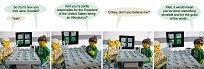
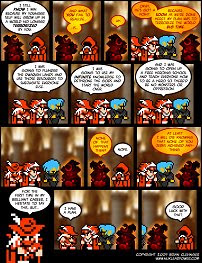
In fact, let’s save you the trouble of actually having to read 8BT yourself, as here’s a pretty good summary of the strip:

8btparody

I guarantee you that strip is more funny than almost all of 8-Bit Theater, and probably a lot better as well.

In my full-fledged Darths and Droids review I said it was no insult to call 8-Bit Theater a poor man’s Order of the Stick. I see now I was wayyyy too kind. 8BT isn’t even as good or compelling as Bob and George, which may be partly the result of having characters that should by all rights be the villains as the protagonists to the extent that you hate them more than rooting for them. Not even Ethan from Ctrl+Alt+Del is as bad as these guys! OOTS‘ Belkar is, but you root for him more than you root for even Fighter! Of course, maybe the real problem is that the former has Lucas and Lilah while the latter has the rest of the OOTS to balance them out, while the closest thing to balance the Light Warriors have, White Mage, hates them as much as anyone else and only pops in and out. Another possibility: Belkar is funny when he’s doing evil things while the Light Warriors are funny when bad things happen to them. (To be honest, probably 90% of the actually funny jokes in 8BT are just Fighter being stupid.)

I’m not sure why people attack CAD so much or why John Solomon went after B&G when 8BT is far more deserving of the vitriol. I want to make clear: this isn’t an anti-sprite-comic review. I read and enjoy Bob and George (which, having ended, is ineligible for a review) and I don’t even see sprite comics as a crutch for an inability to draw, as Dave Anez and Clevinger have mad Photoshop skillz to tweak their sprites the way they want to. The problem is that in Clevinger’s case, he seems to have put too many skill ranks in those and not enough in “being funny” or “having a decent story”, and Anez has a few in at least the former. Like CAD did for video game comics, 8BT started a trend (well, furthered the one started by B&G, much like CAD accelerated the trend started by Penny Arcade) of bad sprite comics by people who only see a way to get into comics without having a lick of art skillz, or even a reason to get into comics. Unlike CAD, I can’t discern Clevinger’s secret to his success, and my leading hypothesis is a bit distressing: geeks like the kind of non-sequitur nonsense Clevinger specializes in. If more CAD strips were like the Chef Brian strips it might be as beloved as xkcd.

On the other hand, if I find out 8BT in any way inspired The Order of the Stick, then all is forgiven. Though I’ll still rib Clevinger for Rich Burlew showing him how it’s done.

Hope DMM didn’t break things by trying to do “IWC on a Postcard” for 2317, assuming he was trying to do so, especially right as he went on vacation…

(From Irregular Webcomic! Click for full-sized charitable act.)

So most of what’s happened up to this point in the Steve and Terry theme since the reboot of the universe turns out to have been an extended flashback that just ended (in what may have supposed to have been June).

Which is rather interesting in terms of fueling the “did the universe reboot to the beginning or not?” debate. All signs now seem to point to “no, except for Space”. Still, the fact that so many comics went into flashbacks with so many different approaches and explanations still seems to hint that the Irregular Crisis is not yet over, especially as regards the implications in themes such as Space and Cliffhangers.

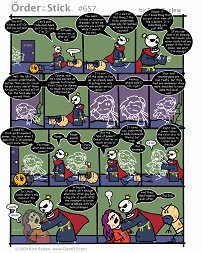
What does it say when you learn moral lessons from Xykon, and he’s RIGHT?

(From The Order of the Stick. Click for full-sized second chance(s).)

Curse you, Rich Burlew.

I was all set to have a nice, enjoyable weekend where I could focus on finishing off some assignments for one of my classes, and you had to go and put up this whopper last night.

Uncharacteristically for this comic, and perhaps to its detriment, it engages in a bit of moralizing, but it’s all to further the greater goal. In the end, V’s real “ultimate power” may come without saying any words at all. This is a major moment in the story of V’s character, on par with taking the soul splice in the first place.

V really learns two lessons here, both related in a way, and they’re both put into stark comparison with each other in this strip. The one Xykon preaches to him is how quixotic V’s quest for “ultimate arcane power” really was all along, how one-dimensionally V saw power, how it ultimately wouldn’t ever be enough, and against someone who really grasped power, wasn’t enough. This seems to both support the idea of the soul splice representing the Four Words, though perhaps for unexpected reasons, and suggest that if it wasn’t, then when the prophecy eventually does come true it’ll come with a twist. (“I’m going to multiclass.”)

Hmm. Maybe the real four words were “My power EXCEEDS yours!”

The other lesson provides the forces of good’s response to Xykon’s characterization of power, and if anyone here is likely to vocalize it it’s O-Chul. It’s this lesson that V takes to heart in her holeside epiphany. Some forumites, before this strip, suggested that V’s run-in with Xykon showed the value of teamwork (after all, Redcloak and Tsukiko did most of the critical dirty work), but what V learns here is slightly different – baby steps, perhaps – and more fit to her situation. It’s learning not to think entirely about himself all the time. In that one moment, V realizes there’s a greater good going on here, and while self-preservation may mean resuming getting out while the getting’s good, the right thing means letting someone get a few more licks in on Xykon. In an odd way, while forum speculation for a while suggested that V and Belkar marked a study in contrasts as they flipped places on the alignment scale (one half fake, but still), the real contrast may be that while Belkar is faking character development and becoming a team player, V is getting the real thing. Maybe they could become real buddies now.

(It’s also worth comparing V to his good friend Haley, who recently said she “takes responsibility for her own actions,” defending why she wouldn’t crack down on Belkar at all. In a way, it makes perfect sense that if V was going to make friends with anyone it would be Haley with their respective look-out-for-number-one tendencies. And now, both are starting to grow out of those shells in varying ways.)

It’s here that V gets her redemption from his failure from earlier. Out of spells and trying only to make it out alive, V indirectly caused the death of several fleeing soldiers as the Battle for Azure City was drawing to a close. When this was revealed, it may have seemed a hastily-conceived way to explain V’s apparent character derailment in the 500s (check out that book V’s holding at the end). But this is an almost identical situation, except here V figures out how to pitch in without any spells and while putting himself at great risk.

The rules of story indicate O-Chul pretty much HAS to get some major damage in against Xykon now. Imagine this scenario (rather plausible without the early plot holes): O-Chul kills Xykon, returning the favor V just paid him, but doesn’t finish off the phylactery. Vaarsuvius and O-Chul leave, but for whatever reason don’t take the Monster in the Dark. Patrols come around, and while Vaarsuvius is powerless to hold them off, O-Chul isn’t. So, V gets out alive no matter what he did at the hole in the wall, but by doing something for the greater good gets someone else to help him out and actually comes out better in the deal. And suppose they subsequently find the Resistance – V gets a chance for some further literal atonement for her failure from earlier. It may have ruined the reunion of the Order, but taking off to fight Xykon may prove to be the best thing to happen to them, and to Vaarsuvius.

What’s the difference between About, Cast, and New Reader pages?

It’s a topic brought up by a webcomics.com post that seems to conflate them. To be sure, a conflation can help some to understand why they’re reading old Websnark posts where Eric Burns(-White) calls out webcartoonists that don’t have a cast page (“dude, it’s a cast page! It’s not the Great Artifact that will bring about the Age of Transcendence!”), but it seems some don’t agree.

Whether or not you conflate them probably depends on your specific circumstances – for example, do you have a gag-a-day comic, or a story comic? If you do conflate one or more you can probably label it with anything it fills the role of. Regardless, I would draw the boundaries like so:

  • About: Basic information about the comic, and optionally, about the author. A quick and dirty way to get acquainted with the setting or the concept. A comic FAQ might fall under an “about” header.
  • Cast: Information about the cast, their personalities, and where they are in the story.
  • New Readers: A more advanced form of the About page, explaining “the story so far”, reducing the reader’s need for an archive binge. May contain links to relevant storylines, for example, if the reader wants to “experience it for themselves”.

So, an About page is about the comic, Cast is about the cast, and New Readers is about the story. Burns(-White) loves cast pages because they can so easily serve as a filter to reveal info about the comic and the story. Cast pages can obviate the need for New Readers pages, but About pages don’t obviate the need for Cast pages without turning into Cast pages, especially when you consider the pages’ relative utility to old readers.

(No, you did not just stumble into the Floating Lightbulb by accident.)

Oh, I’m close to coming up with my own solution to the draft-image-upload situation. Very close indeed.

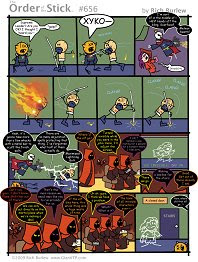
(From The Order of the Stick. Click for full-sized doors! Why did it have to be doors!)

There’s… a lot of stuff going on here. There’s so much going on that I even have more titles than I know what to do with.

First, a lot of the thinking I had in mind for what would happen after #653 is completely busted. Rather than a lot of talking, we got an action sequence. Truth be told, I probably should have done a post on #655, which was pretty weighty in its own right. So let’s see, Redcloak loses an eye and Xykon’s on the verge of losing his phylactery to someone who was a complete no-name before the current book. That’s not an important strip to pay attention to at all.

Yes, I am going to fulfill the April OOTS post I owe you, only with a week left in May. That was a brilliant strategy, wasn’t it?

So in order of what happens in this strip: See those X’s in Panel 2? So Jirix was worse than a background character, but may have saved… someone’s life. As we’ll soon see, possibly not Xykon, maybe Vaarsuvius, but perhaps most likely is just ruining O-Chul’s.

V still has at least a couple of spells left. That screws up some of the thinking that I, at least, had in mind.

Xykon’s phylactery is loaded with protections, as we find out the first time someone tries to break it… which probably suggests Xykon was not as close to being destroyed in the tower as we were once led to believe. So what happens when the time comes to actually break it near the end of the story? Or does Xykon actually survive the end of the story?

Third-to-last panel almost seems designed to address some of the more out-there and deus-ex-machina theories held by forumers… so why do I think it’s going to lead to forum speculation about Qarr popping in despite very little for him to do?

Cleverly, O-Chul’s last panel in this strip is him at the exact moment of him getting hit with the lightning bolt, and it’s clear in the last panel that he’s down, but we not only don’t see him we don’t even see Xykon. Is he dead? Negative hit points? Zero hit points? Even in positive hit points but too weakened to go on?

And now what happens? It would be stupid for someone to just crack open the door and render this little dilemma moot. Does V stick around for a while in the room or something? Does he hop out that huge hole in the wall, if that would be effective in any way at all other than getting a lot more scratches? Maybe Qarr really does hop in and do something? V ain’t gonna die here, because if she was she would be dead already… unless Xykon’s dealing with O-Chul has its own impact, like turning the MitD against him? It’s like Rich is playing chess with his audience!

And what about the rest of the book? We have at least one more strip of V running around like a chicken with his head cut off, that’s 657. Possibly a second, but I could at least see us moving on after the next strip if the circumstances are right. Then we have to zip back over to the main body of the OOTS for the return of Roy. That’s at least two, maybe three, strips. We need a strip for Roy himself to make his triumphant return, then at least one strip to assess the situation, and maybe a strip for looking forward or to serve as transition. That takes us to 660 when you combine the two maybes. Heck, maybe the OOTS will even meet back up with Hinjo and his group.

Because it doesn’t look like we’re going to get the exposition I anticipated for this stretch, you might think that means we’re using fewer strips. And you would be wrong. We’ve already burned two in the tower for different reasons than I anticipated. We have a bunch of establishing shots to burn as well (such as where Redcloak went and what V’s doing), and if the Linear Guild is going to show up in this book we need to see them soon. That’s a minimum of two (the LG and the end-of-book montage) and probably more, taking us to 662 or more.

An average of the last two books’ duration would suggest that the current book will end at or around the auspicious number of 666. We don’t have a lot of strips to answer all the questions that are best answered in the current book. Where do the OOTS go from here? What’s the Linear Guild doing? What will V do if and when he escapes? Are Xykon and/or Redcloak affected by these events? Where did Redcloak go with that Word of Recall? Will Roy tell off Celia? Will the OOTS replace V? How did Redcloak know about soul splices and will V find out? Is there special importance to the island both the Sapphire Guard and OOTS wound up at? Is the sky blue? Is grass green? All that and more, tonight on a very special episode of the Order of the Stick!

So this post isn’t quite as long or in-depth as I originally had in mind. Again, Rich kind of ruined things by going as far away from the exposition as possible. I can’t help but shake the feeling I’m forgetting something by rushing through this post, on either end of it. But at least in my own mind, I’m fulfilling my end of the deal, and that’s all that matters.

Blog of Webcomics’ Identity Crisis: The End of “Free Content”?

A “case in point” on the thought-provoking nature of the Floating Lightbulb: Today Bengo argues that webcomickers should stop thinking of themselves as giving content away for free.

He makes some good points but since he emphasizes preparing comics for later print distribution, I suspect that Scott “Infinite Canvas” McCloud would scream bloody murder at him…

By my standards, I think I’m a month late with this.

In February, at the end of my “Webcomics’ Identity Crisis” series, I said this about The Floating Lightbulb:

I’m probably going to do a review of the Floating Lightbulb itself one day, and when I do I’m probably going to say that Bengo is a more cerebral John Solomon. Bengo doesn’t hate all webcomics – though the Floating Lightbulb doesn’t do much in the way of actual reviews at all – but he certainly seems to hate most of the personages in mainstream webcomics. In his eyes, most big-time webcomics creators are self-promoting jerks who probably cheated to get to the top and as such are bad role models, and most webcomic bloggers are ego-strokers, often with rampant conflicts of interest, who shill the same comics over and over again. Not every webcomic blog gets this charge, not even biggies Tangents and Websnark; mostly the vitriol goes to Gary “Fleen” Tyrell and [Xaviar] Xerexes, proprietor of Comixtalk.

Shortly thereafter, Bengo wrote a post explaining, among other things, that he didn’t hate all mainstream webcomics, he just reserved his vitriol for those grouped under the names of Dumbrella and Halfpixel. And even though he never mentioned me by name and I’m still not sure if he even knows of Da Blog’s existence, I started to panic and planned to start this post with a comedown, stating that maybe I’d overstated his hatred.

Well, earlier this week he banged out a post that seemed to show where I might have gotten the idea he was a curmudgeon. Apparently a large number of webcomic creators are engaging in an e-e-evil plot to mislead Aspiring Webcomickers Everywhere in order to maintain their own standing and keep webcomics mired in a cesspool of mediocrity. Oh yes, what they disseminate is nothing but a mess of LIES! But they won’t succeed, oh no, even now their kingdoms are falling, and soon the curtain will fall away and THE TRUTH SHALL BE REVEALED! They can’t keep it down forever! Ha ha ha, ha ha ha, aha ha ha ha ha hahahahaha!!!!!!!!!!!!

(This isn’t the first time I’ve sat through Bengo putting his tinfoil hat on, either. He seems to think that people who think Scott Kurtz is “nice” are victims of an elaborate charade and front so dead-on and uncanny he should be an actor, not a webcartoonist! Because it can’t possibly be that Kurtz is just a complex, contradictory – GASP! – human being who feels nice in some circumstances and egotistical in others! Not that Kurtz being an arrogant jerk who thinks he’s Scott McCloud’s heir as Representative of All Webcomicdom but always ends up putting his foot in his mouth in doing so is exactly a secret…)

I don’t want to give the impression I find TFL the conspiratorial ramblings of a madman. In fact, TFL is one of the better, or at least more interesting, blogs you’ll find when it comes to advice for aspiring webcomickers. About a year ago, Bengo started trying to research webcomics in preparation of a new project he hoped to do with his wife Pug. Distressed at the paucity and contradictory nature of information, he started the Psychedelic Treehouse website as a storehouse of his findings, and started keeping a running log in TFL. Bengo nonetheless plowed on and ultimately contributed to two webcomics and a side project, while continuing to look for information on what to expect on the financial front. He became so distressed at the information in the HalfPixel group’s “How to Make Webcomics” that after a bad interview with Dave “Sheldon” Kellett and Brad “Evil Inc.” Guigar, he wrote a scathing post casting severe doubt on the book’s business model that made him a lifelong enemy in Kurtz and is largely singlehandedly responsible for much of TFL’s popularity, such as it is (which is to say “more than that of Da Blog”).

The metaphor implied by the title is probably the most succinct summary of most of TFL’s contents. Well, kind of. Sort of. Actually, according to an informal overview I did, only a little more than half Bengo’s posts were classified as “ideas webcomickers can use, perhaps to increase their revenue or help their art, sometimes taking their cue from things existing webcomickers are doing. Often this takes the form of cool stuff on the Internet people can use. Other times it’s highfalutin’ ideas, concepts and classifications that would make Scott McCloud and Eric Burns(-White) blush.” The rest, for the most part, is split fairly evenly between actual webcomic reviews, mere observations about the webcomic community, or ripping into people Bengo hates.

All of those three categories, to some extent or another, furthers the same goal as the first: educating aspiring webcomickers. Bengo reviews webcomics so we can learn from them, his recent posts on webcomic traffic trends were made with an eye to trying to find out why so aspiring webcomickers wouldn’t fall into the same traps, and he doesn’t want anyone looking to Scott Kurtz as a role model or have their business plan ruined by “How to Make Webcomics”. This isn’t just generic stuff you can find anywhere else on the Internet, either. Bengo pretty much assumes you’re looking to enter webcomics for the long haul, and make some money from it at the same time, and maybe even join the Tier 1 Pantheon of Popular Webcomics. I can’t vouch for the effiacy of any of the advice Bengo gives – I’m afraid I would have to classify his comics as Tier 3 and unreviewable until proven good (or at least potential-filled) – but there’s a lot of stuff you won’t find anywhere else (by which I mean you won’t find any competing or affirming advice) and a few things where Bengo seems to be downright pioneering, daring to go where no one has gone before. Where else are you going to find stuff like this?

All of which means TFL has a rather interesting clientele in that it is written primarily not for the general public at large, but for aspiring webcomickers. What really makes this interesting is that a blog written entirely for aspiring webcomickers would ordinarily go entirely into the advice pool. Bengo writes for a specific subset of that clientele, yet he’s also calling out the webcomics community at large for their practices that derail aspiring webcomickers. I think the closest thing to an equivalent I can think of would be Bengo’s mortal enemy at Halfpixel at webcomics.com, yet even that site doesn’t really go into current events or reviews or that sort of thing, yet despite the tagline of “webcomics news,” TFL isn’t really a news site either (by which I mean it’s not much of a news site at all). (The tagline used to be “Webcomics Eureka”, which was a little more accurate if a little redundant with the title and not entirely sensical.)

Now so far, my webcomic blog reviews have been of review sites, so I should probably say a few words about TFL’s reviews. Briefly, they tend to focus on obscure webcomics, and somewhat surprisingly for TFL’s normal subject matter, they tend to be rather basic, focusing on such things as what the setting is, what the format is, how good it is with mechanics, and what Bengo likes and what he thinks could be improved. They’re short, general, and to-the-point, without too much of the rambling or dwelling on specifics of the Burns(-White)/Howard/Solomon/Wick crowd.

The Floating Lightbulb is the closest thing I’ve yet found to the Order of the Stick of webcomics blogs, in that it’s hard for me to find anything (well, much) bad to say about it. If Bengo’s insights into webcomics are vindicated – which really only happens when you become popular, as people either deconstruct your arguments or tell people how much you helped them; it’s damn near impossible to do what the opposite of vindication is, since you generally don’t get popular if you’re wrong, and in any case Bengo may be well on his way – TFL (and Psychedelic Treehouse) could become an absolute must-read for anyone looking to jump into webcomics, as well as anyone else examining the field. And the Webcomic Blog List is not only a useful form of webcomic blog promotion, it’s a useful resource for anyone looking for webcomic blogs to read, such as someone like me who’s looking for more webcomic blogs to review.

The one big elephant in the living room where TFL is concerned is Bengo’s sometimes-obsession with Dumbrella, Halfpixel, and their cohorts, which can come off as just trying to drum up attention by picking fights and proclaiming “everything you know is wrong!” (If Bengo decides to respond to this post in any way, I fully expect him to go on another possibly-conspiratorial rant about all the damage Kurtz and Co. do to webcomics just like all his others.) When Bengo isn’t ripping into the self-proclaimed “role models” of webcomics, his posts are thought-provoking and insightful. Even when he is they can be enlightening and affirming. Either way, you’re guaranteed to get your recommended daily allowance of brain food just about every day.

The Floating Lightbulb is, pending verification of Bengo’s advice, most highly recommended. And I’m not just saying that to get on the Webcomic Blog List – TFL’s on my RSS reader for good. As I said back in February, I’d bet anything Bengo would rip me and Da Blog to shreds, both for lavishing praise on him and focusing too much on popular webcomics for my own good (and maybe echoing Robert A. Howard’s critique on top of that).

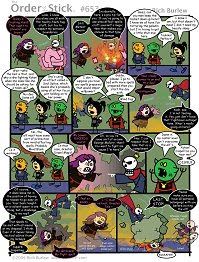
V’s first question after recovering from the shock, assuming the fight doesn’t continue: “How in the Lower Planes do you know about soul splices?” Hey, now that the robe’s red and eyes’re normal again, maybe Redcloak recognizes her as an OOTS member.

(From The Order of the Stick. Click for full-sized end of the line.)

Technically, I still owe you an OOTS post for April, and this doesn’t count. But it does give me some ideas for a full-fledged OOTS post, which I was planning to have next week… assuming I can get a post I was planning for this week in by then. Because it’s been too long since I reviewed another webcomic blog.

Yes, Blogger-in-Draft is still making it impossible to upload images and forcing me to go back to old Blogger (screwing people who had made Draft their default dashboard and can’t go back no matter what they try), why do you ask?
But anyway, since I normally make posts on Big Events and the forums are down as usual, I might as well make some comments here.

First, reflecting back on my original post on the splice, for two reasons. First, Burlew did a good job of keeping us on our toes with the splice. I started out thinking that, despite the power level, V had a good chance of hanging on to it into the next book; then it was revealed that V would lose splices one at a time and I thought that meant it made the most sense for them to all be lost within the current book; then plotlines started getting used up left and right, and things kept happening to V and he never lost a splice to them, and I started thinking there wasn’t enough room for two splices to be lost in the relatively small time left in the current book. Then he decided to take on Xykon.

The pattern established with Haer(t)a seemed obvious: use an epic spell that would see the spliced caster appear “in the background” behind Vaarsuvius, then that caster would have their splice lost. While all the plotlines were being wrapped up, V had already used Ganonron’s epic spell, so every time something happened that might ordinarily cause a splice break, I figured that meant V had one more teleport in her. And there was enough portent in V’s decision to run to Xykon to figure that last teleport had arrived.

It would have been bad enough, in my view, for V to lose Ganonron alone and thus the ability to teleport away from the scene of the crime. I can certainly see the logic in Haer(t)a being the only lone splice lost – to establish that a splice could be lost at any time, to take her spells off the table, that sort of thing. But the fact that Jephton was not able to get off an epic spell doesn’t sit well with me, and tells me that either Rich couldn’t find a place for a third epic spell (a second “Epic Teleport” doesn’t count) or changed his plans at some point after #643 – possibly, given the suddenness of the last two strips, just lost patience with the splice. Certainly I could have seen Ganonron lost but Jephton able to get off an epic spell against Xykon before he was lost – it seems Rich couldn’t figure out what to do that would be big enough to give that shadow shot. (Some forumites suggested Jephton be given a completely ineffectual joke spell, though, so even that’s not a show-stopper.)

Second, after the previous strip I figured that since Xykon had just fired off two Energy Drains and might have more in store, severely weakening the splices (seriously, if Jephton lost all his epic spell slots after the first, he might well be lower level than V after the second) the prudent thing for V to do was get out while the getting was good. Therefore, I figured something would happen to prevent V from leaving. Survey says… not really. I can see going for the Bixby’s Hand after the energy drains, but staying in the game after Xykon neutralizes even that? With your next move being a simple Disintegrate?

It actually makes an odd level of sense, but in a way I doubt Rich intended. While it’s possible that either V, Rich, or both weren’t thinking the circumstances through (less likely than you’d think in the former’s case with two more clear-thinking souls along for the ride with the most to lose), I prefer to think that this is V’s pride and hubris rearing its ugly head again. V really does believe “my power… EXCEEDS yours!” and he can still defeat Xykon with brute force even after evidence comes up to the contrary, only realizing the prudency of retreat once it’s too late. (That pre-current-book V’s style of pounding on a problem until it falls fits the situation is an idea worth considering as well.)

I’m holding off on most of my future predictions until next week, and even then I’ll want to hold off on some because I have a between-books state-of planned for when the current book ends. But for now I have only this: I think we’re more than set up for the remainder of the book between any Team Evil-Vaarsuvius discussions and any discussions surrounding Roy’s resurrection. We’re already about halfway through the “20-strip cooldown period” I’ve identified at the end of each book. I can easily see three strips or more to wrap up the battle and have some catching up to do and tie up loose ends here, plus at least three strips to cover Roy’s resurrection, throw in the usual splash page at the end – that’s seven right there, out of about ten – and since we haven’t seen any of the Linear Guild in the book so far, if they’re to have any real substansive role in the next book – and it’s becoming a fairly firm consensus they will, for reasons relating to Elan’s and Nale’s family – or just appear in this one, they better show up soon.

And if there’s any importance to Roy meeting V’s “subcontractors”, could it be the knowledge that V could have lost them and remain trapped in Azure City, life status uncertain?